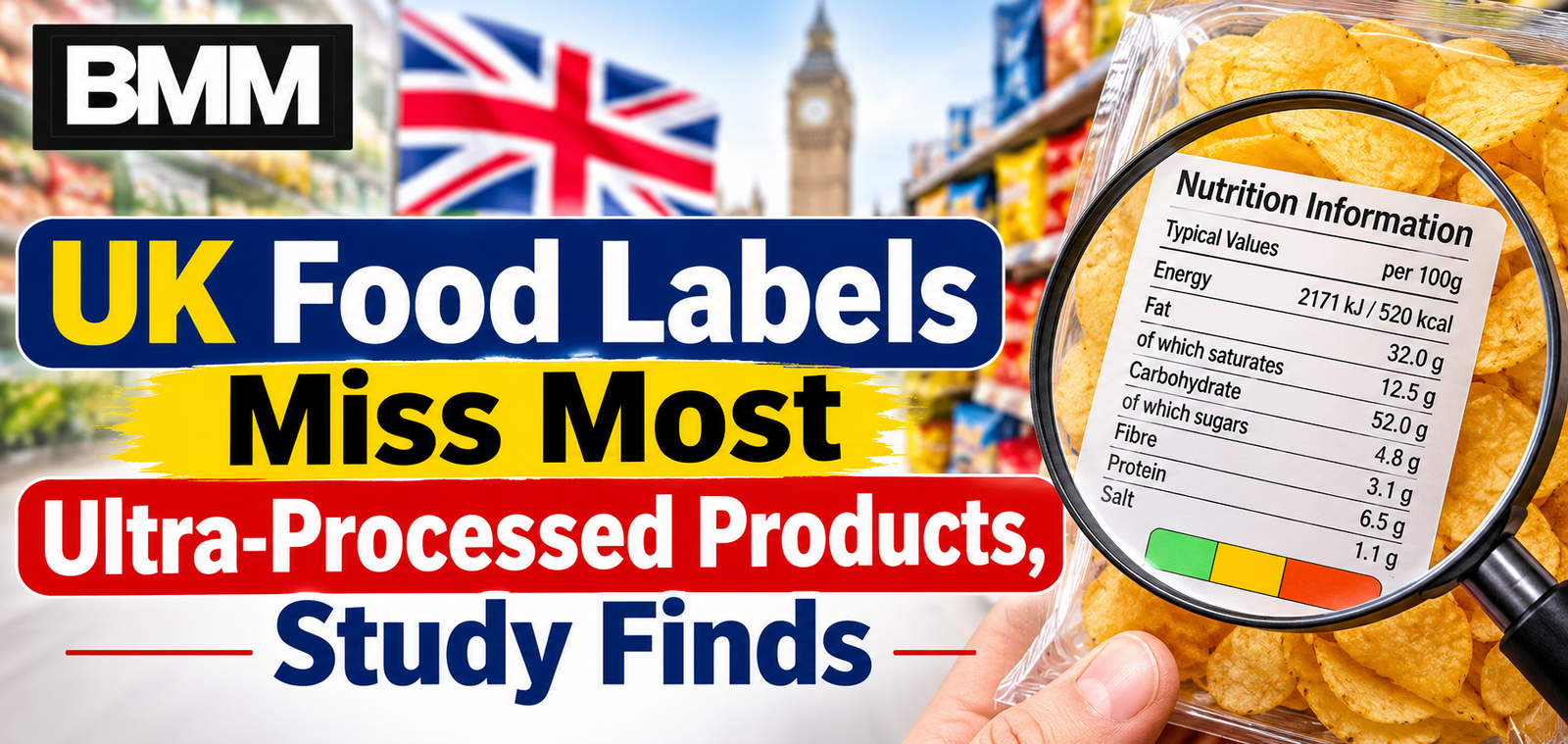
Check the front of a packet in a UK supermarket and you’d expect the colours to tell you something useful. A new study suggests they often don’t. Researchers at University College London found that UK food labels and the rules tied to them miss a large share of processed and ultra-processed products that official dietary advice would call unhealthy.
What the Researchers Did
The work was published in BMJ Medicine. The team analysed a representative database of 262 processed and 1,636 ultra-processed food and drink items sold across the UK. They ran each product through several systems: the voluntary traffic light labels, the Food Standards Agency’s nutrient profiling model (the high fat, salt and sugar, or HFSS, definition), and newer models built around the government’s Eatwell Guide.
The Gap in the Numbers
The results differ sharply depending on the system. The Eatwell Guide models flagged over 98% of ultra-processed products and 95% of processed ones as unhealthy. The traffic light system picked out only 48.2%, while the HFSS definition, which is used to restrict advertising and promotion, caught 57.6%.
In other words, UK food labels and regulation spot roughly half of what the government’s own dietary guidance would reject.
Which Products Slip Through
The study gives some everyday examples. Canned pasta in tomato sauce, packet macaroni cheese and fat-free probiotic yoghurts would count as unhealthy under the Eatwell Guide, yet neither traffic lights nor the HFSS definition mark them that way.
The system also works the other way. Whole fruit and nuts can pick up amber or red warnings for sugar or fat, even though the Eatwell Guide encourages eating them. So one product can look fine under one rule and bad under another.
What the Authors Say
Chris van Tulleken, the senior author, argued that the UK food environment is full of products that make it hard to follow government advice. Because traffic lights are voluntary and the HFSS definition is largely hidden from shoppers, someone could carefully avoid red labels and still eat more sugar, salt and saturated fat than recommended.
Lead author Sam Dicken pointed out that the current tools don’t catch products with excess harmful nutrients, even though the dietary guidance does. Co-author Dolly van Tulleken called for a single, unified way of defining unhealthy food, built on existing UK guidance and developed without influence from the food industry. Adrian Brown said clearer, more consistent classification would help people make informed choices.
Limits of the Study
The authors are careful about what they’re claiming. Their sample is meant to compare how the models perform, not to be an exact list of products that should be regulated. They also didn’t test minimally processed foods, so that area is open for later research. And the study doesn’t say which regulatory approach the government should take.
What This Means for Shoppers
For now, the practical lesson is that UK food labels don’t tell the whole story. A green or amber label doesn’t prove a product fits a balanced diet, particularly if it’s ultra-processed. Reading the ingredients list and the nutrition table gives a fuller picture than the front-of-pack colours alone.
The bigger question is regulatory. If traffic lights remain voluntary and the HFSS definition stays out of public view, the gap between what labels show and what guidance recommends is likely to continue. Whether the government acts on the call for one consistent system is something to watch, and the fact that UK food labels are this inconsistent gives campaigners a strong case.