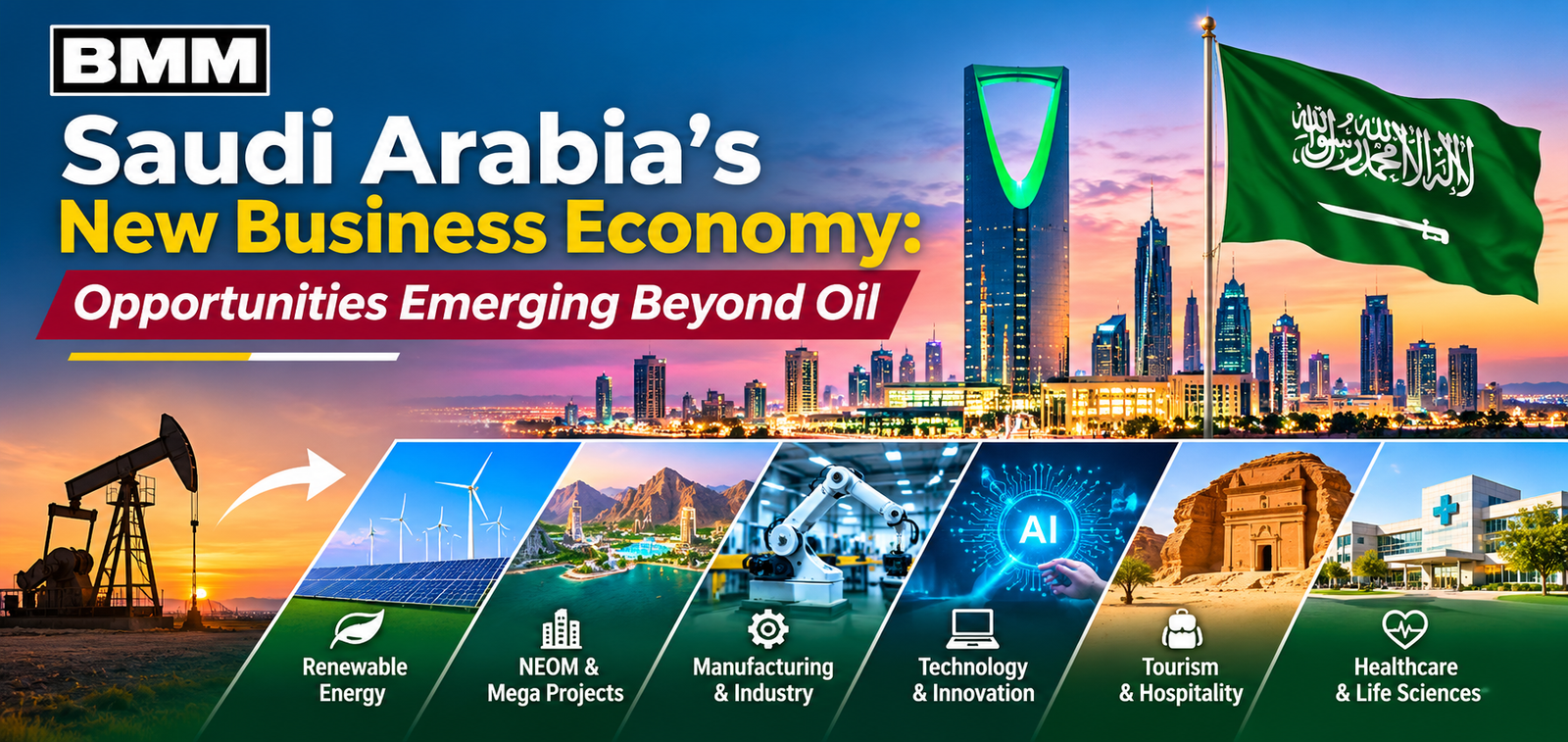
Saudi Arabia has always seen its economy defined by the production of oil and exportation of energy over the years. Currently, the country is diversifying economically through developing new industries, utilizing foreign expertise, and allowing room for the development of a private sector. Tourism, technology, manufacturing, healthcare, logistics, and alternative energy sources are becoming a part of the country’s economic discourse. This trend is influencing the way business is conducted in the Middle East, creating new avenues for firms willing to comprehend the market.
The growing range of Saudi Arabia business opportunities reflects a national effort to diversify income, strengthen domestic capabilities, and expand private-sector participation. Regulatory reforms and infrastructure investment are intended to create an economy supported by a wider mix of industries. The challenge for companies is to identify where these ambitions meet practical customer demand.
An Economy in Transition
The diversification of Saudi Arabia is closely linked to the development of Vision 2030, a national initiative designed to decrease the nation’s dependency on revenues derived from the oil industry by finding alternative sources of income. Attracting investments, improving the investment climate, developing the nation’s competency and innovativeness must be included in these priorities. The idea is not only to replace the industry but to build a diversified economy.
This transition is visible across infrastructure, digital services, retail, entertainment, and hospitality. Saudi Arabia business growth will depend on how effectively companies turn these trends into useful products and reliable services. The strongest opportunity may not always be a high-profile megaproject; smaller suppliers can also succeed by solving specific problems or providing specialised expertise. Sustained Saudi Arabia business growth will also depend on capable teams, customer trust, and consistent delivery.
Tourism and Hospitality Expand the Customer Base
Tourism forms a vital part of the Kingdom’s diversification plans. Investments into cultural sites, entertainment, pilgrim services, hotel facilities, resort services, and tourist-related facilities are aimed at making Saudi Arabia a more accessible destination for both local and international travelers. Cities like Riyadh and Jeddah will be developed alongside tourist destinations that offer unique historical and natural features, such as AlUla.
Tour operators, event organizers, food-related enterprises, transport companies, online ticketing websites, hospitality-related software companies, and employee training service companies can form possible supply chain participants.
Technology and Digital Services
Digital transformation is yet another significant element in the shifting economy. There is potential demand for solutions related to security, information, efficiency, and customer experience for companies operating in finance, healthcare, retail, governmental services, and industry sectors. Technology companies could provide solutions that would enable organisations to modernize their business processes, automate workflow, make better decisions, and improve security. Digital commerce may help in meeting the demands for inventory management, online marketing, fulfilment, and delivery solutions, while digital payments have a chance to succeed in financial services.
It is necessary not to assume that a product or a service that was successful somewhere else will automatically be adopted locally due to the difference in regulations, languages, procurement process, and requirements of particular industries.
Manufacturing and Industrial Capabilities
In addition, there is an effort to promote domestic manufacturing and to diversify products that can be manufactured locally. These include food processing, pharmaceuticals, chemicals, industrial machinery, construction materials, and advanced manufacturing technologies. The energy network, industrial estates, and transport networks in place can help cater to local consumers as well as some regional markets.
There is potential not just for manufacturers, but also for suppliers and service providers. Service providers dealing in industrial automation, machinery maintenance, packing, quality control, labor training, and energy efficiency solutions can aid factories become more efficient.
This development can contribute to the Saudi Arabia non-oil economy by creating jobs, building technical expertise, and increasing domestic value creation. However, manufacturers must evaluate input costs, workforce availability, local-content rules, logistics, and competitive pressure. A careful feasibility study is essential before investing in facilities or production capacity.
Renewable Energy and Sustainability
The knowledge Saudi Arabia has gained from the energy industry can form the basis of creating opportunities in renewable energy and environmental services. The implementation of solar and wind power projects, energy storage solutions, grid enhancements, water supply and efficiency improvements will need machines, skills, and maintenance. Those companies active in the recycling business, waste management, green construction, and environmental consultancy may also discover demand.
Equipment manufacturers, consultants, project developers, and specialized suppliers may provide equipment and skills. Project feasibility will depend on its structure, funding, procurement, and regulations.
For investors interested in Saudi Arabia investment opportunities, projects related to sustainability might have long-term prospects, but expected financial results cannot be guaranteed based only on policy aspirations. Companies have to evaluate each project separately.
Healthcare, Education, and Consumer Services
The healthcare sector might require medical equipment, medicines, information technology, and specialized services. Educational institutions could meet the need for technical expertise and skills according to the evolving job specifications.
Sectors like retail, food services, entertainment, fitness, beauty, and lifestyle services can benefit from consistent value, technological convenience, and services that cater to local preferences.
Such industries expand the scope of the Saudi Arabia non-oil economy as they add value via services, employment, skills, and domestic consumption. They can even offer easier access for SMEs than capital-intensive industrial projects. Nevertheless, corporations must verify the demand, compare competitors, understand pricing, and confirm licensing obligations before launching.
Building a Practical Market-Entry Strategy
One must be prepared as well as ambitious in entering Saudi Arabia. One needs to analyze registration processes, permits, taxation, hiring, ownership, and local content obligations related to one’s venture. Since these obligations depend on the nature of the industry and the organizational form chosen, consulting professionals might be useful at this stage.The Road AheadSaudi Arabia’s transformation is creating a commercial landscape in which established energy capabilities can coexist with emerging industries. Saudi Vision 2030 business priorities guide attention toward developing sectors, but companies must still identify problems they can solve and customers willing to pay. For investors, understanding Saudi Vision 2030 business goals can help connect commercial plans with national development priorities.For entrepreneurs and international companies, the opportunity lies in combining market knowledge with dependable execution. Saudi Arabia investment opportunities range from professional services to technology partnerships and industrial projects, each requiring research and realistic planningIn light of the diversity being witnessed in the Kingdom, the economic success of the future will depend on the strength of its private companies, their capabilities as well as the potential of turning the investments into action. Those who will adapt themselves to the environment, develop a partnership and deliver value will have an opportunity to become participants in this new era. It is not about following the trend; it is about creating the business that fulfills a need.
FAQ
1. What are the major business opportunities in Saudi Arabia beyond oil?
Saudi Arabia offers growing business opportunities in renewable energy, tourism, healthcare, technology, artificial intelligence, manufacturing, construction, logistics, and entertainment as part of its economic diversification strategy.
2. Why is Saudi Arabia focusing on business opportunities beyond oil?
Saudi Arabia aims to diversify its economy, reduce dependence on oil revenues, attract foreign investment, create employment opportunities, and establish itself as a global business and innovation hub through Vision 2030.
3. What is Saudi Vision 2030?
Saudi Vision 2030 is a national development strategy designed to transform the country’s economy and society. It focuses on economic diversification, private-sector growth, tourism, technology, infrastructure, and sustainable development.
4. Which industries offer the best investment opportunities in Saudi Arabia?
Some promising industries include:
Renewable energy and clean technology
Information technology and artificial intelligence
Tourism and hospitality
Healthcare and biotechnology
Manufacturing and industrial development
Construction and infrastructure
Logistics and supply chain management
5. Is Saudi Arabia a good destination for foreign investors?
Yes. Saudi Arabia is actively attracting international investors through investment reforms, business-friendly initiatives, infrastructure development, and opportunities across emerging industries. Investors should evaluate sector-specific regulations and licensing requirements.
6. What opportunities are available in Saudi Arabia’s renewable energy sector?
Saudi Arabia is investing in solar power, wind energy, energy storage, green hydrogen, and clean energy infrastructure. These developments create opportunities for renewable energy companies, technology providers, equipment manufacturers, and engineering businesses.
7. How is technology creating new business opportunities in Saudi Arabia?
The country’s digital transformation is increasing demand for artificial intelligence, cloud computing, cybersecurity, fintech, automation, smart cities, and software development services.
8. What role does tourism play in Saudi Arabia’s new economy?
Tourism is a major pillar of economic diversification. Developments in cultural tourism, luxury hospitality, entertainment, religious tourism, and large-scale tourism destinations are creating opportunities for hotels, travel agencies, restaurants, and tourism service providers.
9. Can small and medium-sized businesses succeed in Saudi Arabia?
Yes. SMEs can explore opportunities in e-commerce, digital marketing, consulting, logistics, food services, technology, construction support, and specialised professional services. Understanding local regulations and customer demand is essential.
10. What are the opportunities for international companies entering Saudi Arabia?
International companies can explore joint ventures, technology partnerships, manufacturing facilities, infrastructure projects, consulting services, distribution networks, and participation in major development projects.