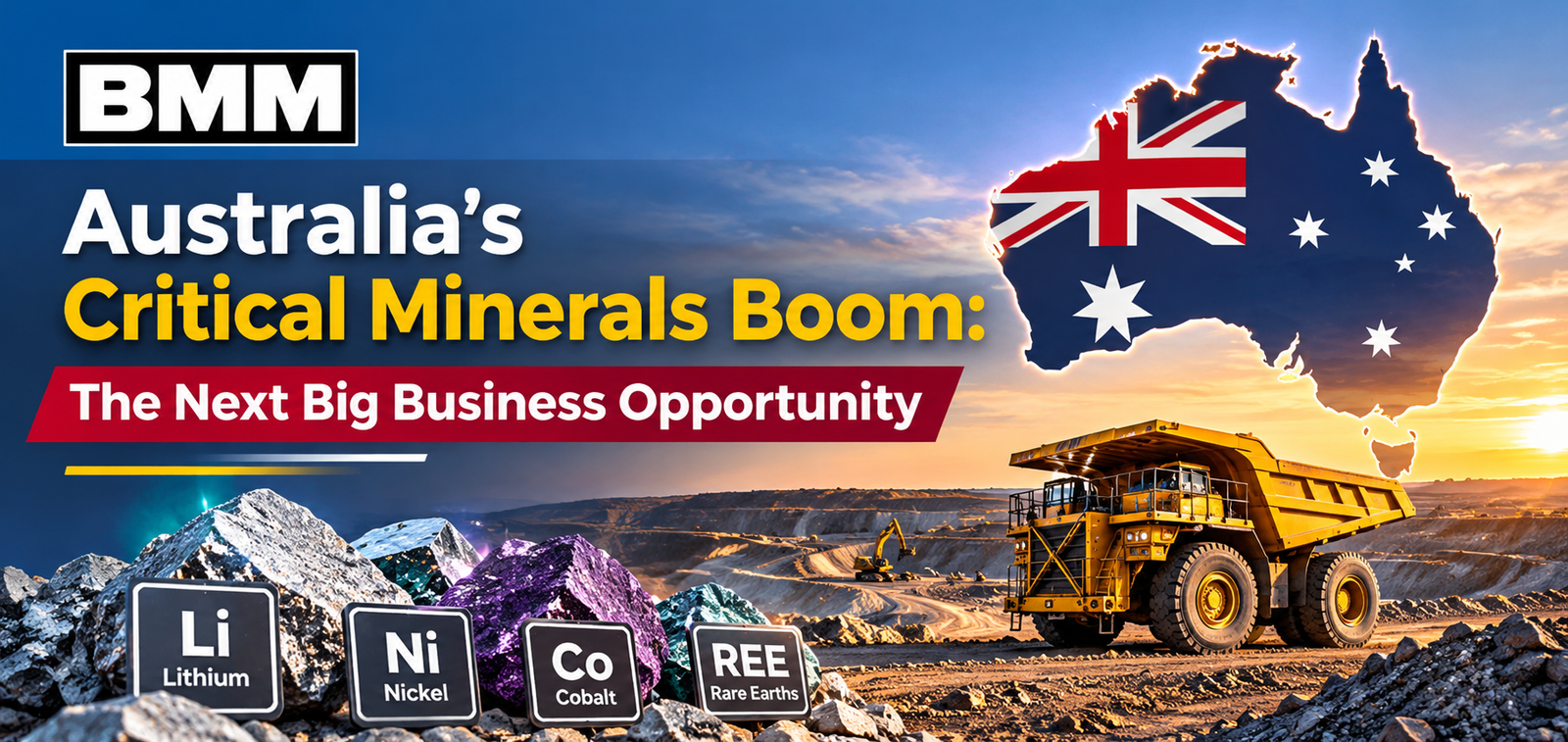
The technologies that will define future industries require raw materials that many consumers may not even think about. Mineral resources are required for electric car batteries, wind farms, solar technology, sophisticated electronics, and defense systems. With nations looking to source their requirements from reliable sources of these raw materials, Australia has become an increasingly relevant player in the mineral resource sector.
The country’s opportunity extends beyond extracting ore and exporting it overseas. Developing processing facilities, improving recovery technologies, supplying mining equipment, and building specialised services can create additional commercial value. For companies looking towards the resources sector, Australia critical minerals represent an emerging area of interest where industrial capability, global demand, and strategic investment intersect.
Why Critical Minerals Matter
Critical minerals refer to those materials that are essential to economic activity, advanced technology, energy systems, or national security. The exact materials differ from country to country depending on the needs of the industry and the supply chain. Lithium, rare earth elements, graphite, cobalt, vanadium, and other specialized minerals facilitate uses in energy storage, electronics, and defense.
Australia possesses well-established mining skills and vast reserves of minerals which form the basis for its participation in international supply chains. However, minerals alone are not sufficient to ensure commercial success. There is a need for infrastructure, finance, environmental clearances, labor, processing, and good customers.
The Australian critical minerals industry is therefore evolving beyond conventional mining. Companies are exploring ways to retain more value domestically by improving refining capacity, developing new technologies, and establishing stronger relationships with manufacturers. These activities can create opportunities for businesses at different stages of the supply chain, including those that do not own or operate mines.
Opportunities Beyond Extraction
Even though mining will always play a key role in such an environment, the business community has various ways through which a company can enter this market. The exploration of minerals requires geological surveying, mapping software, drilling machines, laboratory equipment, and consulting.
Processing is also a key element. Conversion of raw minerals to valuable commodities might need engineering, equipment, automation, quality control, and energy efficiency among others. Companies that help increase the rate of recovery or reduce costs of processing might be able to find ways into the market.
These developments can broaden the Australia critical minerals industry by supporting technical innovation and creating demand for specialised suppliers. Small and medium-sized enterprises may participate through subcontracting, engineering services, research partnerships, and equipment supply, without taking on the financial burden of developing a mine themselves.
The Growing Importance of Processing and Refining
One of the major business challenges in Australia is the increase in the amount of mineral processing taking place locally. Mining resources and selling them in an unrefined or semi-refined state could mean that there will be considerable value left to be captured down the line. Being able to compete in refining and processing minerals may prove to be a solution to this problem.
Processing of lithium, separation of rare earths, refining graphite, and development of mineral products are some of the ways through which industrial growth can be achieved. This will need expertise, secure energy sources, waste disposal solutions, and economies of scale.
Businesses can participate in the design of equipment, development of chemicals, provision of laboratory services, and improved production processes. There will also be the chance for research institutions and manufacturers to partner and develop economically or environmentally viable processes.
Nonetheless, processing projects may prove to be capital intensive and sensitive to changes in commodity prices. It will therefore be necessary to analyze operating costs, feedstock availability, customers’ commitment, and competition by international players before venturing into such projects.
Investment and Government Support
The Australian Government has enacted legislation of a Critical Minerals Production Tax Incentive that aims to offer a qualifying processing company with a refundable tax offset equivalent to 10 percent of the cost of processing incurred. The incentive will take effect from 1 July 2027 provided the requirements are met.
For companies evaluating Australia mining investment, these initiatives can be relevant when assessing project feasibility and potential funding structures. Nevertheless, government support should be treated as one element of a business case rather than a substitute for commercial analysis. Eligibility, timing, capital requirements, and market conditions all influence the final decision.
Technology and Innovation Create New Markets
There is a rising dependence on technological processes in mining operations. Remote control, automation of machinery, predictive maintenance, geological modeling, and data analysis can help mining companies increase their efficiency and lower downtime.
Another field that requires innovations that can provide commercial benefit is environmental performance. Technologies aimed at water recycling, waste management, emission monitoring, and more efficient mineral extraction can help companies meet environmental requirements while saving costs.
It is possible to provide such services and products by technology firms themselves or in collaboration with engineering companies and mining service providers. Collaboration with universities and research organizations can also be beneficial since they will help to implement laboratory discoveries into practical industrial application.
The capability to use mining experience in order to develop technology can be an important competitive advantage. Companies that will be able to show improvement in safety, minerals recovery, reliability, or efficiency are likely to build sustainable business relations.
International Demand and Supply-Chain Partnerships
Critical minerals in Australia have become strategically valuable because many nations desire better access to the raw materials used in clean-energy systems, advanced manufacturing, and defense technology. The high degree of supply chain concentration has prompted the search for collaboration with other producers.
There is room for Australia in this regard to supply raw materials and build relations with international processors, battery producers, technology firms, and manufacturers. The exporters, logistics companies, testing facilities, and certifiers can help foster these relations.
Businesses that seek to participate in the Australia critical minerals industry will find partnership opportunities with other nations helpful in reaching customers and accessing technical know-how. Nonetheless, any business deal will need to consider aspects of specification, schedule, price fluctuation, regulations, and the strength of the partner.
Businesses will stand to gain from long-term supply agreements through greater visibility of producers and buyers. However, the worth of such deals is dependent on the terms agreed and the market environment prevailing. There is no need for businesses to presume that demand equals profitability.
Understanding Australia’s Mineral Resources
The resource potential of the country offers opportunities not only in different areas but also with regard to different minerals. Western Australia is crucial for lithium extraction, whereas other regions have projects related to the extraction of rare earths, graphite, copper, vanadium, and other strategic minerals. The degree of maturity of the project, infrastructure presence, and economic prospects differ depending on the location of the project.
Proper geological information and evaluation of specific projects are critical in assessing Australia mineral resources. One must be able to differentiate between deposits, economically viable resources, exploratory projects, and projects that have received all the required permissions and funding. The location of a project is important not only in terms of the quality of a mineral deposit but also with regard to transportation cost, labor availability, energy cost, processing facilities, and export infrastructures.
Challenges Businesses Must Consider
Nevertheless, the sector faces significant risks despite its opportunities. Commodity prices may experience considerable volatility, and building new mines and plants can take several years. There may be other factors such as technology risk, finance, environmental considerations, and community engagement that would have to be considered.
The due diligence should be performed prior to any investments in order to mitigate the risks involved. This includes looking at feasibility studies, assessing customer needs, license issues, and the company’s environmental and social responsibilities. In addition, smaller players should evaluate the payment conditions, contract terms, and their reliance on specific customers.
It is particularly essential when companies decide to enter the industry for the first time. They should consider starting with a specialized service, technology cooperation, or supplies instead of launching a capital-intensive mine.
Looking Ahead
Critical minerals in Australia offer a broad range of potential business opportunities, from exploration and mining services to processing technology, logistics, and advanced manufacturing. Its long-term development will depend on converting geological advantages into commercially competitive products and reliable supply chains.
For investors, manufacturers, and entrepreneurs, Australia mining investment requires an understanding of both the resource itself and the industrial ecosystem surrounding it. The same applies to Australia mineral resources, where geological potential must be assessed alongside infrastructure, processing economics, regulatory requirements, and customer demand.
Ultimately, the strongest Australia critical minerals business opportunities may emerge for companies that solve specific industry challenges, strengthen domestic processing, or help international customers secure dependable supplies. Businesses that combine technical capability with disciplined investment decisions and responsible operating practices can position themselves to participate in the sector’s development.
The next chapter in the minerals narrative of Australia will not be shaped solely by extraction. Innovation, processing ability, collaboration with other nations, and business execution will contribute to determining the ultimate value derived from the country’s natural resources.
FAQ
1. What are critical minerals, and why are they important to Australia?
Critical minerals are naturally occurring resources essential for modern technologies, renewable energy, electric vehicles, batteries, and defence industries. Australia is rich in minerals such as lithium, cobalt, nickel, rare earth elements, and graphite, making it a major global supplier.
2. Which critical minerals are found in Australia?
Australia has significant deposits of lithium, cobalt, nickel, manganese, graphite, copper, and rare earth elements. These minerals are essential for clean energy technologies and advanced manufacturing.
3. Why is Australia becoming a major player in the global critical minerals market?
Australia has abundant mineral resources, established mining infrastructure, political stability, and strong international trade partnerships. These advantages position the country as an important supplier in the global critical minerals supply chain.
4. How are critical minerals used in modern industries?
Critical minerals are used in electric vehicle batteries, solar panels, wind turbines, smartphones, semiconductors, energy storage systems, aerospace, and defence technologies.
5. What business opportunities does Australia’s critical minerals industry offer?
The industry offers opportunities in mining, mineral exploration, processing, refining, battery manufacturing, recycling, equipment supply, logistics, and advanced materials production.
6. Why is lithium important to Australia’s critical minerals industry?
Lithium is a key component in rechargeable batteries used in electric vehicles, smartphones, and renewable energy storage systems. Australia is one of the world’s leading lithium producers, creating opportunities across the battery supply chain.
7. How can international investors benefit from Australia’s critical minerals sector?
International investors can explore opportunities in mining projects, mineral processing facilities, technology partnerships, infrastructure development, and battery supply chains, subject to Australian investment regulations.
8. What role do critical minerals play in Australia’s renewable energy transition?
Critical minerals support the production of solar panels, wind turbines, batteries, and electric vehicles. They help strengthen Australia’s renewable energy infrastructure and contribute to global decarbonisation efforts.
9. What challenges does Australia’s critical minerals industry face?
Key challenges include high processing costs, infrastructure requirements, environmental regulations, global price fluctuations, skilled labour shortages, and competition from international mineral producers.
10. How can small and medium-sized businesses enter Australia’s critical minerals market?
Small and medium-sized businesses can participate by providing mining equipment, engineering services, transportation, technology solutions, environmental consulting, maintenance, and supply chain services.