
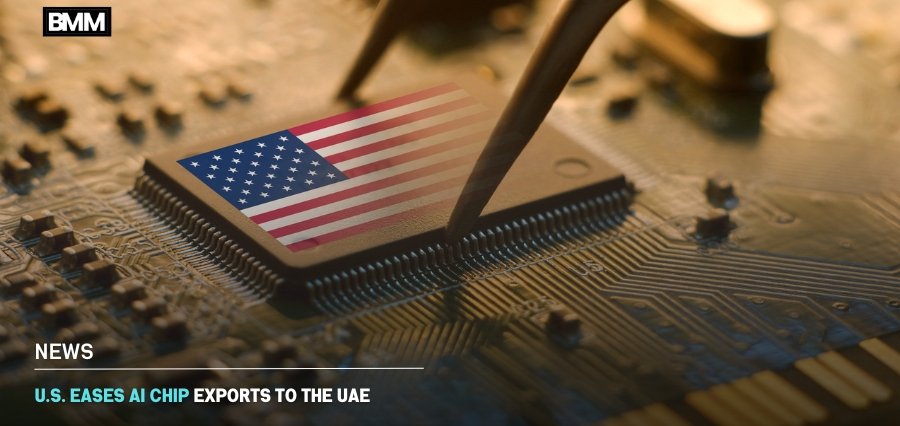
The United States has significantly relaxed export controls on advanced artificial intelligence chips and other sensitive technologies destined for the United Arab Emirates (UAE), marking a major shift in bilateral technology and security cooperation. The decision grants approved Emirati entities license-free access to advanced AI hardware, including chips from companies such as Nvidia, while also easing restrictions on exports of military equipment, satellites, and other dual-use technologies.
The policy change has drawn widespread attention because it reflects the growing strategic importance of artificial intelligence in international diplomacy. It also signals Washington’s willingness to strengthen technology partnerships with trusted regional allies as competition for AI leadership intensifies.
Why the Policy Changed
The U.S. Commerce Department further stated that the updated export regulations are in line with the long-term collaboration of the UAE with the United States regarding regional security issues as well as its cooperation in recent U.S. military activities against Iran.
The Wall Street Journal reported that the increased privileges are due to the UAE’s military aid in the recent conflict with Iran, involving operations in the air, missile interceptions, as well as ensuring that shipping lanes in the Strait of Hormuz remain open. This action was described as a form of a reward for its support, even though the United States government considers this as part of their strategic partnership.
Boost for the UAE’s AI Ambitions
This new policy will help speed up the plans of the UAE to turn into an AI hub on the world level. This will make it possible for Emirati technology firms to do more research in AI and build bigger data centers, and create better computing infrastructures.
This move helps G42, which is the top AI firm of Abu Dhabi, and also US-based technology firms operating in the UAE, like Microsoft, OpenAI, Google, Amazon, Oracle, and others who used to need longer export licenses to use their advanced computers.
For companies investing heavily in generative AI and cloud infrastructure, the easing of UAE AI chip exports removes a significant regulatory hurdle while supporting the country’s long-term digital economy strategy.
Business and Investment Implications
The new export policy is not limited only to artificial intelligence. The new export policy makes the process easier for obtaining commercial satellites, aerospace technology, and some industrial equipment utilized in fields like energy and civil nuclear power. Such developments will definitely bring more investment by both U.S. and Emirati firms.
Industry analysts believe the new rules could unlock billions of dollars in commercial opportunities across AI infrastructure, semiconductor deployment, cloud computing, and advanced manufacturing. The expansion of UAE AI chip exports also reinforces the country’s position as a regional destination for high-performance computing and large-scale AI development.
Questions Over Security and Governance
Despite its economic potential, the policy has generated debate in Washington. Some lawmakers and national security experts have questioned whether expanding UAE AI chip exports could increase the risk of sensitive American technology reaching China because of the UAE’s historical commercial ties with Chinese firms.
Further examination has been carried out regarding the alleged associations of top Emirati officials and their investments linked with businesses of the United States’ President, Donald Trump’s family. Calls for more strict supervision have been raised, although the White House denies claims of undue influence by the president in the decision to export.
This issue raises questions regarding the evolving connection between technology policies, national security, and international investments.
AI Becomes a Diplomatic Asset
Artificial intelligence technologies are no longer just a commercial enterprise. They have become a tool of diplomacy, economy, and geopolitics. The availability of cutting-edge semiconductors is something like energy security or infrastructure, determining how governments engage with each other.
UAE AI chip exports prove the growing link between technology policies and foreign policy goals. Countries that successfully merge economic and technological factors with strategic cooperation gain growing influence in the world of artificial intelligence.
This may not affect the voters’ attitude, but it has not hindered the party’s progress in increasing its support base.
Looking Ahead
Loosening the UAE AI chip exports is significant to U.S.-UAE relations and highlights the importance of AI in contemporary global strategy. This move brings more potential to innovation, investment, and technology infrastructure. However, there are some wider implications regarding how technology governance works and technological exportation and competitions among the states.
With AI gaining prominence in economy and security policies, technology partnerships are expected to depend not only on business but also on strategic cooperation.
Also Read :- Ukraine Presidential Elections and Referendum Amid War Pressures