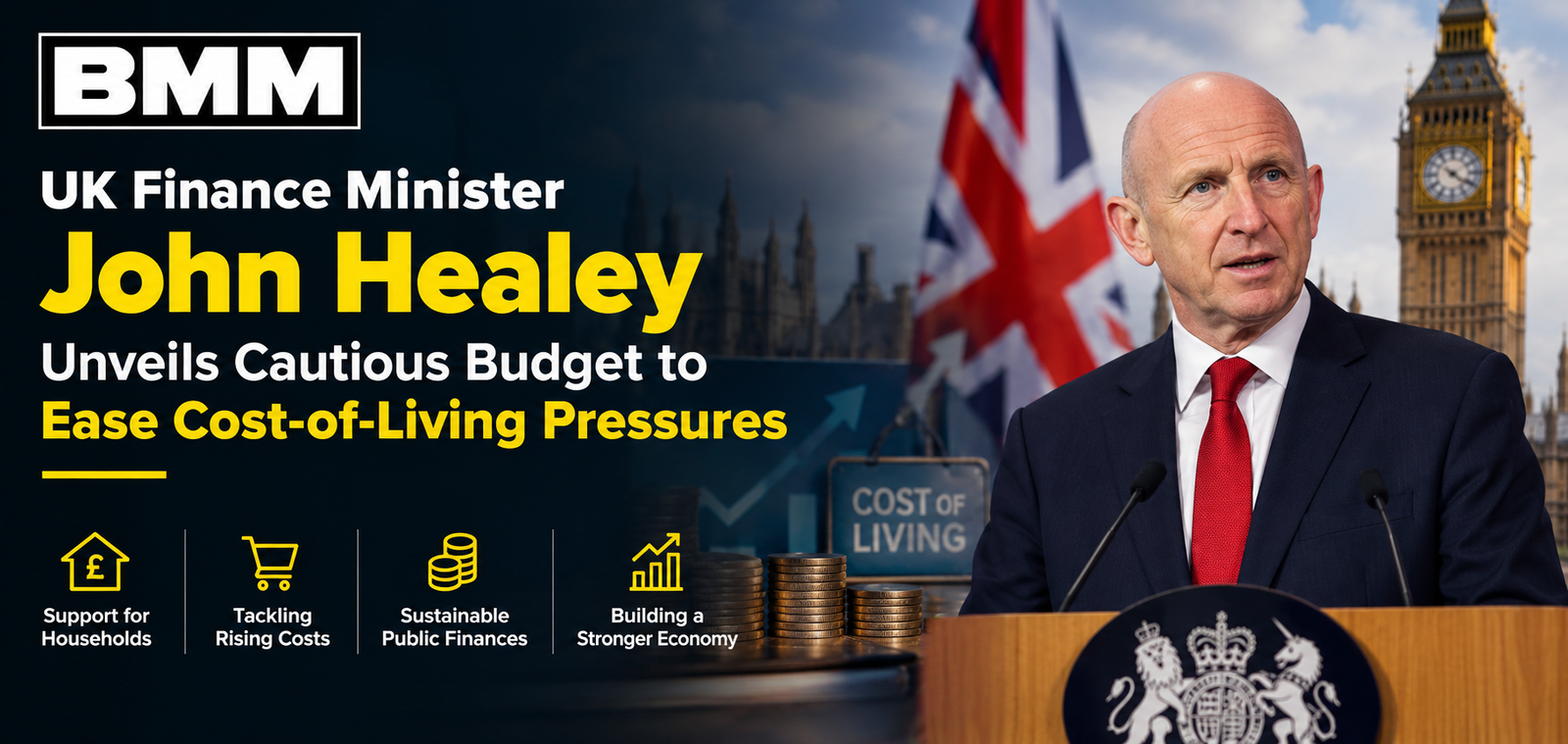
Britain’s Finance Minister John Healey unveiled a cautious budget on October 28, 2026, aimed at easing household financial pressures while maintaining confidence in the country’s public finances. The UK budget 2026 comes as the government confronts rising energy costs, inflationary pressures and elevated borrowing costs linked to international conflicts and trade tensions.
Healey’s first budget under Prime Minister Andy Burnham’s administration introduces temporary support for households and drivers, alongside higher taxes on selected sectors to help finance the measures. The government is seeking to provide immediate relief without placing additional pressure on financial markets, which remain sensitive to Britain’s borrowing requirements.
The measures follow two rounds of significant tax and spending changes introduced by former Finance Minister Rachel Reeves. Healey has adopted a more restrained approach, with limited interventions intended to address immediate economic concerns while leaving broader reforms for future policy reviews.
Energy Bill Relief and Fuel Duty Freeze
One of the main aspects of the UK Budget 2026 is financial support to families experiencing increased utility expenses. The government promised to provide a one-off £100 grant to about 20 million households in houses with lower value for an estimated amount of £2.6 billion.
Healey extended the fuel duty freeze to at least July, providing further help to motorists in a period of increased fuel prices. This policy will cost about £1.4 billion during the mentioned time span.
Other changes include abolition of standing charges on gas bills for most families. Standing charges are fixed daily charges that are charged to consumers regardless of their gas consumption level. According to the new system, charges will be linked to the level of consumption.
These targeted policies are expected to soften the effects of rising energy prices without developing a general support scheme.
Higher Taxes to Finance Government Support
In order to finance relief, the UK budget 2026 will also hike taxes on certain sectors including banking firms, gambling firms, savers, and landlords. The government is further tightening up its Value Added Tax regime concerning internet-based trading platforms such as Amazon and eBay.
There will be an increase in the bank levy by three percent to six percent for 15 months, which is expected to raise more funds and minimize overall taxes relative to some previous expectations of the market.
There is further to be some relief for small firms concerning property taxes. Meanwhile, Healey has called for reduced regulation of businesses, with the government estimating that reduced red tape may save businesses £800 million each year.
Economic Growth and Public Debt Remain Key Concerns
The UK budget 2026 comes in the face of a tough financial situation. According to the Office for Budget Responsibility (OBR), the budget proposals, coupled with increased inflation and borrowing rates, will raise the government’s borrowing needs by £65 billion in the next five years.
According to the OBR, GDP growth in the country will be 1.2% in 2026 and then decline to 1.0% in 2027. Inflation will peak at 3.8% in early 2027, placing further strain on household purchasing power and government spending.
Fiscal room, or the financial space available to the government to meet its fiscal targets, for Healey’s administration has been cut from an earlier estimate of £24 billion in March to the current £15 billion. The government remains committed to meeting these targets despite the increased economic challenges.
The initial reaction to the budget from investors was positive due to the relatively tame nature of the budget. Yields on British 30-year government bonds were at their lowest in more than a month during trading.
Investment in Defence, Artificial Intelligence and Green Energy
Apart from addressing cost-of-living concerns, the UK budget 2026 is aimed at channeling more than £20 billion in additional funding towards state finance entities in order to foster investments in artificial intelligence, defense, and clean energy till the early 2030s.
On the other hand, efforts are being made by the government to decentralize the fiscal policy as well. This is done through enabling regional mayors to have more control over tax revenues, as a part of the wider program by Burnham to enhance regional decision-making.
Nonetheless, the issue of funding for increased defense spending still poses some problems.
Outlook
The UK budget 2026 is designed to provide help for families while trying to keep fiscal prudence. The impact of this budget depends on the efficiency of these policies in easing up living costs as well as on changes in inflation and interest rates in the coming months.
As the UK economy is expected to experience slower growth in 2027 and as the fiscal space for the government is shrinking, Healey needs to find a way to help families without damaging market sentiment. This budget helps solve short-term issues, but the long-term economic prospects of Britain depend on productivity growth and investments.