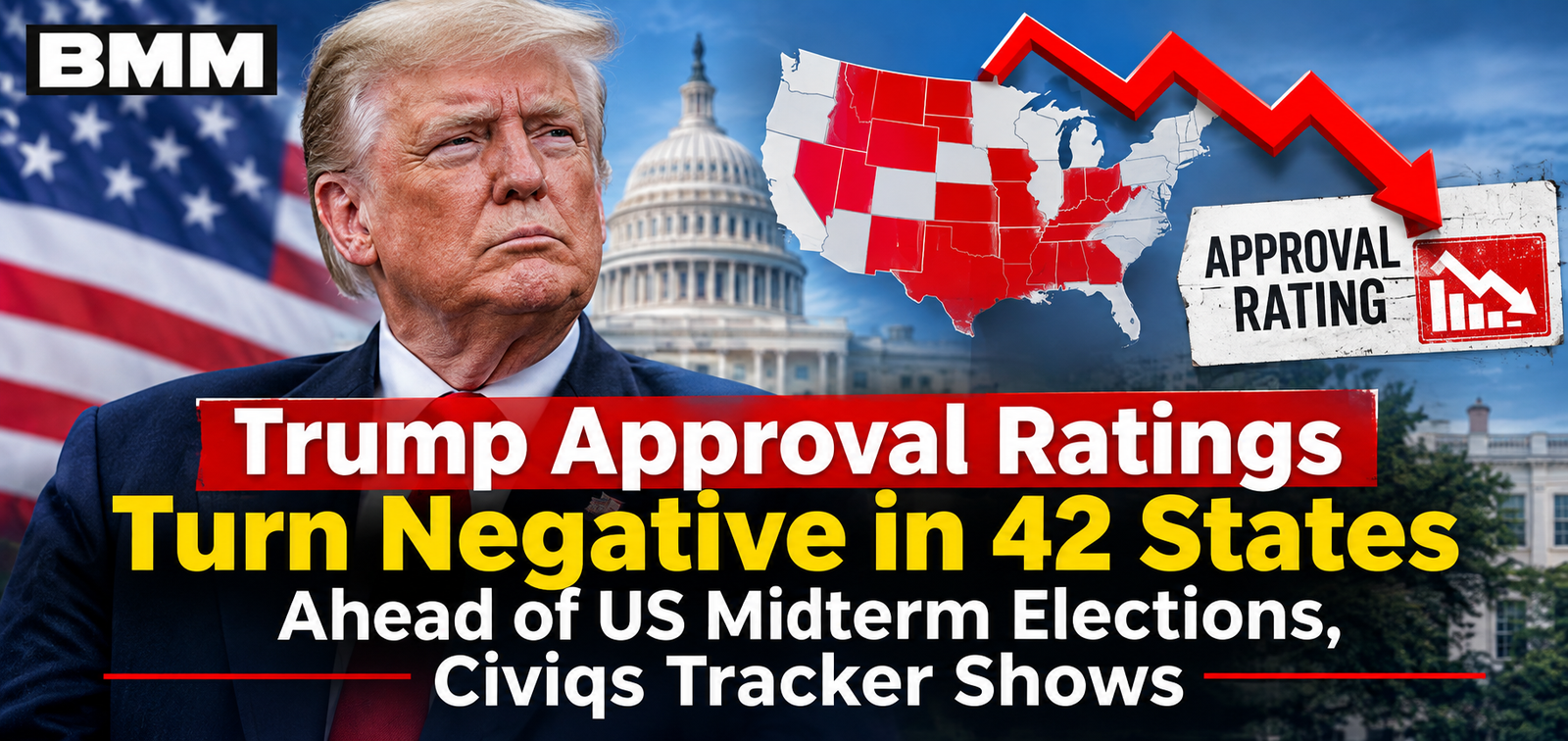
With the United States approaching a crucial midterm election on November 3, President Donald Trump is facing declining approval across much of the country. The latest state-by-state assessment of Trump approval ratings indicates that his net approval is positive in only eight of the 50 states, while 42 states record more disapproval than approval. The findings, published by USA Today on October 31 and based on the Civiqs state-level tracker, offer a snapshot of the political environment just days before voters head to the polls to elect members of Congress.
Approval Remains Positive in Only Eight States
According to the latest Civiqs findings, Trump’s approval remains above disapproval in Alabama, Arkansas, Idaho, North Dakota, Oklahoma, Utah, West Virginia and Wyoming. All eight states supported Trump in the 2016, 2020 and 2024 presidential elections.
Wyoming recorded the highest net approval rating at positive 14 percentage points, making it the president’s strongest state in the latest assessment. Kansas, meanwhile, remained evenly divided, with 46% of respondents approving of Trump’s job performance and an equal percentage expressing disapproval.
The geographical distribution of Trump approval ratings indicates that his strongest support remains concentrated in traditionally Republican states. However, the tracker also identifies declining approval in several states that have historically provided substantial Republican support.
Six Senate Battleground States Record Negative Ratings
One of the significant findings concerns six states featuring closely contested Senate races. The tracker recorded negative net approval ratings for Trump in Alaska, Michigan, Maine, North Carolina, Ohio and Texas.
The figures show the following state-level readings:
- Alaska: -25 percentage points
- Michigan: -26 percentage points
- Maine: -29 percentage points
- North Carolina: -18 percentage points
- Ohio: -18 percentage points
- Texas: -20 percentage points
Maine had the least net approval among these six states, while Michigan and Alaska were second. This shows that there is more disapproval than approval in many states in which control of the Senate is highly contested.
These state-level approvals of President Donald Trump are significant for the reason that they comprise states from varying regional and political groupings whose Senate races are determined by both local and national politics.
Republican Strongholds Also Show Declining Support
The latest assessment is also pointing out the negatives among traditionally Republican states, with Kentucky having a net approval of -13 per cent and South Carolina -10 per cent.
This clearly shows that the discontent with his job performance is not limited to states that are considered competitive in the presidential elections.
The fluctuating Trump approval ratings also show how the political climate has changed since he was inaugurated into his second term as president. The state assessments reveal that he has lost popularity in many regions, but with varying degrees of disapproval among states.
National Polls Reflect Similar Trends
The results found in the state level are consistent with the other national polling estimates that have been issued just before the midterms.
A poll conducted by Emerson College, released on October 30, gave an approval rating of 37% for Trump nationally, which was the lowest reading that has been obtained in the history of the pollster. This was also two points lower than their previous record of 39%.
In the same poll conducted by Emerson, the Democratic candidates were ahead of the Republican candidates by 10 percentage points in the generic congressional ballot test.
In another Reuters/Ipsos poll conducted on October 26, Trump had an approval rating of 32%, an increase of one point from its previous reading. In the generic congressional ballot test among registered voters, Democrats were ahead of the Republicans 47% to 36%.
These national findings provide additional context to the state-level Trump approval ratings, although differences in polling methodologies and sampling approaches should be considered when comparing results.
What the Numbers Mean Ahead of November 3
Current Trump approval ratings provide an important barometer of voter mood as the midterm campaign period ends. Nevertheless, presidential approval and congressional voting intentions differ in how they measure voter behaviour.
While dissatisfaction with a particular president is not necessarily associated with disapproval of members of his/her political party, there are many other factors which affect the voting intention, including local election issues, candidates’ profile, economic issues, turnout, among others.
With American voters ready to go to the polls on November 3, state-level analysis gives a good indication of the difficulties that the political position of the administration will face. The ultimate results of the elections will give another measure of voter mood concerning their political representatives and the general course of politics in the country.