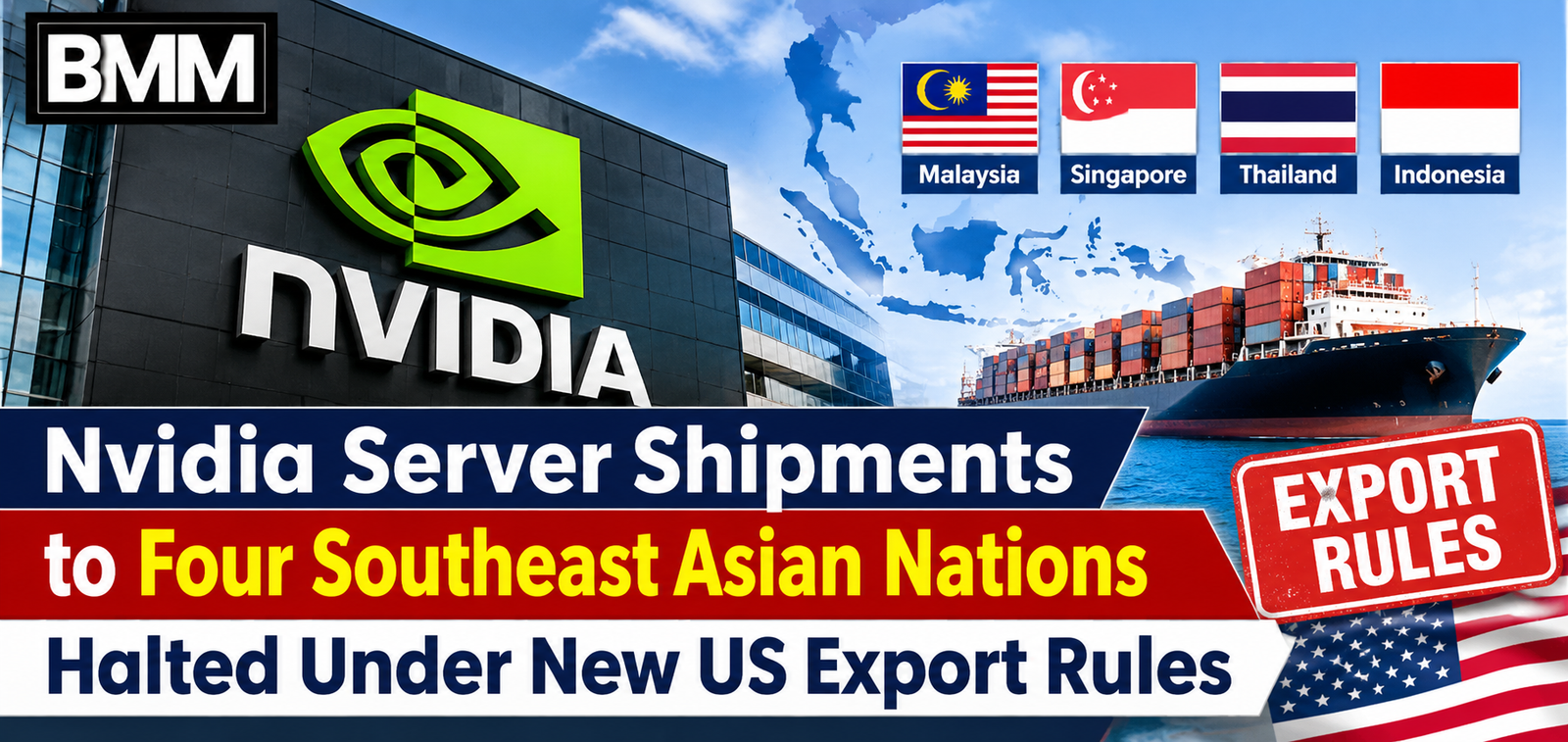
Nvidia server shipments to Malaysia, Singapore, Thailand and Indonesia have reportedly come to a stop. The Financial Times reported on Thursday that Nvidia told its manufacturing partners to stop shipping servers containing its chips to the four countries. The move follows a tightening of US export controls aimed at keeping advanced AI hardware away from Chinese buyers.
What happened
The instruction reached buyers through the companies that build the servers. Partners such as Dell and Supermicro, which package Nvidia’s chips into servers, told customers in the four countries that their orders would not be allowed to ship. Reports differ slightly on the wording. TechCrunch describes it as a pause for an unspecified period while Nvidia checks whether regional partners are meeting US export requirements.
Nobody has said how long the halt will last. The FT said it was unclear whether the stoppage would be temporary while Nvidia and its partners work through compliance requirements. Nvidia, Dell and Supermicro had not responded to requests for comment when the reports first appeared.
The rules behind it
The decision follows US curbs that took effect last week and require export licences for shipments of advanced chips to several Southeast Asian countries. Washington’s target is a specific workaround. Chinese AI labs had used these countries to reach Nvidia’s most powerful chips by renting access from cloud providers that bought servers with the GPUs inside. That route let them use top-end computing power without buying the hardware directly.
Under the new rules, cloud providers that already serve Chinese customers have 90 days to obtain a licence or face export restrictions, and providers say the process is unclear. That uncertainty helps explain why Nvidia server shipments are being held back while the rules are interpreted.
The Megaspeed link
The Singapore-based cloud company Megaspeed sits at the centre of the story. The Commerce Department added Megaspeed to its Entity List on Wednesday, so Nvidia and other companies now need a US licence to ship covered goods to it. Megaspeed had leased access to Nvidia chips to Chinese companies, and the Justice Department is investigating whether it broke US export rules.
Reports also tie the episode to a leadership shake-up. The Commerce rule was published days after Nvidia CEO Jensen Huang resigned following reports of an affair with a suspected Chinese spy who had worked at Megaspeed. These are claims drawn from news reports, and readers should treat details as developing.
Why it matters for Nvidia and the region
The commercial stakes are large. Demand from Chinese tech firms set off a data centre construction boom across Southeast Asia, and Nvidia booked $104 billion in revenue through its Singapore subsidiary in 2025, up 72 percent from the year before. Any lasting slowdown in Nvidia server shipments could therefore hit data centre builders, cloud operators and server makers in the region.
For Washington, the logic is straightforward. The measures are part of a wider crackdown on overseas data centres and alleged chip smuggling routes, amid scrutiny over whether enough is being done to stop sensitive US technology reaching China.
What to watch next
Little suggests Nvidia will resist. Sources told TechSpot there is little indication Nvidia will hold back from carrying out the new rules. Several things will show how this plays out:
- Whether Nvidia or its partners confirm the halt and give a timeline.
- How the licensing process for cloud providers is clarified before the 90-day window closes.
- Whether other chipmakers and server vendors adopt similar restrictions.
- Any fallout for the data centre projects already under way in the four countries.
Bottom line
The facts so far are narrow but significant. Nvidia server shipments to four Southeast Asian countries are on hold, the US has tightened the rules on advanced AI chips, and the length of the pause is unknown. Until Nvidia or its partners speak publicly, the story remains based on anonymous sources and will likely shift as compliance details emerge.