Warehouses were once viewed as quiet storage backbones of supply chains, measured primarily by capacity and throughput. Today, they stand at the epicenter of competitive advantage. Across APAC, the acceleration of e-commerce, cross-border trade, and consumer expectations has transformed distribution centers into high-performance environments where precision and speed determine market leadership. The modern warehouse is no longer defined by square footage alone. It is defined by intelligence, adaptability, and integration.
Warehouse 4.0 reflects this transformation. Rooted in automation, data connectivity, and advanced robotics, it signals a structural shift from manual coordination to digitally orchestrated fulfillment ecosystems.
Machines in Motion
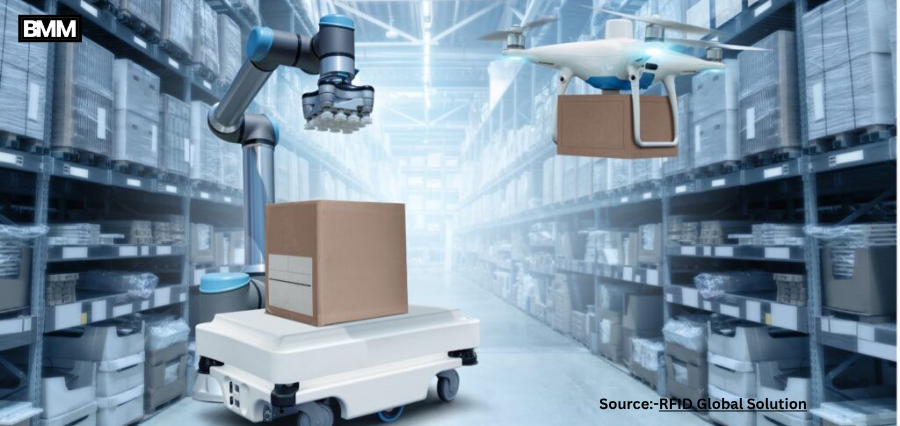
At the operational core of Warehouse 4.0 are robotics systems engineered to streamline repetitive and labor-intensive tasks. Autonomous mobile robots move inventory seamlessly across storage zones, guided by sensors and real-time mapping systems. Robotic arms equipped with computer vision technology execute picking and sorting functions with remarkable consistency.
Unlike earlier fixed automation systems, modern robotics platforms are modular and scalable. They can be introduced incrementally and reconfigured as demand patterns evolve. This flexibility is particularly critical in APAC markets where seasonal fluctuations and rapid consumer shifts require operational agility. Robotics enhances throughput, reduces human error, and maintains steady performance even during demand surges.
Collaboration Over Replacement
The narrative surrounding automation often focuses on workforce displacement. Warehouse 4.0 presents a different story. Collaborative robots, or cobots, are designed to work alongside human operators rather than in isolation. They assist with lifting, repetitive picking, and sorting tasks while employees concentrate on quality assurance, exception handling, and decision making.
This human-machine partnership improves safety and productivity simultaneously. In markets facing labor shortages or rising workforce costs, cobots provide a sustainable model for capacity expansion without overreliance on manual labor. The warehouse becomes a collaborative workspace where technology augments human capability.
Intelligence Embedded in Infrastructure
Technology in Warehouse 4.0 extends beyond visible robotics. Smart sensors, RFID tagging, and connected inventory systems generate continuous streams of data. Warehouse management platforms aggregate this information into real time dashboards that monitor stock levels, order status, and equipment performance.
Artificial intelligence layers on predictive capability. Algorithms analyze historical trends and live inputs to anticipate order volumes, optimize storage allocation, and recommend picking sequences. Predictive maintenance tools detect anomalies in equipment performance before failures occur, reducing costly downtime.
In this environment, decision making shifts from reactive to proactive. Bottlenecks are identified early. Inventory imbalances are corrected dynamically. Fulfillment flows adjust in response to real time conditions.
Designing for Speed and Sustainability
Efficiency in Warehouse 4.0 is measured not only in time saved but also in resources optimized. Automated route planning minimizes unnecessary movement within facilities. Smart lighting systems adjust according to operational zones, reducing energy consumption. Optimized space utilization decreases the need for facility expansion.
As ESG accountability strengthens across APAC, intelligent warehouses contribute to sustainability objectives. Reduced waste, improved packaging accuracy, and energy-efficient operations support both environmental responsibility and cost discipline. The fulfillment center evolves into a model of operational and ecological balance.
The Financial Equation
The investment in robotics and digital platforms is significant, but the returns are equally tangible. Faster order processing enhances customer satisfaction and retention. Higher picking accuracy reduces reverse logistics costs. Optimized inventory levels free up working capital.
Real-time visibility also strengthens collaboration with logistics partners and suppliers. Performance metrics become transparent and measurable. Decision makers gain the clarity required to align operations with strategic growth plans. In competitive sectors such as electronics, fashion, and consumer goods, fulfillment excellence directly influences brand perception.
Culture, Capability, and Cybersecurity
Technology alone does not define Warehouse 4.0. Organizational readiness determines its success. Workforce training must evolve to include digital literacy, system management, and data interpretation. Leaders must redesign workflows to integrate automation seamlessly rather than layering it onto outdated processes.
Cybersecurity becomes a parallel priority. As warehouses connect to broader digital ecosystems, protecting data integrity and system reliability is critical. Governance frameworks, secure networks, and continuous monitoring ensure that digital transformation strengthens rather than exposes operational resilience.
Toward Autonomous Ecosystems
The future trajectory of Warehouse 4.0 points toward deeper integration and autonomy. Advances in edge computing and high-speed connectivity will enable machines to make faster, localized decisions. Digital twins may simulate warehouse operations under varying demand scenarios, allowing managers to test configurations virtually before applying them physically. Autonomous yard management and automated last-mile integration may further extend intelligent coordination beyond facility walls.
What remains constant is the principle that intelligence and adaptability drive competitive advantage.
Fulfillment as Strategy
Warehouse 4.0 represents more than a technological upgrade. It reflects a strategic redefinition of the warehouse as an active, intelligent node within global supply networks. Robotics provides mechanical precision. Cobots foster human collaboration. Data systems deliver cognitive oversight.
Together, they form smart fulfillment ecosystems capable of sustaining speed, resilience, and scalability across APAC’s diverse markets. In this new paradigm, operational excellence is not accidental. It is engineered, measured, and continuously optimized. The warehouse becomes not merely a storage space, but a strategic engine powering the future of logistics and supply chain performance.
Also Read :- Business Minds Media for more information