
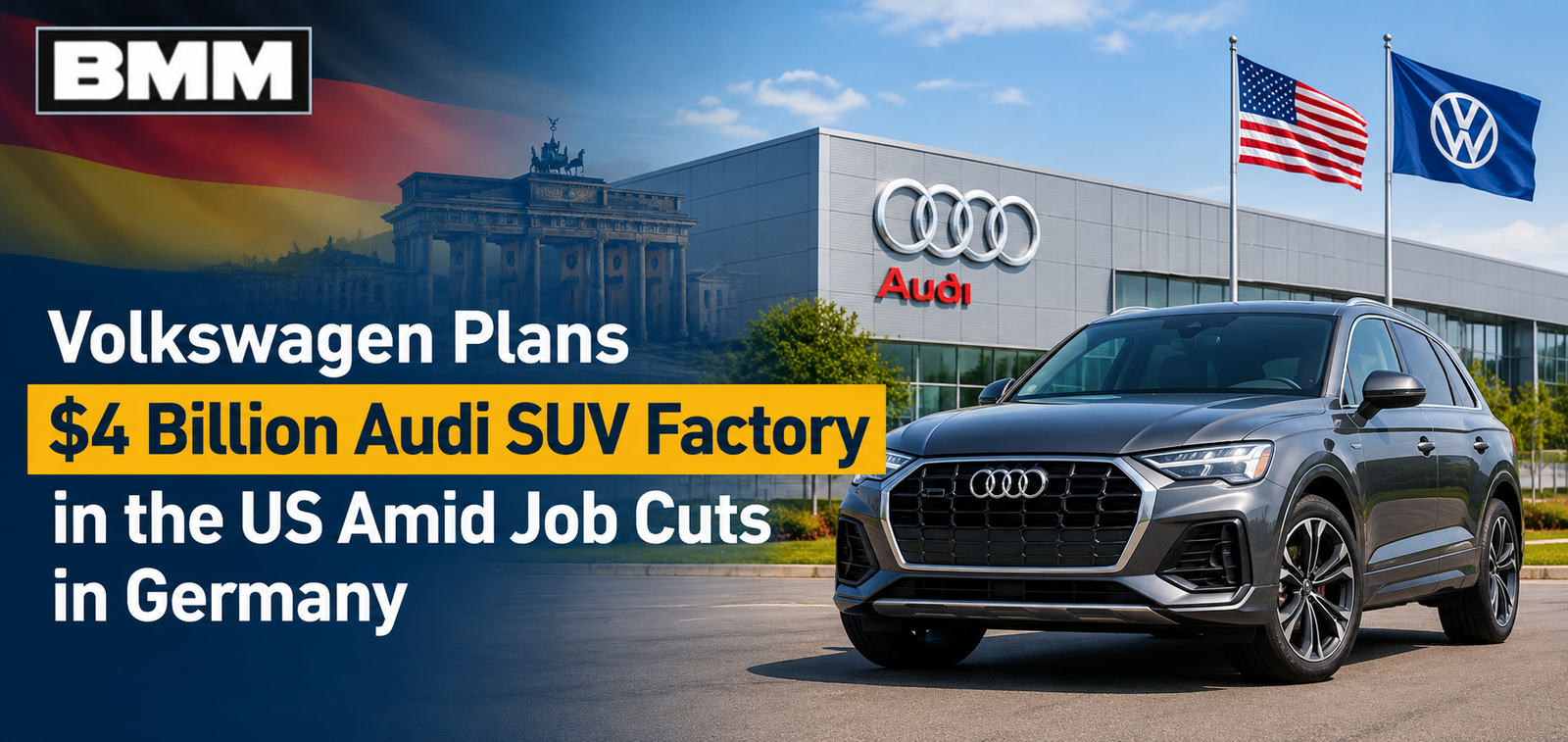
German automotive giant Volkswagen is planning a $4 billion investment to establish Audi’s first dedicated manufacturing plant in the United States, marking a significant expansion of its presence in the American market. The proposed Audi factory in the US will be located in Macon, Georgia, and is expected to create approximately 4,500 jobs while strengthening the company’s local production capabilities.
The announcement was made on October 24, 2026, by Audi chief executive Gernot Döllner alongside US President Donald Trump at a campaign rally in Perry, Georgia. The investment comes as European automakers face mounting pressure from trade tariffs, intensifying competition and the financial demands of transitioning towards electric vehicles.
According to Volkswagen Group, construction is scheduled to begin in 2027, with manufacturing expected to commence in the early 2030s. The plant is designed to produce up to 200,000 vehicles annually, establishing a significant production base for Audi in North America.
Q7, Q8 and Q9 SUVs to Be Manufactured Locally
According to the proposal, the US-based Audi factory will be dedicated to the production of the firm’s high-end sports utility vehicles such as Audi Q7, Q8, and Q9. This strategy is a reflection of the continuous demand for bigger and luxury sports utility vehicles in the United States and Audi’s intention to enhance its competitive advantage within one of the major premium car markets globally.
The firm believes that its competitiveness will be enhanced through reduced risk from import taxes, transportation cost, and foreign exchange risks. Some production that was being done in Bratislava, Slovakia, will be relocated to the new plant in the US.
This investment is part of the general strategy of Volkswagen Group to establish its production base internationally. North America has been identified as an important market for the company, besides Europe and China.
US Tariffs Influence Volkswagen’s Investment Strategy
Trade policy has become one of the key factors for growth. The United States has introduced a 15% import tariff on goods from the European Union, resulting in extra expenses for European automakers delivering their products across the ocean. Volkswagen has calculated the cost of US tariffs at about €5 billion per year without taking into account decreased sales.
The Audi factory in the US allows the company to decrease its dependence on imported automobiles and the financial consequences of trade barriers. The company has decided to move some of its production operations of such cars as the Jetta and Taos from Mexico to the United States under the pressure of tariffs.
The investment has been used by Trump as an example of how trade policy drives manufacturers to create plants in the country. Still, the influence of tariffs on the domestic employment situation and car prices is debatable.
Expansion in America Contrasts With Job Cuts in Germany
This comes amid reports that Volkswagen is undertaking an extensive restructuring process involving job cuts and plant closures in its German operations as a result of escalating costs, reduced demands, and stiff competition from the Chinese firms.
The contrast between the multibillion dollars of American investment and the job cuts in Germany brings out the problems of the European automobile industry. This is because it is imperative to cope with the high cost associated with technology transformation while maintaining profitability and competing with other rivals in the industry.
In this regard, the American Audi assembly plant for Volkswagen can be viewed as a bid to ensure future growth in a very critical market despite the fact that the parent company is restructuring in the domestic market. This is especially in view of the need to develop cars in order to meet the new consumers’ needs.
Investment Carries Economic and Political Significance
The project has drawn the attention of politicians in view of its announcement at a time just before the upcoming US mid-term elections that were to be held on November 3. The Trump Administration has consistently used such projects to demonstrate that its policies have provided jobs and industries.
For Georgia, the establishment of the Audi factory in the US will provide job openings not only for the manufacturing plant itself but also for its suppliers and logistics services. According to Volkswagen, this project is expected to bring about 4,500 jobs, though these are planned and not yet created.
Outlook for Volkswagen’s American Operations
Audiis expansion shows its long-term commitment to the US luxury car market; by producing its largest SUVs in America, it plans to become more cost-competitive and avoid international trade issues.
Nevertheless, Audi factory in the US will require several years before it starts operating, which means that it will contribute to production and employment incrementally. On the other hand, Volkswagen must cope with restructuring pressure in Germany, international trade issues, and the industry’s shift toward producing low-emission cars. In conclusion, this decision can be viewed as an attempt to strike a balance between the expansion in a promising market, cost reduction, and restructuring at home