
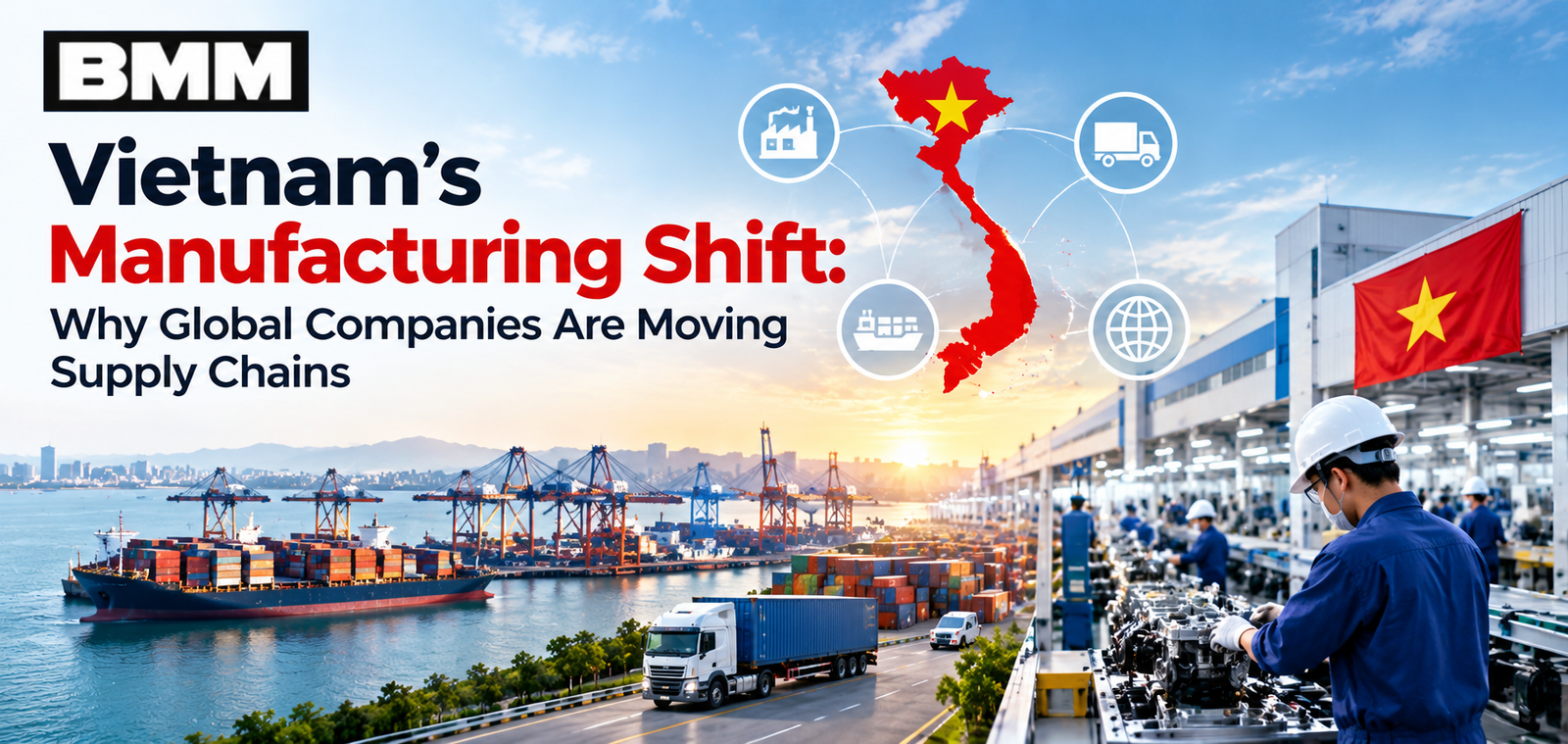
Global manufacturing is undergoing a significant shift as businesses reassess where their products should be made, how materials should be sourced, and how production risks can be managed. For years, China served as a preferred manufacturing destination because of its extensive industrial infrastructure, established supplier networks, and large production capacity. However, rising operating costs, trade uncertainties, geopolitical tensions, and lessons from pandemic-related disruptions have encouraged companies to diversify their manufacturing operations.
Vietnam has emerged as an important destination in this transition. Its competitive production costs, strategic location in Southeast Asia, expanding industrial infrastructure, and access to international markets have attracted businesses across electronics, textiles, footwear, furniture, and other industries. The growing interest in Vietnam manufacturing reflects a broader change in corporate strategy, where companies are balancing efficiency with flexibility and long-term resilience.
Instead of giving up the already existing manufacturing hubs altogether, companies have adopted a more diversified strategy. They are sticking to their existing plants while creating new manufacturing capacities elsewhere. Vietnam is a beneficiary of this trend; however, its continued success will depend on how much progress it makes in infrastructure, skill sets, and industrial environment at home.
Why Vietnam Is Becoming a Manufacturing Destination
One of Vietnam’s strongest attractions is its competitive operating environment. Labour costs have historically been lower than those in several established manufacturing economies, making the country appealing to companies producing goods that require substantial labour input. Apparel, footwear, furniture, and consumer products have been among the industries benefiting from this advantage.
Yet, cost competitiveness is not the sole reason. The country has made efforts in developing industrial parks, logistical connections, exporting facilities, and infrastructures to facilitate manufacturing activities. This development enables firms to set up their factories in the industrial zones and be supplied with the facilities required for their activities.
Another factor contributing to the success of Vietnam manufacturing industry is its policies encouraging foreign investments to boost manufacturing in the country. Foreign firms have invested in operations which are supportive of export, labor, and production know-how. Such investments have helped boost the position of the country in international manufacturing networks.
The geographical location of the country also provides it with an added advantage. Vietnam is located near China and is connected to major Asian shipping routes to enable coordination between suppliers and buyers in the region. Thus, for firms looking for an additional manufacturing base other than Asia, the country is a suitable choice.
China Plus One and the Need for Diversification
Production relocation to Vietnam is linked to the “China Plus One” strategy. The concept of this strategy includes having plants in China as well as in some other countries in order to lower dependence on one single plant. Such countries as Vietnam, India, Thailand, Indonesia, and Malaysia are used for implementing this strategy.
The requirement for diversification has become more evident amid the COVID-19 crisis, which was marked by shutdowns of factories, delays in transportation, and a lack of essential parts. Trade conflicts and changes in tariffs have motivated companies to think about diversifying the location of their production facilities.
What many companies seek to achieve is not simply replacing one country with another but rather developing an alternative operational scheme. Thus, a company could maintain the production of specialized parts in China and move the assembly processes to Vietnam. Another company could divide its production between various countries in order to minimize the risk of regional events interfering with its operations.
Vietnam supply chain diversification could be one of the tools used by businesses as a part of this approach. Relocation, however, does not simply mean setting up a new factory; companies will also have to find qualified suppliers, train the employees, set up production machinery, follow the regulations, and make sure that quality requirements are met.
Although Vietnam cannot duplicate all capabilities available in more developed economies, it offers an increasingly attractive option for companies willing to combine production efficiency with operational resilience.
Trade Agreements and International Market Access
The trade agreements entered into by Vietnam have improved the attractiveness of Vietnam for export-oriented production. This includes trade agreements like the Comprehensive and Progressive Agreement for Trans-Pacific Partnership, the European Union-Vietnam Free Trade Agreement, and the Regional Comprehensive Economic Partnership.
In certain instances, these agreements can grant qualified products preferential treatment with regard to tariffs, as well as better access to the global market. When a company is making substantial amounts of exports, these benefits can impact its production costs, pricing policies, and manufacturing location.
However, when manufacturing in Vietnam for these benefits, a company needs to be aware of what is required by the applicable trade agreement. Factors such as product classification and rules of origin will affect whether a company qualifies for preferential treatment.
For example, it is not enough to transfer final assembly alone to Vietnam in order to take advantage of lower tariffs for certain goods. In order for a company to make use of the trade relationship, it needs to consider its sourcing and production practices.
Technology Is Expanding Manufacturing Capabilities
Industrialization in Vietnam is slowly moving away from the conventional labour-intensive industries. Industries such as electronics, electrical products, machinery, and technology-based industries have been significant due to the expansion of firms overseas.
Amongst these, electronics manufacturing has been notable. Firms have set up electronics manufacturing plants to assemble electronics, manufacture electronics components, and provide logistics services and export-oriented industries.
The future of the Vietnam manufacturing investment rests to some extent on its ability to move up the value chain. As plants incorporate technological machinery and processes, they require employees skilled in managing technology and machinery and analyzing production processes.
Foreign Investment and Business Opportunities
Foreign direct investment has been very important for the growth of Vietnam manufacturing industry. The firms have capital, technology, production know-how, and access to international markets. They may also create business opportunities for local firms that produce components, packaging, transport, equipment maintenance, and other services for industries.
For foreign firms, manufacturing investment could be a way to enter the production systems in Southeast Asia. There may be various industrial parks and export zones that would be suitable locations for the new factory, depending on the needs of the firm and investment structure.
The opportunities go well beyond large multinational companies. Domestic suppliers that satisfy international criteria for quality, reliability, traceability, and delivery can become useful allies for growing manufacturers. The involvement of the local sector could help Vietnamese firms to benefit from the economic development of their country rather than being dependent only on importation and assembling of parts.
Nonetheless, investment must be carefully evaluated. There should be an evaluation of such factors as land, utilities, labour force, transport costs, tax liability, licenses, and the capacity of potential suppliers. Furthermore, they need to evaluate the capacity of their facility to grow as their needs increase.
Nevertheless, investment is about more than just the establishment of a factory. It is about a realistic assessment of the operational environment and a long-term strategy for building capacity.
Challenges Companies Must Consider
Despite the numerous benefits, there are some factors that may become a problem for manufacturing companies. Fast industrial development creates pressures on the infrastructure, electricity, transport system, ports, and industrial land. Problems related to capacity or delays of these factors may affect production and shipments.
The depth of the local network of suppliers is industry-specific, as well. There are some manufacturing businesses that need specialized components, materials, and services that cannot be supplied locally. As a consequence, these businesses will have to continue importing required components, and face other issues in logistics.
Training the workforce is another aspect that should be taken into account by companies. Advanced manufacturing requires technicians, engineers, production managers, and specialists in quality control. It is important for companies to expand the availability of skilled workforce.
Environmental standards, labor practices, and responsible sourcing also play an important role. Modern companies expect to see these aspects demonstrated during production processes.
This list of problems does not mean that Vietnam does not offer any opportunities. On the contrary, it only confirms the importance of planning and assessing the overall environment, rather than focusing only on low labor costs.
Why Global Companies Are Moving Manufacturing to Vietnam
The question of Why global companies are moving manufacturing to Vietnam can be answered through several connected factors: cost competitiveness, trade access, diversification, geographic advantages, and opportunities for industrial development. Together, these factors have made Vietnam an increasingly important destination for businesses reassessing their global production networks.
For companies considering manufacturing in Vietnam, success will depend on selecting suitable locations, developing dependable suppliers, training employees, and understanding the requirements of target markets. Businesses must also determine which production activities can be transferred without compromising quality, efficiency, or delivery schedules.
The future of the Vietnam supply chain will depend on the country’s ability to strengthen infrastructure, expand technical capabilities, and integrate more domestic businesses into international production networks. Continued progress could support a transition towards more sophisticated manufacturing and higher-value industrial activity.
Ultimately, Vietnam manufacturing investment represents more than a response to rising costs elsewhere. It reflects a broader effort by global companies to build production networks that are competitive, diversified, and better prepared for uncertainty. Vietnam may not replace every established manufacturing hub, but its expanding industrial capabilities have made it a significant part of the changing global manufacturing landscape.
FAQ
1. Why are global companies moving their supply chains to Vietnam?
Global companies are expanding into Vietnam to diversify their supply chains, manage production costs, access export markets, and reduce reliance on a single manufacturing location. Vietnam’s established industrial zones and growing manufacturing ecosystem make it an attractive option.
2. What makes Vietnam an attractive manufacturing destination?
Vietnam offers competitive labor costs, a strategic location in Southeast Asia, improving infrastructure, a growing industrial workforce, and access to international trade agreements. These factors help manufacturers serve regional and global markets.
3. Which industries are driving Vietnam’s manufacturing growth?
Key industries include electronics, textiles and apparel, footwear, furniture, machinery, automotive components, and electrical equipment. Electronics manufacturing and export-oriented industrial production are particularly important to Vietnam’s role in global supply chains.
4. How does the China-plus-one strategy benefit Vietnam?
The China-plus-one strategy encourages companies to maintain operations in China while establishing additional manufacturing capacity in other countries. Vietnam benefits from this approach by offering an alternative production base and helping businesses diversify geographic and operational risks.
5. What business opportunities are emerging from Vietnam’s manufacturing shift?
Opportunities are growing in industrial real estate, logistics, warehousing, packaging, component manufacturing, automation, quality control, supply-chain technology, and workforce training. Local suppliers can also benefit as international manufacturers develop regional production networks.
6. How do Vietnam’s free trade agreements support manufacturing businesses?
Vietnam’s trade agreements can provide preferential market access for eligible goods, helping businesses connect with international customers and suppliers. Companies must meet applicable rules of origin, product standards, and other requirements to benefit from these agreements.
7. What challenges do companies face when moving manufacturing operations to Vietnam?
Companies may face infrastructure constraints, rising operating costs, skilled-labor shortages, complex compliance requirements, and dependence on imported components. Businesses should assess supplier availability, transport networks, energy reliability, and regulatory requirements before relocating operations.
8. How can Vietnamese businesses benefit from foreign investment?
Vietnamese businesses can gain opportunities to become suppliers, distributors, logistics partners, and service providers for multinational companies. Technology transfer, employee training, and stronger partnerships can also help local firms improve productivity and compete in international markets.
9. Is Vietnam a good alternative to China for manufacturing?
Vietnam can be a strong alternative for selected manufacturing activities, particularly in electronics, apparel, footwear, and export-oriented production. However, it may not match China’s scale, supplier networks, or infrastructure in every industry. Many businesses use Vietnam as part of a diversified manufacturing strategy rather than a complete replacement for China.
10. How is technology changing Vietnam’s manufacturing sector?
Automation, artificial intelligence, digital inventory systems, robotics, and data-driven production planning are helping manufacturers improve efficiency, quality control, and supply-chain visibility. Investment in workforce skills and digital infrastructure will be important for broader adoption.