
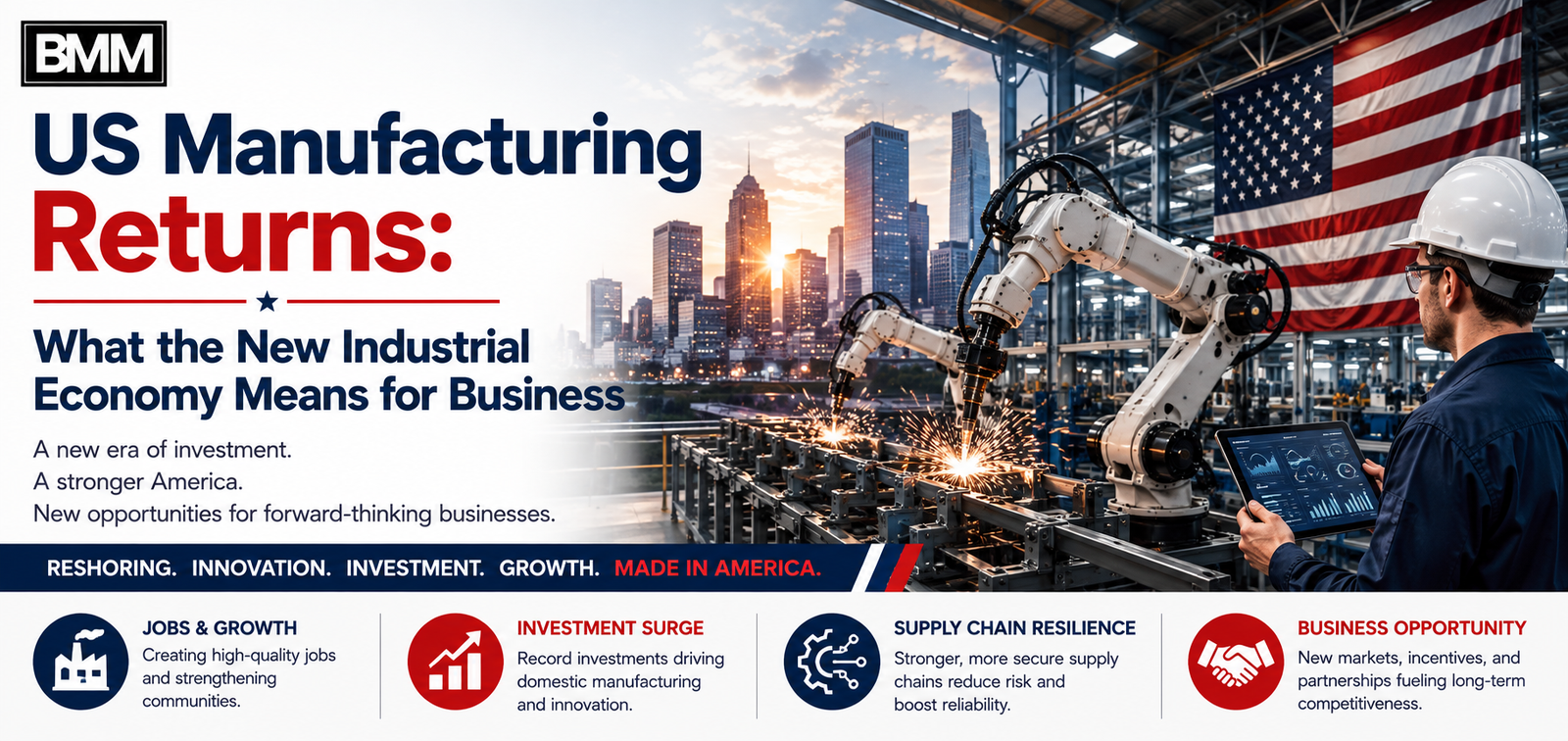
The global manufacturing landscape is undergoing a profound transformation. After decades of offshoring production to lower-cost markets, the United States is witnessing a renewed focus on domestic manufacturing capacity, industrial investment, and supply chain resilience. This shift is being driven by a combination of geopolitical uncertainty, technological advancement, government incentives, and lessons learned from recent supply chain disruptions.
While much of the discussion has centered on factory construction and industrial policy, the implications extend far beyond manufacturing itself. Businesses across sectors are reassessing sourcing strategies, investment priorities, workforce development plans, and technology adoption initiatives. For companies seeking growth in a rapidly changing environment, understanding the new industrial economy has become increasingly important.
Interestingly, these developments are also influencing broader global conversations about UAE Business Trends 2026, as businesses worldwide evaluate resilience, localisation strategies, and industrial competitiveness in an increasingly uncertain market.
The Resurgence of American Manufacturing
For several decades now, corporations had been opting for reduced manufacturing costs by relocating their manufacturing plants abroad. Nevertheless, the recent disruptions showed the weaknesses that came along with having dispersed supply chains around the globe. Pandemics-related closures, geopolitical issues, disruptions in delivery, and shortages of raw materials highlighted the dangers of relying too heavily on distant suppliers.
Consequently, America has enjoyed a period of increased industrial strength. The manufacturing industry has seen its highest performance in four years in 2026, owing to high order volumes, increased industrial production, and investments. Industries like the manufacture of transportation equipment, machines, electronics, and food saw an expansion.
The return of American manufacturing power is not just a simple process.
The Rise of Supply Chain Reshoring
One of the most important factors affecting the emergence of the new industrial economy is the development of supply chain reshoring.
Instead of depending heavily on foreign producers, firms are trying to discover ways to move production closer to their own home markets. The trend towards reshoring is becoming popular due to such benefits as lower transport risks, shorter lead times, faster responses to demand, and better visibility of the supply chain.
The trend towards supply chain reshoring is also facilitated by government policies, which encourage domestic businesses. Tax cuts, investments in infrastructure, trade policies, and industrial development programs stimulate businesses to explore domestic production possibilities.
For many firms, the idea of reshoring is not considered to be just a response to disruptions anymore.
Industrial Growth Creates New Business Opportunities
The current wave of US industrial growth presents opportunities in many different industries.
Construction of factories involves investment in construction, engineering, logistics, automation, software, cybersecurity, training of employees, and consulting services. The more factories are developed, the higher the need for innovative solutions and skilled people remains.
US industrial growth not only has implications for traditionally industrialized regions but also leads to the development of new industrial clusters in various states. Such a process creates opportunities for all stakeholders.
Businesses that cooperate with the process of industrial development will be able to develop new sources of income.
Manufacturing Opportunities Continue to Expand
The economic revitalization is providing major manufacturing opportunities in USA for an array of industries.
Industries such as semiconductors, electric cars, batteries, advanced electronics, aerospace parts, medicines, and industrial equipment are among those receiving considerable investments in their developments. There are efforts from both the government and private sectors towards development in these industries.
While manufacturing opportunities are coming up for the smaller manufacturers, there are also major manufacturing possibilities for the small and medium sized enterprises. This is happening as large manufacturers are looking for domestic suppliers.
There are many businesses that have found renewed manufacturing possibilities in the changing domestic supply chains.
Technology Is Powering the New Industrial Economy
The resurgence of manufacturing does not signal the resurrection of the old model of manufacturing plants.
Modern manufacturing plants now depend more than ever on automation, artificial intelligence, machine learning, robotics, analytics, and connectivity to be more efficient in their operations and to solve labor shortage problems.
Digital transformation is proving to be one of the most important drivers of competitive advantage. Smart factories can track factory operations, detect impending mechanical failure, schedule production efficiently, and make decisions based on data.
Technology capability is fast becoming an important distinguishing factor for companies operating in manufacturing ecosystems.
The Future of Manufacturing Jobs
Industrial revitalization is also affecting the job market.
Despite increased automation, US manufacturing jobs continue to be an essential element for growth. Yet, the type of jobs is evolving. Modern manufacturing needs professionals who are highly skilled in automation technology, robotics, analytics, engineering, and manufacturing technologies.
The rise of US manufacturing jobs brings both positive and negative aspects. On one hand, new jobs are emerging. On the other hand, firms face problems in hiring specialists who meet requirements. Shortage of workforce is one of the major hindrances to industrial development.
Consequently, firms have begun to invest more money into training programs, apprenticeships, educational institution partnerships, and employee development programs.
Those organizations which develop an effective pipeline of skilled talent may have a competitive edge in the years to come.
Challenges Facing the Industrial Revival
The recovery of the manufacturing sector is facing some challenges, even though it has made some gains.
Shortage of labor, delays in getting permits, high costs of construction, uncertainties in the policy area, and supply chain disruptions still pose difficulties to the sector. According to certain experts, although the investment intentions are strong, making sure that these investments translate to production growth calls for tackling structural problems in the industrial ecosystem.
Moreover, the cost of production in the process of reshoring is normally higher than the cost of production in other countries. It will be a task for businesses and policymakers to reconcile the need for resilience and profitability in this regard.
What Business Leaders Should Do Next
Business executives must recognize the industrial revival as more than an industry-specific phenomenon. It is a paradigm shift in relation to resilience, risk, sourcing, and growth for businesses.
Organizations must identify their potential vulnerabilities regarding disruptions within their global supply chains, identify possibilities within their own domestic markets for collaboration, invest in skills training, and develop digital technologies. Those organizations not in conventional industrial sectors can consider ways in which expansion of the industrial base might present indirect growth possibilities.
The organizations that adjust early will be well-placed to take advantage of the next stage of industrial evolution.
Conclusion
The return of manufacturing to the United States marks one of the most significant economic developments of the decade. Driven by resilience, technological advancement, and strategic investment, the new industrial economy is reshaping supply chains, labor markets, and business strategies.
From accelerating industrial growth and expanding manufacturing opportunities in USA to increasing demand for skilled talent and supporting reshoring, the impact is being felt across industries. Meanwhile, the evolution of manufacturing jobs highlights the growing importance of technology and workforce development in sustaining long term competitiveness.
For businesses willing to adapt, invest, and innovate, the manufacturing resurgence represents not just a return to production, but the emergence of a new era of economic opportunity.
FAQ
Q1. What is meant by the “return of U.S. manufacturing”?
It refers to the growing trend of companies bringing manufacturing and production activities back to the United States after years of outsourcing production to countries such as China and Mexico. This process is often called reshoring.
Q2. Why did U.S. companies move manufacturing overseas?
Companies moved production overseas mainly to reduce labor and production costs, access global supply chains, and take advantage of lower-cost manufacturing in countries such as China.
Q3. Why is U.S. manufacturing returning?
Supply-chain disruptions
Rising overseas labor costs
Geopolitical tensions
Desire for greater control over production
Government incentives
Advances in automation and robotics
Growing demand for domestically produced strategic goods
Q4. What role did the COVID-19 pandemic play?
The pandemic exposed weaknesses in global supply chains. Shortages of semiconductors, medical equipment, and other critical products showed companies that depending heavily on distant suppliers could create serious risks.
Q5. What is reshoring?
Reshoring means bringing manufacturing operations back to the company’s home country. For a U.S. company, it means moving production from another country back to the United States.
Q6. How has technology changed U.S. manufacturing?
Q1. What is meant by the “return of U.S. manufacturing”?
It refers to the growing trend of companies bringing manufacturing and production activities back to the United States after years of outsourcing production to countries such as China and Mexico. This process is often called reshoring.
Q2. Why did U.S. companies move manufacturing overseas?
Companies moved production overseas mainly to reduce labor and production costs, access global supply chains, and take advantage of lower-cost manufacturing in countries such as China.
Q3. Why is U.S. manufacturing returning?
Supply-chain disruptions
Rising overseas labor costs
Geopolitical tensions
Desire for greater control over production
Government incentives
Advances in automation and robotics
Growing demand for domestically produced strategic goods
Q4. What role did the COVID-19 pandemic play?
The pandemic exposed weaknesses in global supply chains. Shortages of semiconductors, medical equipment, and other critical products showed companies that depending heavily on distant suppliers could create serious risks.
Q5. What is reshoring?
Reshoring means bringing manufacturing operations back to the company’s home country. For a U.S. company, it means moving production from another country back to the United States.
Q7. Does the return of manufacturing mean more jobs?
Yes, but not necessarily the same number or type of jobs that existed decades ago. Modern factories are highly automated, so they generally require fewer workers but more technically skilled employees, such as engineers, technicians, programmers, and maintenance specialists.
Q9. What is meant by the “new industrial economy”?
The new industrial economy combines manufacturing with advanced technology, automation, software, data, artificial intelligence, and highly skilled labor. Modern manufacturing is therefore very different from the traditional factory model.
Q10. How does government policy support U.S. manufacturing?
The U.S. government has used subsidies, tax incentives, infrastructure investment, and industrial policies to encourage domestic production, particularly in strategically important industries such as semiconductors, batteries, and clean energy.