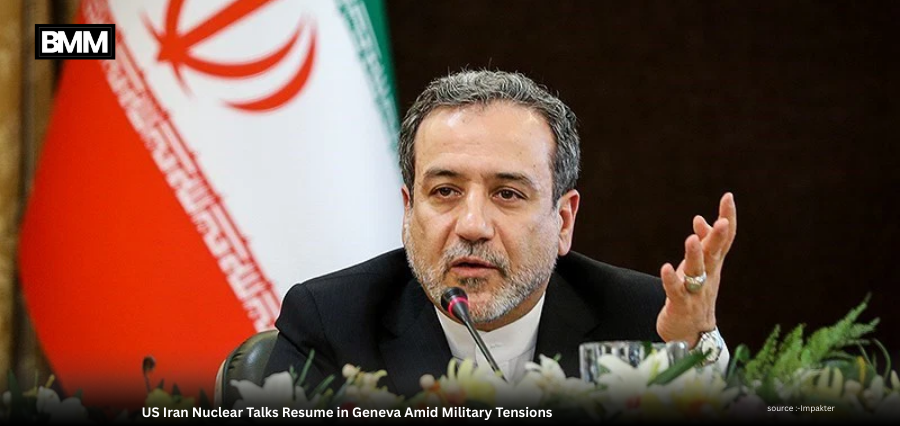
The latest round of US Iran nuclear talks began in Geneva on Tuesday, as Washington and Tehran attempt to revive negotiations over Iran’s disputed nuclear program. The indirect discussions, mediated by Oman, come at a moment of heightened military tension in the region, with the United States massing naval forces and Iran conducting military drills in the Strait of Hormuz.
The renewed diplomatic effort shows both a sense of urgency and a lack of clarity. Both sides have agreed to meet again, but there aren’t many clear signs that either is ready to make big concessions.
Diplomacy Under Pressure
The US Iran nuclear talks are being led on the American side by envoys Steve Witkoff and Jared Kushner. They are engaging indirectly with Iranian Foreign Minister Abbas Araqchi, with Omani officials facilitating communication between the two delegations.
On February 6, Tehran and Washington officially started talks again, looking for a way to move forward after years of rising tensions and stalled agreements. The main issue is still Iran’s plans for nuclear weapons. The US and its ally Israel say that Iran could try to make a nuclear weapon that could threaten Israel’s safety. Iran, on the other hand, says that its nuclear program is completely peaceful.
Tehran has enriched uranium to levels far above what is needed for civilian energy production, but it says it has the right to do so and denies any plans to make a bomb. Iranian officials have said recently that they have stopped enriching uranium. This is seen as a possible sign of goodwill before the talks in Geneva.
Military Buildup Raises Stakes
Despite diplomatic engagement, the US Iran nuclear talks are unfolding against a backdrop of significant military preparations. According to U.S. officials, the American military is preparing contingency plans for weeks of potential operations against Iran should President Donald Trump authorize an attack.
Trump has called the current U.S. deployment in the region a huge naval armada, which shows that he is ready to escalate if talks break down. Many people think that the military posture is an attempt to make Washington’s bargaining position stronger while also stopping Iran from doing things
Iran, on the other hand, started military exercises in the Strait of Hormuz on Monday The strategic waterway is a major route for oil around the world, moving a large part of the world’s energy supplies. Gulf Arab countries, which depend on stable oil exports, have told both Washington and Tehran to put diplomacy ahead of conflict.
Broader Political and Economic Pressures
The US Iran nuclear talks are taking place amid significant internal challenges within Iran. The country’s leadership has been weakened by widespread protests in recent years, driven largely by a severe cost-of-living crisis. International sanctions have sharply curtailed Iran’s oil revenues, exacerbating economic hardship.
The memory of last year’s failed attempt to start talks again is also very strong. In June, while talks were going on, Israel started bombing Iranian sites. Later, the U.S. joined in by hitting nuclear facilities. The failure of that diplomatic effort has made both sides more careful in this round.
Reports say that Washington wants to expand the talks to include Iran’s missile program in addition to nuclear restrictions. Tehran has firmly turned down this offer, saying it will only talk about limiting its nuclear activities in exchange for lifting sanctions. Iranian officials have also made it clear that they will not agree to a complete stop to uranium enrichment.
Marco Rubio, the U.S. Secretary of State, spoke in Budapest on Monday and said that the talks were difficult. He said it was hard to reach a deal with Iran, but he stressed that Washington was still willing to try.
International Oversight and Parallel Diplomacy
Ahead of the Geneva session, Iranian Foreign Minister Abbas Araqchi met with Rafael Grossi, Director General of the International Atomic Energy Agency. Their discussions focused on technical cooperation and verification mechanisms, signaling that any agreement emerging from the US-Iran nuclear talks would likely involve renewed international monitoring.
At the same time, U.S. diplomats are working on a number of different diplomatic fronts. Later on Tuesday, Witkoff and Kushner will take part in talks with Russia and Ukraine. Washington is trying to help end Moscow’s four-year war in Ukraine by getting the two sides to talk to each other.
The fact that so many important negotiations are happening at the same time shows how fragile global security is. The world is watching closely as the US and Iran talk about nuclear weapons in Geneva. The outcome could either ease tensions in the region or bring the Middle East closer to another major war.
Also Read :- Disney Sends Cease and Desist Letter to ByteDance Over AI Copyright Dispute