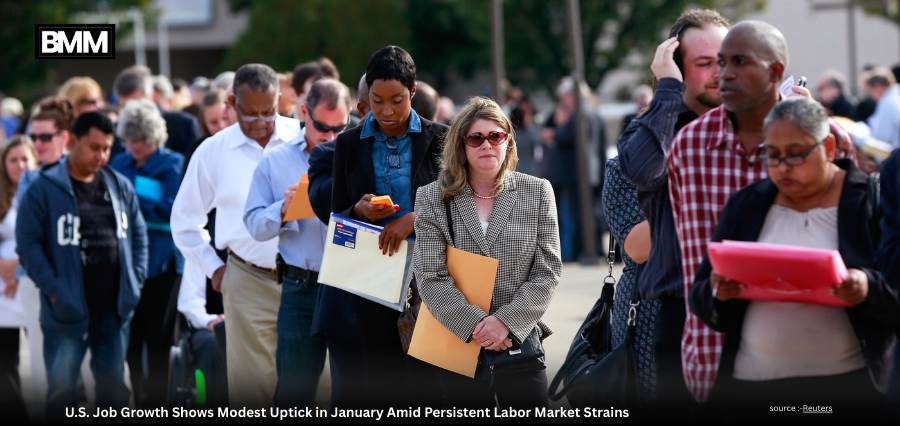
U.S. job growth likely picked up modestly in January, supported by fewer layoffs in some seasonal industries, but broader labor market conditions remained sluggish as uncertainty over import tariffs and tighter immigration enforcement continued to weigh on hiring. Economists say the latest data highlights a labor market that appears resilient on the surface but fragile underneath, reinforcing concerns about the sustainability of U.S. job growth in January trends.
According to reports, nonfarm payrolls are expected to have increased by around 70,000 jobs in January, following a gain of 50,000 in December. Estimates varied widely, ranging from a loss of 10,000 jobs to a gain of as many as 135,000, underscoring the uncertainty surrounding the pace of U.S. job growth in January. Some private surveys have even suggested that job losses may have occurred during the month.
Fewer Seasonal Layoffs Offer Temporary Support
January is typically the largest month for holiday-related layoffs, especially in retail, warehousing, and delivery services. However, economists noted that seasonal industries hired fewer workers than usual during the 2024 holiday season. As a result, layoffs in January were likely lower than normal, mechanically lifting employment figures and providing short-term support to U.S. job growth in January.
Despite this boost, analysts caution that the improvement does not necessarily signal a strengthening labor market. Instead, it reflects seasonal distortions rather than a broad-based acceleration in hiring.
Trade and Immigration Policies Weigh on Hiring
Most economists concur that President Donald Trump’s unclear policies have slowed the pace of the labor market. Stricter immigration enforcement has limited the pool of available labor, and ongoing worries about import taxes have made companies more hesitant about growing payrolls.
“The underlying stress in the labor market is greater than the overall unemployment suggests,” said Diane Swonk, chief economist at KPMG. She noted that wages are cooling, job switching has become more difficult, and new graduates are finding it harder to enter the workforce, even as the economy continues to show headline growth. These dynamics complicate the outlook for U.S. job growth in January and the months ahead.
Unemployment Steady, Wage Growth Cooling
The unemployment rate is predicted to remain stable at 4.4 percent in January, according to the Labor Department’s much-awaited employment report. It is anticipated that annual pay growth will continue to decline, supporting the idea that labor demand is slowing. While slower pay growth may help reduce inflationary pressures, it also indicates that workers have less negotiating power and that hiring conditions are becoming more lenient.
The report, originally scheduled for release last Friday, was delayed due to a three-day federal government shutdown. Markets and policymakers are closely watching the data for clues about the direction of U.S. job growth in January amid mixed economic signals.
Data Revisions Add Another Layer of Uncertainty
The Bureau of Labor Statistics’ birth and death model, which calculates job growth from company openings and closures, is being updated as of the January report. The methodology has come under fire for possibly exaggerating recent payroll increases.
The BLS will also release its annual benchmark revision to payroll data. Last year, the agency estimated that the economy likely created 911,000 fewer jobs in the 12 months through March 2025 than previously reported. Economists expect the final downgrade to fall between 750,000 and 900,000 jobs, which could further reshape perceptions of U.S. job growth in January and recent labor market performance.
According to Goldman Sachs economists, model modifications might reduce monthly payroll growth by 30,000 to 50,000 jobs when compared to recent trends. Data from April through December 2025 is likely to have downward revisions.
Slower Labor Force Growth Caps Employment Gains
One of the main factors limiting the expansion of employment is a declining labor force. Ron Hetrick, senior labor economist at Lightcast, called the job market “anemic,” saying that “people are still leaving the country, and that has been hurting some of the payroll numbers.”
Kevin Hassett, the White House’s economic adviser, recently issued a warning that slower labor force growth could cause job increases to significantly slow down in the months ahead. In the year ending June 2025, the U.S. population increased by just 0.5 percent, or 1.8 million individuals, according to Census Bureau data.
Outlook Remains Cautious
While tax cuts are expected to provide some support to hiring later in the year, economists remain cautious. For now, U.S. job growth in January reflects a labor market caught between slowing momentum and policy-driven uncertainty, suggesting that stronger gains may remain elusive in the near term.
Also Read :- Ukraine Presidential Elections and Referendum Amid War Pressures