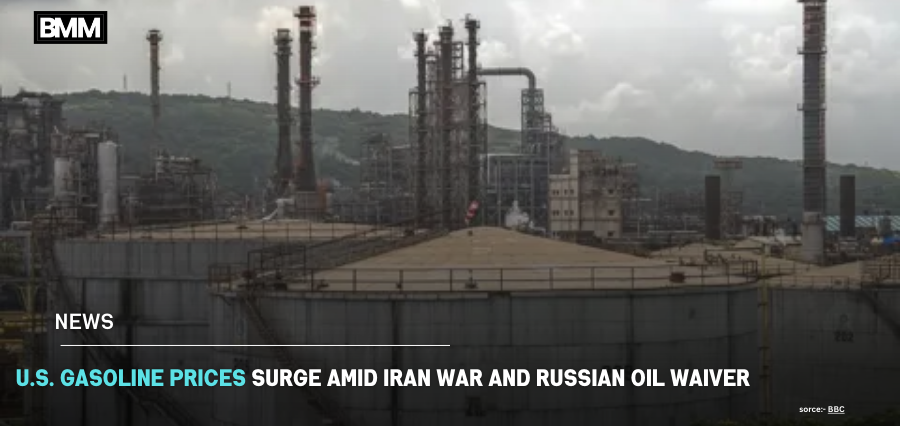
The U.S. gasoline prices surge has become a major economic concern as the ongoing Iran conflict and global energy uncertainties continue to influence oil markets. Officials from the Trump administration defended a recent decision to temporarily ease some sanctions on Russian oil exports, arguing that the move could help stabilize global supply and reduce pressure on fuel prices. As the war enters its second week, Americans are experiencing noticeable increases in fuel costs, raising concerns about inflation and broader economic stability.
Energy officials, however, believe the price spike may only be temporary. They argue that the waiver allowing certain oil shipments to continue flowing into international markets will prevent severe shortages and help calm global energy markets.
Russian Oil Waiver Aims to Stabilize Supply
The administration has made one of the most important steps, which is a temporary waiver that can enable India to purchase Russian oil. The authorities claim that the action is meant to ensure that millions of barrels already in transit do not disrupt world supply chains.
U.S. Ambassador to the United Nations Mike Waltz justified the decision when he appeared on the NBC show Meet the Press. The waiver gives a 30-day grace period during which the shipments that are already in the tankers may arrive at the Indian refineries (Waltz).
The administration is of the opinion that the move would ease panic and that the U.S. gasoline price increase associated with the threat of supply shortages would be toned down by letting those barrels make their way to the market.
The move was also defended by the Energy Secretary, Chris Wright, who appeared on the State of the Union on CNN. He indicated that the waiver would help to de-escalate the markets that have responded intensely to the geopolitical tensions.
Wright gives this to be the aim of tamping out the fear of oil scarcity, tamping out the price spikes, and tamping out the fears in the market.
Rising Fuel Prices Impact U.S. Consumers
Despite these reassurances, American drivers are already feeling the effects of rising fuel costs. Data from the motorists group AAA shows that the national average price for regular gasoline reached $3.32 per gallon as of Friday.
This represents an 11 percent increase compared to the previous week and marks the highest gasoline price since September 2024. Diesel prices have risen even more sharply, reaching $4.33 per gallon—up 15 percent in just one week and the highest level since November 2023.
The sudden U.S. gasoline prices surge is creating new challenges for the American economy, which recently reported an unexpected loss of 92,000 jobs in February. Higher fuel prices could increase transportation and production costs across industries, potentially affecting inflation and consumer spending.
Trump Predicts Price Spike Will Be Temporary
President Donald Trump addressed the issue in a post on Truth Social, suggesting that the rise in fuel prices would be short-lived.
He argued that the military operation targeting Iran’s nuclear capabilities is necessary for global security and that temporary economic pain is a small price to pay for long-term safety.
“Short-term oil prices, which will drop rapidly when the destruction of the Iran nuclear threat is over, is a very small price to pay for U.S.A., and world safety and peace,” Trump wrote.
Energy Secretary Wright echoed this view during an appearance on “Fox News Sunday.” He said there is currently no actual shortage of oil or natural gas in global markets.
According to Wright, the U.S. gasoline prices surge is largely driven by fear and speculation rather than real supply constraints.
Global Oil Markets React to War Concerns
Despite these assurances, oil markets have reacted strongly to the escalating conflict in the Middle East. U.S. crude futures rose more than 20 percent during early trading in Asia on Monday, reaching their highest level since July 2022.
Analysts attribute the surge to fears that the war could disrupt shipments through the Strait of Hormuz, one of the world’s most critical oil transit routes. Any prolonged disruption in that region could significantly tighten global supply.
If tensions continue, experts warn that the U.S. gasoline prices surge could persist longer than officials expect.
Political Debate Over Strategic Oil Reserves
The situation has also sparked political debate in Washington. Senate Minority Leader Chuck Schumer called on the administration to release oil from the Strategic Petroleum Reserve (SPR) in order to stabilize markets.
The reserve currently holds about 415 million barrels of oil, which is equivalent to more than four days of global oil consumption.
Schumer argued that releasing oil from the reserve could help reduce the U.S. gasoline prices surge and protect American households from further price increases.
However, President Trump indicated in a recent interview that he is not currently considering tapping the reserve.
Market Speculation Blamed for Rising Prices
Other legislators have attributed the blame to speculation in the energy market and not on lack of supply. Senator John Kennedy of Louisiana attacked the oil traders in an interview on Fox News Sunday.
Kennedy has claimed that traders are speculating, which causes prices to rise under stable supply conditions.
To him, traders are bidding the price high as a way of responding to uncertainty about the conflict.
Outlook for Fuel Prices
Although the leaders are hopeful that the fuel prices will normalize in the next few weeks, things are not so clear. A lot will be determined by the Iran conflict and whether the shipping routes across the world are safe.
To date, the U.S. gasoline price spike underscores the extent to which even minor geopolitical tensions can easily trickle down to the global energy markets and have impacts on the average consumer. In case of a swift resolution of the conflict, the prices will go back. However, as things may get heated, the stress on oil markets and the American drivers may persist.
Also Read :- China–Iran Talks Over Strait of Hormuz Oil Transit Amid Escalating Middle East War