
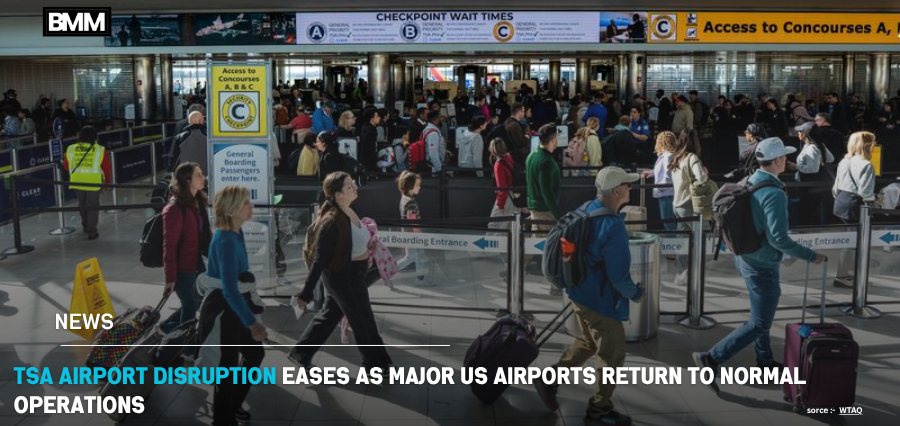
Major airports across the United States are experiencing some relief as they return to normalcy following a series of unprecedented disruptions caused by unpaid Transportation Security Administration officers. The TSA airport disruption has been affecting major airports, including New York, Baltimore, Houston, New Orleans, and Dallas.
On Monday, these airports reported a significant decrease in wait times at airport security checkpoints. Passengers across these airports had been experiencing unprecedented delays in recent weeks, with some experiencing up to four hours of delay—the longest wait time in the Transportation Security Administration’s almost 25-year history.
The disruptions had caused widespread frustration among passengers, particularly as the country is in the midst of spring break.
Emergency Directive Signed by Donald Trump Brings in Payments
The TSA airport disruption has come to a close as Donald Trump signed an emergency directive on Friday, allowing immediate payments for 50,000 TSA officers who have been without pay since mid-February due to a partial government shutdown.
The disruptions were exacerbated as more officers started calling in sick due to financial difficulties. The Department of Homeland Security has announced that most of these officers have received their back pay on Monday.
The Department of Homeland Security has reported that TSA officers have received at least two weeks’ worth of pay as part of a retroactive payment. The remaining balance from early in the shutdown will be paid as soon as possible. It seems like the emergency action has paid off as attendance has improved significantly across these airports over the weekend.
Worker Absences Triggered Chaos
The peak of the TSA airport disruption was characterized by alarming rates of worker absenteeism. For instance, on Friday alone, a total of 12.4% of the total TSA staff nationwide failed to turn up to work, a figure that added up to a total of 3,560 officers.
The problem was worse at some airports compared to others. For example, at New York’s John F. Kennedy International Airport, more than a third of airport security staff failed to turn up to work. The two major airports in Houston, on the other hand, recorded the worst cases of worker absenteeism, with nearly 45% of airport security staff failing to turn up to work.
The crisis also led to a number of resignations, with more than 500 airport security officers resigning since mid-February. This, therefore, contributed to the severe TSA airport disruption witnessed at various airports across America.
Political Deadlock Continues
Although TSA airport disruption staff have finally started receiving their pay, a large number of Department of Homeland Security employees remain unpaid as a result of the ongoing political standoff.
The Democrats in Congress have deliberately delayed approving funds for the Department of Homeland Security, a move that has been motivated by a desire to push for reforms in immigration enforcement operations.
The standoff, which has been ongoing for a while, was exacerbated by recent controversial operations carried out by immigration officers, prompting Congress to push for reforms in immigration operations.
The Republicans in Congress, on the other hand, rejected a bipartisan proposal brought to Congress by Senators in an attempt to resolve the six-week standoff. Instead, they passed a separate bill to finance the entire Department of Homeland Security.
The ongoing TSA airport disruption has thus become a manifestation of the shutdown, a move that has put immense pressure on Congress to resolve the standoff as soon as possible.
Spring Break Travel Adds Pressure
The timing of this crisis, however, couldn’t have been any worse, as air travel is seeing a surge in passengers due to spring break, with passenger traffic expected to increase by 5% over last year.
To deal with this situation, hundreds of immigration officers and Homeland Security Investigation officers were deployed to 14 airports to help with security screening.
The White House has confirmed that these officers will stay until airport operations are back to normal.
Looking Ahead
The funding crisis, which has crippled Homeland Security, still remains unresolved, and the recent incident of a TSA airport disruption has highlighted the risks to critical national infrastructure in a prolonged political standoff.
For now, air travelers in the United States can look forward to a smoother airport experience, but this situation will change only if Congress manages to resolve the funding crisis in the days to come.
Also Read :- Min Aung Hlaing Presidency Move Signals New Political Shift in Myanmar