
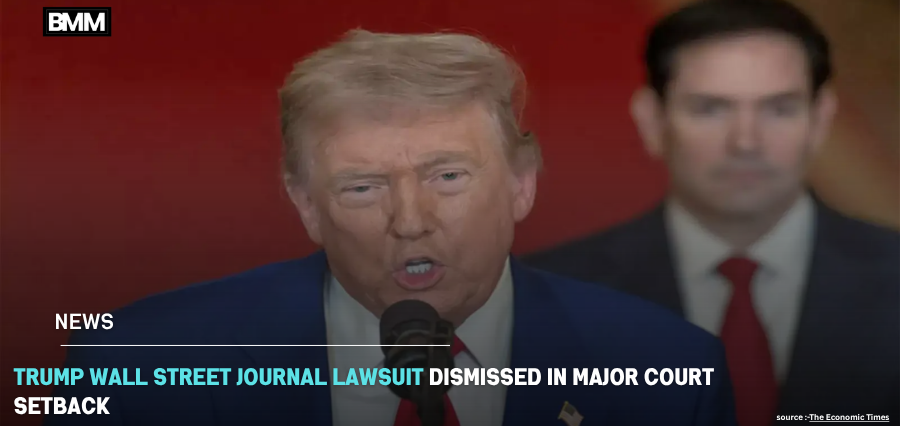
The Trump Wall Street Journal lawsuit took a major turn after a federal judge dismissed President Donald Trump’s defamation case against The Wall Street Journal, dealing a significant setback to his ongoing legal campaign against major media organizations. The ruling comes amid wider debates around press freedom, defamation standards, and the use of litigation by public figures against news outlets.
Federal Judge Dismisses the Case
On Monday, U.S. District Judge Darrin P. Gayles dismissed the Trump Wall Street Journal lawsuit, ruling that the complaint failed to meet the legal threshold required in defamation cases involving public figures.
The judge stated that Trump had not come close to satisfying the “actual malice” standard, which requires proof that the publisher either knew the statement was false or acted with reckless disregard for the truth. In his order, Gayles noted that the complaint “comes nowhere close to this standard.”
However, the dismissal was made without prejudice, allowing Trump the opportunity to file an amended complaint by April 27.
What the Lawsuit Was About?
The lawsuit filed by Trump at the Wall Street Journal was based on a report by the newspaper that recounted a birthday card that allegedly contained the signature of Trump and was associated with the late financier Jeffrey Epstein.
Trump and his attorneys claimed that the card was a forgery and that the article had brought bad publicity. The case was initiated in July 2025 and was suing the newspaper to pay significant damages and alleged that they published fake and defamatory information.
The case gained a lot of publicity as it coincided with a resurgence of interest in the Epstein case and
Trump having a past affiliation with Epstein.
Why the Judge Rejected the Claim?
One of the issues that made the Trump Wall Street Journal lawsuit to be dismissed was the inability to prove actual malice.
Judge Gayles stressed that The Wall Street Journal had approached Trump to comment before it was published and had added his denial to the report. This, according to the ruling, gave the readers a chance to draw their own conclusions, which undermined the argument that the paper was maliciously acting.
This is especially important due to the fact that the U.S. defamation law establishes a very high standard on which public figures are judged, notably sitting presidents.
Trump Plans to Refile
Trump, in response to the dismissal, posted on his Truth Social, that he will re-join the Trump Wall Street Journal lawsuit with the court before the deadline.
This implies that the court struggle can still be a long way, despite the fact that the pending grievance has been dismissed.
In the meantime, the Wall Street Journal parent company, Dow Jones, celebrated the decision and again stated its trust in the reporting guidelines and editorial integrity of the news outlet.
Wider Concerns Over Press Freedom
A suit filed by the Trump Wall Street Journal is not the only court case that Trump has taken against the giant media houses.
Others, such as press freedom advocates and Democratic legislators, have feared that the recurring defamation cases against news companies could have a chilling effect on critical news coverage and news independence.
The proponents, however, posit that the public ought to be allowed to take action against what they perceive to be untrue reporting.
With Trump on the verge of re-filing, the case is expected to continue to be a hotspot in the current war between political authority and media.
Also Read :- UK Business Energy Support Plan as Rachel Reeves Responds to Rising Costs