
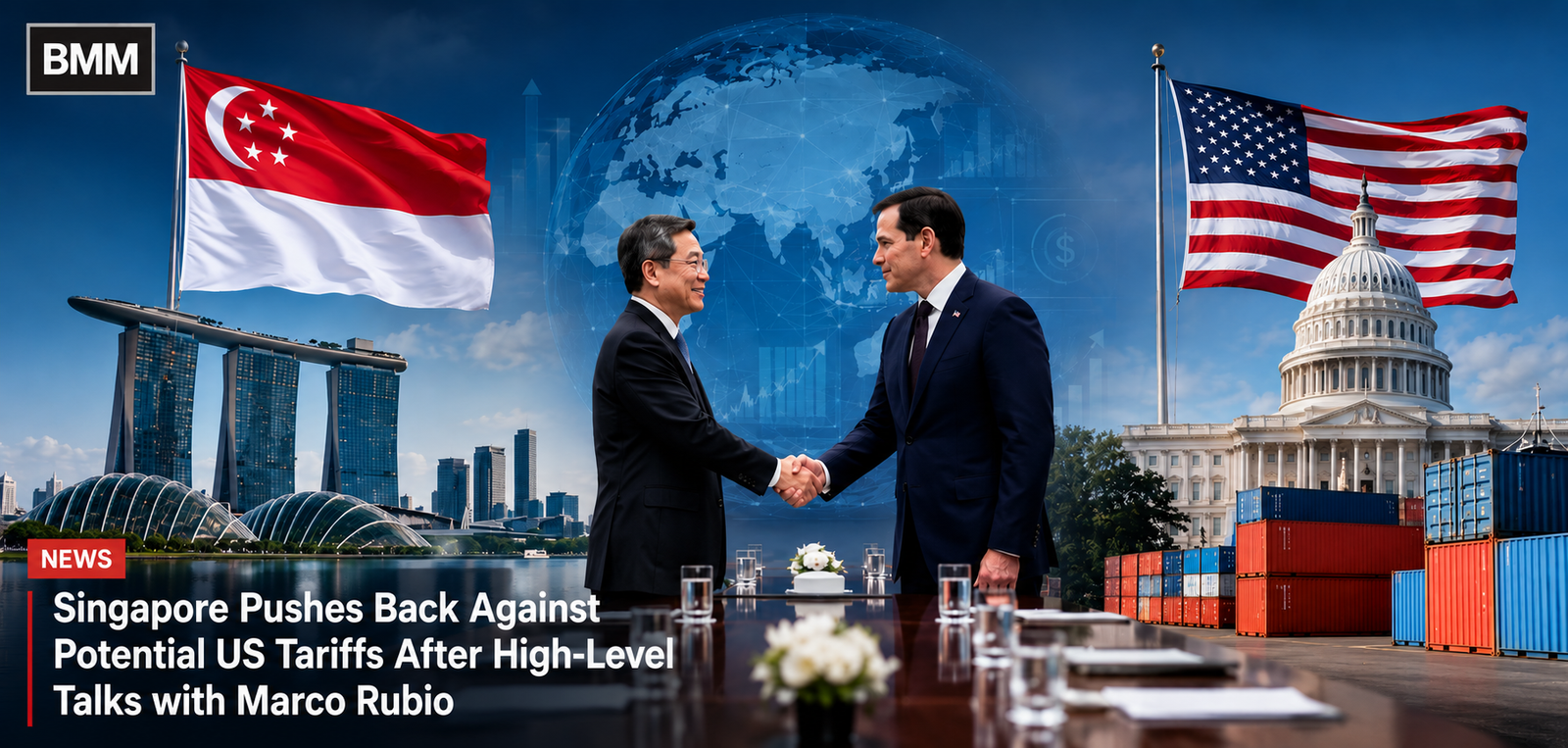
Singapore has formally raised concerns over possible Singapore US tariffs during high-level talks between Foreign Affairs Minister Vivian Balakrishnan and US Secretary of State Marco Rubio on the sidelines of the ASEAN Foreign Ministers’ Meeting in Manila. Balakrishnan said he made it clear that Singapore should not become “collateral damage” as Washington considers expanding tariff measures against several trading partners.
The minister stressed that the United States enjoys a growing trade surplus with Singapore, arguing that there is neither a technical nor an economic justification for imposing tariffs on the city-state. According to him, the discussion with Rubio was candid and constructive, with both sides acknowledging the importance of maintaining strong bilateral economic ties.
Tariff Concerns Dominate ASEAN Discussions
The prospect of Singapore US tariffs comes as the Trump administration prepares to introduce a new round of global trade measures after the expiry of a temporary import surcharge. Washington has indicated that additional duties could be imposed on countries found to have engaged in unfair trade practices under Section 301 investigations.
Singapore has rejected suggestions that it benefits from unfair trade practices or forced labour within its supply chains. Officials maintain that such practices are criminalised under Singaporean law and that there is no evidence linking the country to the concerns raised by US authorities. The government has continued engaging with American officials in an effort to prevent Singapore US tariffs from taking effect.
ASEAN Looks Beyond Immediate Trade Challenges
Addressing reporters after the regional talks, Balakrishnan added that uncertainties in the field of global trade have underscored the importance of the need for ASEAN to integrate more economically and be resilient. ASEAN centrality, economic cooperation, and resilience were highlighted by Balakrishnan as some of the key areas of focus for ASEAN going forward in its future transitions of leadership.
Balakrishnan further observed that despite the existence of strategic competition between the United States and China, both nations handled the ASEAN meetings in a very balanced and constructive manner. He hopes that continued dialogues among major powers would result in alleviating uncertainties in the field of trade and investment in Southeast Asia, including Singapore US tariffs.
Trade Relationship Remains Strong
Singapore has continued to underscore the significance of its economic ties with the United States. According to officials, the current trade surplus of Washington clearly proves that Singapore does not contribute to any trade imbalance that has been used as an excuse to impose tariffs. Keeping the trade flow open is of utmost importance to both governments as businesses keep an eye on policy developments.
It has also been highlighted by business organizations that the imposition of Singapore US tariffs may affect the smooth functioning of supply chains and add to the cost burden of exporters. No final decision has yet been made, but this issue has definitely come under the spotlight.
What Comes Next?
The government of Singapore would pursue its diplomatic approach towards Washington as America finishes formulating its own trade policies in the days to come. The officials still believe that their discussions with American colleagues will not end up putting any unnecessary barriers on trade and that the longstanding economic cooperation will be protected in that regard.
At the moment, Singapore US tariffs would continue to be a source of worry for policymakers, businesses, and exporters in the area. The results of current negotiations might affect not just the trade future of Singapore but also the economic approach of ASEAN amid the increasing geopolitical and business uncertainty in the world today.
Also Read :- Ukraine Presidential Elections and Referendum Amid War Pressures