
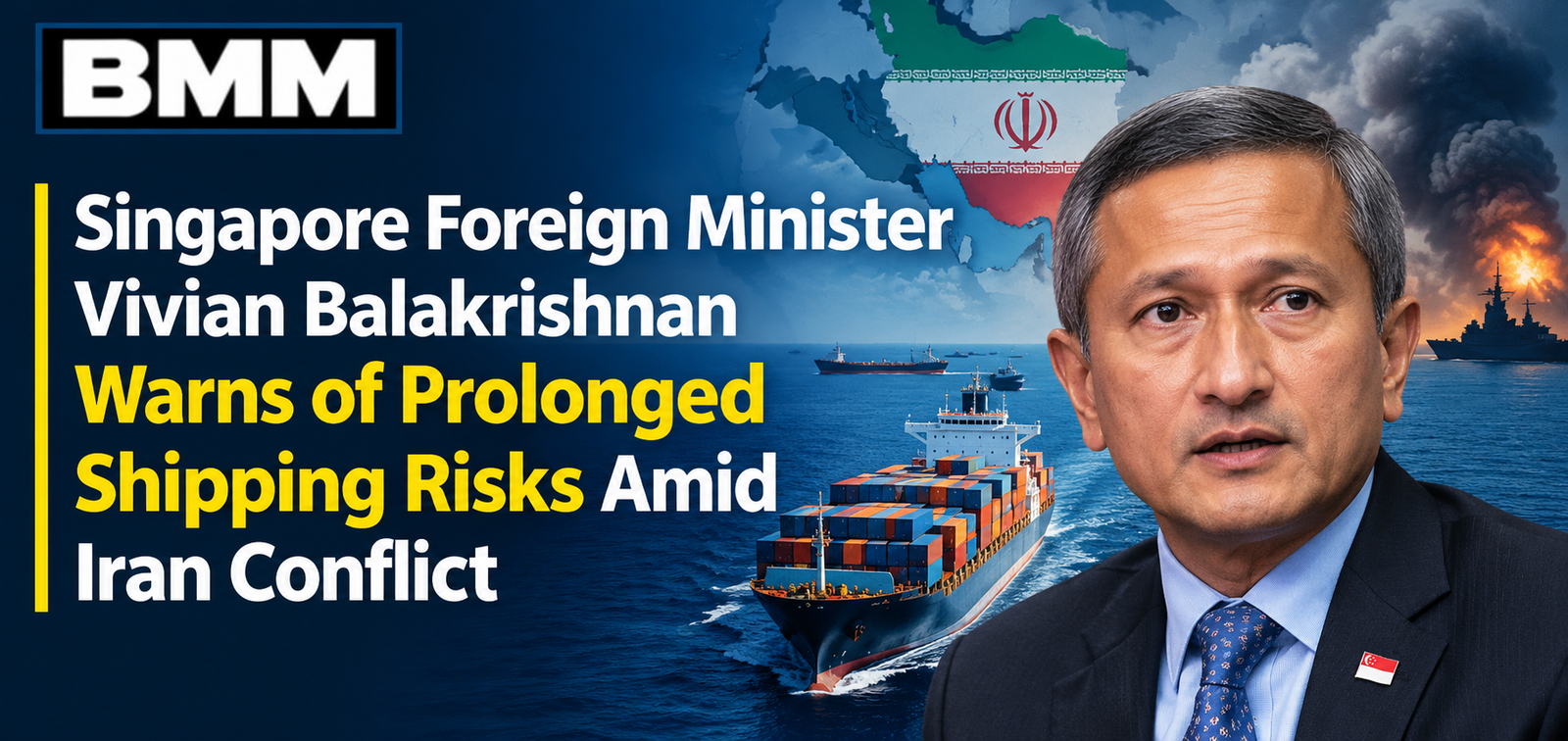
Singapore Foreign Minister Vivian Balakrishnan has warned that the ongoing conflict involving Iran and the United States could have lasting consequences for international trade, energy security and shipping costs. Speaking to CNBC on October 7, 2026, on the sidelines of the Milken Institute Asia Summit in Singapore, Balakrishnan said he did not anticipate a quick diplomatic resolution to the tensions surrounding the Strait of Hormuz.
His remarks come as the strategic waterway remains a major concern for global energy markets. Connecting the Persian Gulf with the Gulf of Oman and the Arabian Sea, the Strait of Hormuz serves as a critical route for international oil and gas shipments. Any disruption can affect energy-importing economies, particularly across Asia.
The continuing Strait of Hormuz crisis has also raised concerns about rising shipping insurance costs, supply chain uncertainty and the potential for higher energy prices.
Balakrishnan Addresses Trump’s Position on Asia
While admitting that US President Donald Trump was partially right in asserting that the Asian nations had to bear more responsibilities in securing the safety of the water channel, Balakrishnan pointed out that Asian nations were major consumers of the energy being shipped through the Strait of Hormuz.
However, according to Balakrishnan, the dispute is far more than the simple issue of who is getting the most benefits from the energy being transported across the strait. Ultimately, according to him, the dispute revolves around freedom of navigation and the rules for international waterways.
According to Singapore, ships have to be allowed to pass through international straits without being restricted unilaterally by any toll or other restrictions. Balakrishnan called this stance non-negotiable, citing the United Nations Convention on the Law of the Sea.
Iran’s Influence Over Maritime Routes
Among the major issues related to the Strait of Hormuz crisis is the danger of Iran gaining control of the passage rights of the ships that move through the strait.
According to Balakrishnan, the authority to charge transit fees was not just a means of raising money for Tehran. Instead, it would provide the country with the opportunity to gain significant strategic advantage by controlling access to the international channel.
According to him, neither the US nor the Gulf countries would be willing to tolerate such an arrangement in the long run. Balakrishnan expected tensions in the area in the future even if some oil tankers continue to pass through the Gulf.
Global Shipping and Energy Markets Face Uncertainty
This is a situation that has added more pressure to the shipping industry, since there is need to consider security issues, increased insurance rates and disruptions of maritime routes.
While oil still finds its way to international markets, Balakrishnan stressed the need not to ignore the risks involved. According to him, there would be a risk premium within the cost of energy and the supply chain that could continue for quite some time.
Furthermore, the Strait of Hormuz crisis has been followed by fears over another maritime route, which is Bab al-Mandeb Strait linking the Red Sea to the Gulf of Aden.
Singapore’s Energy Security Strategy
Singapore has attempted to increase its energy resilience by building infrastructure and making diverse supply arrangements that are diverse. The Singapore liquid natural gas terminal enables the country to source from various international markets instead of relying only on the Middle East.
According to Balakrishnan, another aspect of Singapore is its being a major bunkering and oil trading as well as refining center. This gives Singapore some economic cushion but it has to be ready to pay international prices for energy.
What Lies Ahead?
The Strait of Hormuz crisis highlights the potential risks the global economy faces from disruptions at key maritime chokepoints. Singapore’s strategic location stems from its reliance on shipping lanes and the navigational freedoms it enjoys globally.
In light of ongoing diplomatic friction and an absence of quick resolution of the problem, businesses, shipping companies, and importing countries will have to brace themselves for further uncertainty. Coming months may well become decisive in terms of whether the route will stabilize itself or continue posing a risk.