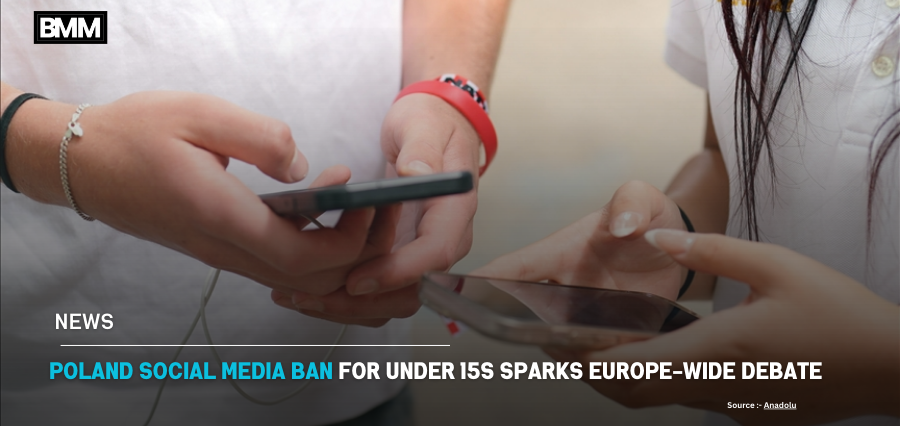
The Poland Social Media Ban proposal has ignited debate across Europe after Education Minister Barbara Nowacka announced plans to introduce legislation prohibiting children under 15 from accessing social media platforms. In an interview with Bloomberg News, Nowacka said the draft outline would be presented by the ruling Civic Coalition, with the law potentially coming into force by early 2027.
The proposed framework would make social media companies directly responsible for checking the ages of their users. Platforms that don’t stop kids from getting in could be fined, but the exact amount of the fines is still being worked out. The Poland Social Media Ban would be one of the strictest ways to protect young people online in the European Union.
Mental Health and Educational Concerns
Nowacka backed the proposed law by talking about worries about how the law would affect children’s mental health and cognitive development. She says that young people are getting less smart, and she thinks this is partly because they spend too much time on digital devices.
The Poland Social Media Ban is positioned as a preventive step to counter what policymakers view as addictive platform designs and harmful online environments. Increasing evidence across Europe suggests that prolonged social media use among minors may contribute to anxiety, reduced attention spans, and exposure to harmful content.
The Polish government says that letting families handle most of the age verification is no longer enough. Instead, tech companies would have to put in place strong systems to keep kids under 15 from getting in.
Growing European Momentum
The Poland Social Media Ban is not emerging in isolation. Several European governments are exploring similar restrictions amid mounting public pressure. Countries such as Denmark, Greece, France, and Spain have examined regulatory frameworks aimed at limiting minors’ access to social media platforms.
The UK government said in January that it was thinking about putting in place stricter rules to make the internet safer for kids. In December, Australia passed similar laws, setting a precedent that European policymakers are keeping a close eye on.
The larger trend in Europe shows that people are becoming more doubtful about letting tech companies regulate themselves. Lawmakers say that voluntary safeguards haven’t done enough to keep kids safe from algorithm-driven content loops, cyberbullying, or other inappropriate material.
Potential Clash with U.S. Tech Giants
If enacted, the Poland Social Media Ban could create friction between Warsaw and major U.S. technology companies. Platforms operated by Meta and X, owned by Elon Musk, may be required to overhaul age verification systems or face penalties.
Some tech companies have fought against strict national rules in the past, especially ones that require full identity verification. After Australia put restrictions in place last year, some companies said that strict bans might be hard to enforce and could raise privacy concerns if platforms have to collect more personal data to verify a user’s age.
The Poland Social Media Ban is at the crossroads of protecting children, holding businesses accountable, and protecting people’s digital privacy rights. To avoid legal problems, implementation would probably need to be in line with European Union data protection standards.
Enforcement Challenges and Timeline
The political message is clear, but there are still many important practical questions. Age verification systems can include things like entering your age yourself, using biometrics, or linking to a digital ID. Each method presents its own legal and ethical complexities.
Officials have said that the draft law will go into more detail about how to enforce it and what the penalties will be. If the law is passed, it could go into effect in early 2027, giving platforms time to make changes to their systems.
The Poland Social Media Ban also raises broader societal questions about digital literacy and parental responsibility. Critics argue that outright bans may push minors toward unregulated or underground digital spaces, while supporters contend that firm regulation is necessary to reset norms around youth screen time.
A Defining Policy Moment
As debates intensify across Europe, Poland’s proposal could become a landmark case in digital governance. The Poland Social Media Ban reflects a growing willingness among governments to intervene directly in platform operations in the name of child protection.
Whether it becomes a model for other nations or triggers legal and corporate resistance, the legislation signals a decisive shift in how European states are approaching the digital lives of children.
Also Read :- Macron Nuclear Doctrine Update Signals Limits of European Deterrence Ambitions