
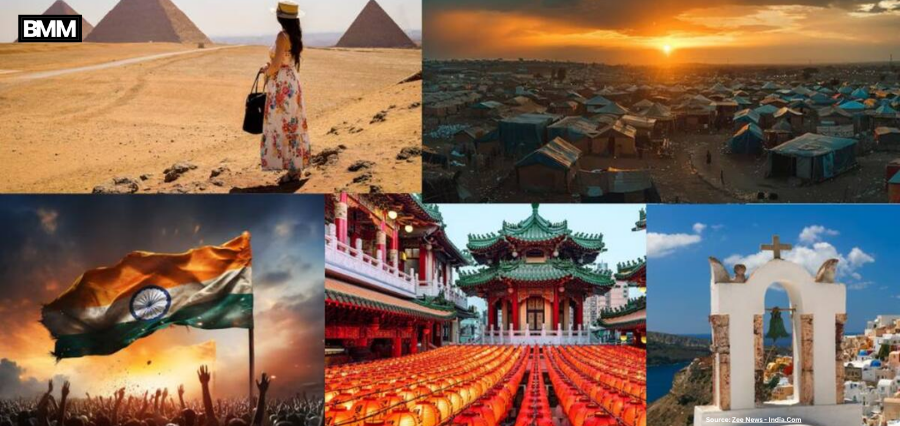
Nations rise, evolve, and transform over centuries, but only a few can claim roots that stretch back to the earliest chapters of human civilization. The idea of the oldest country in the world often sparks debate because history is shaped by kingdoms, empires, and changing borders. Some countries have preserved their cultural identity for thousands of years, while others have redefined themselves through time. Understanding the oldest country in the world means looking beyond modern political boundaries and exploring civilizations that have maintained continuity across generations.
Understanding the Oldest Country in the World
Historians tend to refer to uninterrupted civilization, cultural identity, and constant rule when it comes to the discussion of the oldest country in the world. It is not merely about ancient ruins or early settlements, but it is about whether a nation has managed to maintain its identity in the course of centuries of transformation.
These discussions usually involve countries such as Egypt, Iran, China, India, Japan and Greece due to their rich historical backgrounds. Both have made immense contributions to human development in the field of philosophy, science, government, art and culture.
Why Historical Continuity Matters?
An ancient country can be a country whose political and cultural identity is no more and it becomes difficult to categorize such a country as one of the most ancient countries. Continuity is important as it links the past and present.
To give an example, Egypt bears the tradition of the Pharaohs and China boasts one of the most continuous civilizations in the history of mankind. That is why the discussions connected with the issue of the oldest country in the world are often complicated.
1. Egypt and the Legacy of Ancient Civilization
Egypt is often regarded as one of the most powerful competitors of being the oldest country in the world. The ancient Egyptian civilization started circa 3100 BCE when the Upper and Lower Egypt were united under King Narmer.
The nation was renowned because of its pyramids, the civilization of the Nile, and exceptional progress in the areas of architecture, medicine, and administration. In Egypt, the cultural identity is so strong that it has maintained it despite the invasion and political transformations that occurred in Egypt.
The Enduring Influence of Egypt
Even today, Egypt remains a symbol of one of humanity’s earliest organized societies. Its influence on writing systems, mathematics, and religion continues to shape historical studies worldwide.
2. China and Its Continuous Civilization
The other major competitor in the quest to determine the oldest country in the world is China. Its history dates back over 4,000 years, and the Xia dynasty, the Shang dynasty, and the Zhou dynasty established the Chinese civilization.
The power of China is in its continuity. Through the changes of dynasties, invasions, and revolutions, its language, philosophy, and cultural identity were closely related throughout the centuries.
A Civilization That Never Lost Its Identity
Traditional governance systems, the Confucian philosophy and culture have been the key elements in the Chinese society thousands of years ago. This continuous legacy causes China to be one of the most admirable instances of historical continuity.
3. India and One of the World’s Oldest Civilizations
The Indus Valley Civilization is considered one of the oldest and makes India one of the oldest countries as well, dating back to circa 3300 BCE. Early cities such as Harappa and Mohenjo-daro demonstrate sophisticated urban planning and trade and social organization.
The cultural continuation of India with Hindu philosophy, the literature in Sanskrit and spiritual traditions is such a strong example when speaking about the oldest country in the world.
Spiritual and Cultural Continuity
The ancient writings of India like the Vedas and Upanishads, are relevant to the modern world. It has preserved its traditions even during empires, colonialism, and independence, which have preserved a close relationship between ancient and modern India.
4. Japan and the World’s Oldest Monarchy
The Japanese people are unique due to their continuous imperial line. Traditionally, Emperor Jimmu established Japan in 660 BCE, and it is the birthplace of the oldest hereditary monarchy in the world.
Even though the exact dates of Japan are the subject of debate among modern historians, its consistent imperial institution makes it a special part of global history.
Stability Through Tradition
The modernization and global influence have not diminished the identity of Japan. It is one of the oldest operating nations today, its cultural continuity, and political preservation.
Conclusion
The issue of which country in the world is the oldest one is not a simple question which could be answered in a single way. Egypt provides insight into timeless state building, China with an unparalleled continuity, India with spiritual perseverance, Japan with traditional royalty, and Greece with an intellectual legacy.
Both countries have a different story of survival and identity. It is better to find the answers to more than one question and to value how these nations have brought human civilization to the present place over thousands of years. Their history teaches us that the foundations of the modern world were laid a long time before our times.
Also Read :- Exploring Global Peace: Which Is the Safest Country in the World in 2026