
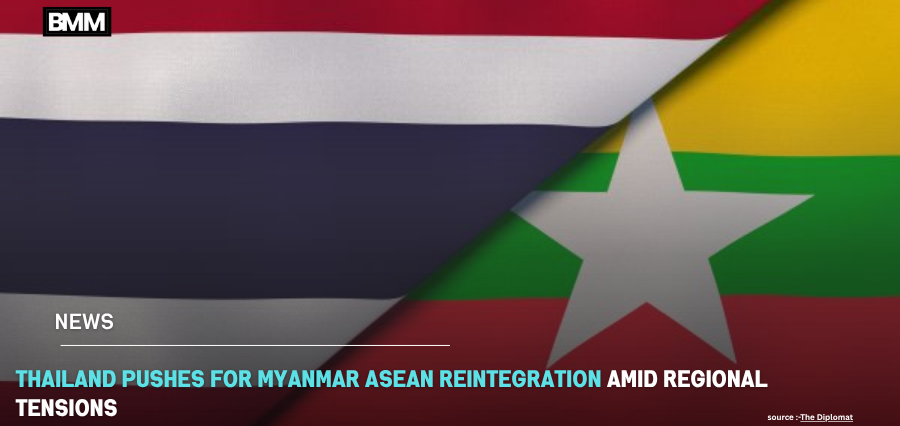
The issue of Myanmar ASEAN reintegration has once again come into focus as Thailand signals its intention to help Myanmar return to full participation within the regional bloc. After five years of diplomatic isolation following the 2021 military coup, Myanmar is seeking to rebuild its relationship with the Association of Southeast Asian Nations (ASEAN), with Thailand stepping forward as a key supporter.
Thai Foreign Minister Sihasak Phuangketkeow announced ahead of his meeting with Myanmar’s newly appointed President Min Aung Hlaing that Bangkok wants to play a leading role in facilitating Myanmar’s path back into ASEAN’s core diplomatic framework.
Thailand’s Support for Myanmar’s Return
Thailand has made it clear that it supports Myanmar ASEAN reintegration, but with important conditions attached. Foreign Minister Sihasak stated that while Thailand is ready to help Myanmar re-engage with ASEAN, the country must first respond to the concerns repeatedly raised by the bloc.
He emphasized that Myanmar must show genuine progress toward peace, stability, and political reconciliation. ASEAN has consistently demanded steps toward ending violence and beginning meaningful dialogue among all parties involved in the conflict.
Thailand believes that rebuilding diplomatic trust will require gradual engagement rather than immediate full restoration of Myanmar’s previous standing.
Background of Myanmar’s Political Crisis
Myanmar’s exclusion from top ASEAN summits began after the February 2021 military coup led by former army chief Min Aung Hlaing. The coup ended a decade of limited democratic transition and removed the elected government led by Nobel Peace Prize laureate Aung San Suu Kyi.
The military takeover triggered widespread protests, armed resistance, and a prolonged civil war that continues to destabilize the country. In response, ASEAN introduced a peace plan known as the Five-Point Consensus, which called for an immediate cessation of violence and dialogue among all sides.
However, Myanmar’s military leadership has faced criticism for failing to meaningfully implement these commitments, making Myanmar ASEAN reintegration a difficult diplomatic challenge for the bloc.
Min Aung Hlaing’s New Presidential Role
On April 3, Myanmar parliament elected Min Aung Hlaing as president in an election where the military-oriented party prevailed. This election was massively criticized owing to the lack of any viable opposition and dismissed by various western governments as not being legitimate.
The appointment enhanced the political system of Myanmar and gave more power to Min Aung Hlaing even when the international community was skeptical about it. At his inauguration speech, he said that his priorities would be peace and national reconciliation and that he wanted to normalize the international relations especially with ASEAN.
The attempts of his government to strengthen the relations took the center stage of debates on Myanmar ASEAN reintegration.
ASEAN’s Continuing Concerns
Myanmar crisis is one of the most challenging internal issues of ASEAN. A number of the member states have openly criticized the military government in terms of providing minimal cooperation as they carry on with military activities against opposition groups.
Even though Myanmar is a member of ASEAN, the Myanmar government has never attended key meetings with top officials but rather with the lower officials. The 11-member bloc has failed to officially recognize the new military supported government too.
The leaders of ASEAN are to reconsider the matter in their next summit, in the Philippines, next month, and the further involvement of Myanmar into the group may be one of the central questions.
Recent Amnesty and Humanitarian Expectations
Thailand was pleased to see Myanmar recently provide amnesty to thousands of prisoners, including former President Win Myint and a lighter sentence on Aung San Suu Kyi. This action was regarded as a good one, yet most observers think that more serious measures are yet to be taken.
The second aspect emphasized by Sihasak is the significance of lessening violence and increasing access to humanitarian aid. The ASEAN and international organizations are still striving to have more access to the conflict-impacted regions where humanitarian needs are dire.
These measures might enhance trust and facilitating wider Myanmar ASEAN reintegration.
Opposition Rejects Dialogue Offer
This week Min Aung Hlaing invited opposition armed groups to start peace negotiations before the end of July. Nevertheless, two large rebel forces declined the offer and it was an indication that the process of reconciliation on the national level is very challenging.
The future of Myanmar in terms of peace and acceptance by ASEAN will not be clear without large-scale involvement of resistance groups.
Conclusion
The future of Myanmar ASEAN reintegration is greatly determined by the ability of Myanmar leadership to go beyond mere token gestures and provide actual political gains. Thailand is a positive step in terms of diplomacy, but the expectations of ASEAN are high.
With regional leaders gearing up to the coming summit, how much Myanmar is willing to curb violence, permit humanitarian access and conduct an authentic dialogue will define whether Myanmar will revert to its niche in the most significant regional coalition in Southeast Asia.
Also Read : – Gwynne Shotwell Among the Highest Paid U.S. Executives With $85.8 Million in SpaceX Compensation