
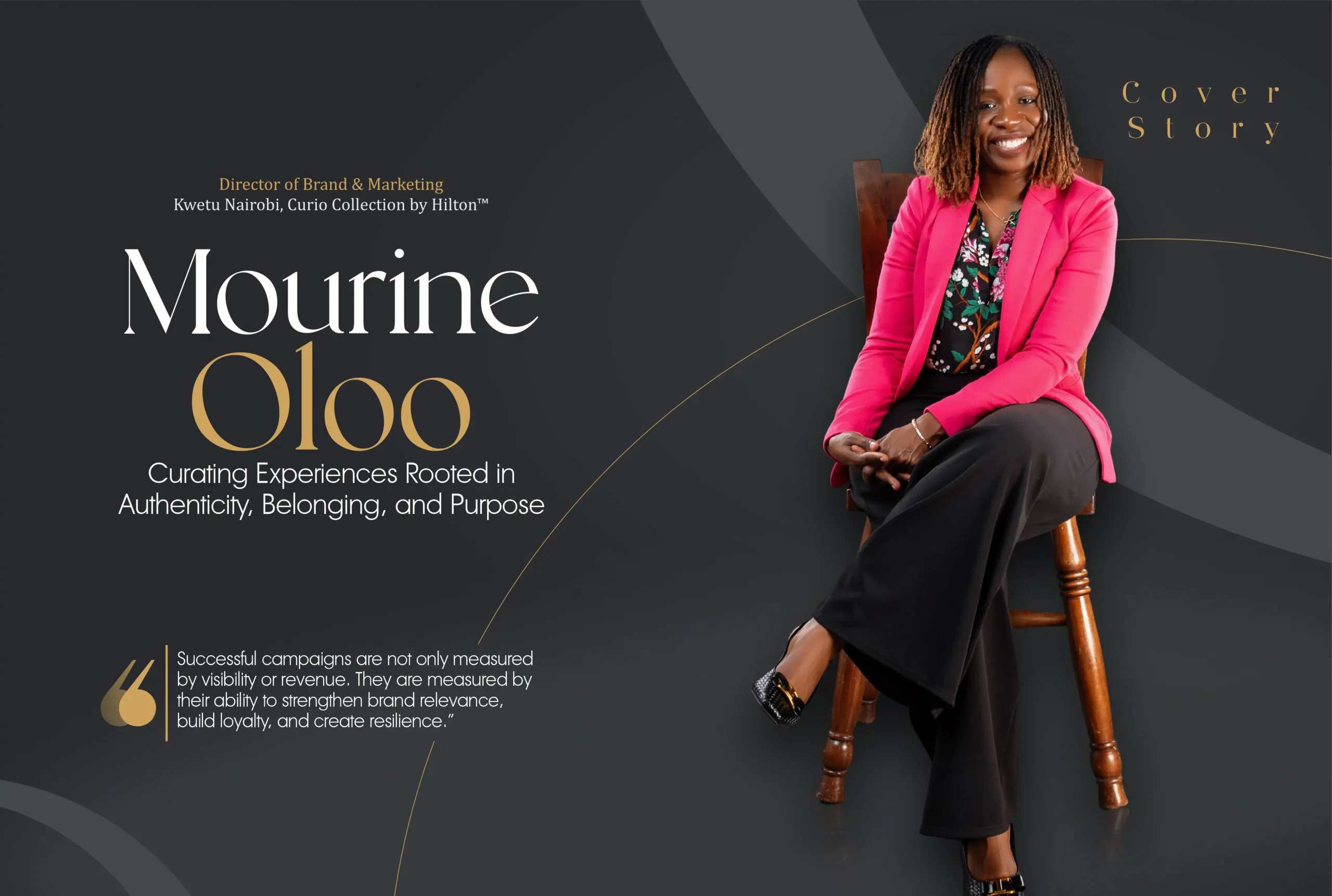
The most memorable experiences are often shaped by things that cannot be photographed. A gesture. A conversation. A sense of ease. A feeling that, for a brief moment, a place felt less like a destination and more like it was created with you in mind. Those moments may seem small, yet they are the reason people return, recommend, and remember.
Understanding how to create them has become the defining thread of Mourine Oloo’s career. As Director of Brand & Marketing at Kwetu Nairobi, Curio Collection by Hilton™, she has cultivated an approach to leadership that places people at the center of every decision. Guided by a belief that brand is ultimately an expression of culture, emotion, and human connection, she has helped position Kwetu as a hospitality experience rooted in authenticity, belonging, and purpose.
Building a Brand That Drives Business
For Mourine, marketing exists to drive business outcomes. She believes that a brand is far more than campaigns, public relations, social media, or visual identity; it is one of the most powerful commercial assets an organization possesses when it is understood, protected, and consistently delivered.
At Kwetu Nairobi, her priorities sit at the intersection of brand, sales, revenue, guest experience, and long-term market positioning. The meaning of “Kwetu,” which translates to “our home” in Swahili, serves as the foundation of the property’s identity. Under her leadership, the hotel’s brand is built around a sense of belonging, offering a lifestyle luxury experience that combines contemporary sophistication with authentic Kenyan warmth.
She views the property’s unique location beside Karura Forest as a defining advantage, enabling the hotel to create a sanctuary that balances nature, culture, business, and lifestyle. Every element, from design and dining concepts to service philosophy and guest experiences has been intentionally curated to reflect a distinctly Kenyan identity with global relevance.
Protecting that identity remains one of her most important responsibilities. Mourine ensures that every team member understands what the brand stands for and how their individual role contributes to delivering its promise. In her view, brands are not built solely by marketing departments but through every guest interaction.
Beyond brand stewardship, she focuses on creating demand that supports both immediate bookings and long-term growth. Leveraging market intelligence, guest behavior insights, analytics, and commercial data, she helps shape strategies that strengthen Kwetu’s market position while ensuring sustainable business success.
Drawing on her background in sales, Mourine approaches marketing as a revenue-enabling function. She understands the challenge of selling a product that lacks awareness and believes marketing should make sales conversations easier by ensuring target audiences already understand who the brand is, what it offers, and why it matters.
She also champions alignment across departments, believing that brand, sales, revenue, operations, and guest experience must function as one ecosystem. When that alignment is achieved, the brand becomes more than a message; it becomes a genuine competitive advantage.
Authenticity as a Luxury Advantage
Mourine believes authenticity begins with confidence in one’s identity. In an industry where many brands attempt to replicate successful international models, she sees greater value in embracing local culture and character.
At Kwetu Nairobi, the philosophy behind the name “our home” shapes both storytelling and guest experiences. Rather than creating a luxury environment that could exist anywhere in the world, the property is intentionally rooted in Nairobi, reflecting Kenyan warmth, community, and the natural beauty of its surroundings.
She believes authenticity serves different purposes for different audiences. International travelers seek discovery and a genuine connection to the destination, while local guests appreciate seeing a modern, ambitious, and globally aware reflection of contemporary Kenyan culture.
Her role is to ensure that, regardless of market segment, the essence of the brand remains unchanged. Whether speaking to corporate travelers, leisure guests, diplomats, or local diners, the expression of the brand may evolve, but its core identity remains constant.
A Journey Shaped by Service and Growth
Mourine’s path into hospitality was unexpected. As a young girl, she dreamed of becoming either a nun or a primary school teacher, professions she admired because of their focus on service and making a positive impact on people’s lives.
Her professional journey began in sales across multiple industries, including insurance. A pivotal moment arrived during her time at EatOut Kenya, where she developed campaign solutions for restaurants. During a pitch meeting at what was then Crowne Plaza Nairobi, she was offered an opportunity to join the hotel industry. Encouraged by her manager, she accepted and underwent six months of training before joining the team.
That decision transformed her career.
What immediately attracted her to hospitality was the service element. She found fulfillment in guest interactions, solving problems, negotiating, closing business, and witnessing the direct impact of exceptional service. Later, recognizing her creativity, her manager encouraged her to pursue marketing, a transition she embraced wholeheartedly.
One of the most influential experiences in her career came from working under a leader who consistently made her feel inadequate despite her efforts. Rather than discouraging her, the experience motivated her to return to school and invest in her personal development. It ultimately shaped both her commitment to continuous learning and the leadership philosophy she follows today.
Where Storytelling Meets Commercial Impact
For Mourine, storytelling and revenue generation are not separate disciplines. She believes the most effective storytelling influences behavior, while the strongest revenue strategies understand emotion.
Her approach combines creativity with analytical rigor. She enjoys studying data, booking patterns, and market analytics to guide decision-making, but she recognizes that numbers alone cannot tell the full story. Data reveals what is happening; storytelling explains why people care.
Her sales background reinforces the importance of connecting compelling narratives with measurable commercial outcomes. In her view, awareness should generate demand, demand should drive conversion, conversion should produce revenue, and revenue should support profitability and growth.
She recognizes that different audiences make purchasing decisions for different reasons. Corporate travelers may prioritize efficiency, location, loyalty benefits, and meeting facilities, while leisure travelers seek discovery, dining experiences, relaxation, and emotional connections. Understanding those motivations allows her to tailor messaging that resonates with each segment.
By mapping the guest journey carefully, Mourine ensures that the right story reaches the right audience at the right time, transforming storytelling into a powerful commercial strategy.
The Heart Behind the Hospitality
According to Mourine, Kwetu Nairobi was never intended to be just another luxury hotel. While Nairobi already offers several traditional luxury properties, Kwetu was created to introduce a lifestyle hospitality experience defined by intimacy, warmth, design, and belonging.
The hotel’s location beside Karura Forest, combined with its proximity to Nairobi’s diplomatic and business districts, offers guests a rare blend of accessibility and tranquility. Yet for Mourine, the property’s greatest differentiator lies in its people.
While guests may initially be drawn by the brand, location, or association with Hilton, she believes what they remember most is the warmth and authenticity of the team. The emotional connection created through thoughtful service leaves the most lasting impression.
For her, true luxury is not about excess, formality, or perfection. It is about care, consistency, thoughtfulness, and making guests feel genuinely valued.
Understanding the Modern Traveler
Mourine has long been fascinated by guest behavior and the factors that influence decision-making. She recognizes that today’s travelers are significantly different from those of even a few years ago.
Modern guests are more informed, intentional, and experience-driven. They seek authenticity, flexibility, convenience, meaningful engagement, and deeper connections to the destinations they visit. Their booking habits, information consumption, and reliance on reviews and recommendations have also evolved considerably.
For Mourine, segmentation goes beyond demographic categories; it is about understanding motivation. She continually explores why different guests choose different booking channels, respond to different value propositions, and prioritize different experiences.
To identify these evolving preferences, she relies on a combination of analytics, guest feedback, booking trends, market intelligence, social listening, and sales insights. These findings are then translated into targeted messaging, partnerships, campaigns, packages, and guest experiences designed to resonate with specific audiences.
Her sales experience continues to influence this work. Having experienced firsthand the challenge of introducing unfamiliar products to the market, she understands the importance of building awareness before sales conversations begin.
Ultimately, she believes segmentation allows brands to remain relevant in an increasingly competitive landscape. The hospitality brands that will succeed, she says, are those that consistently listen, adapt, and evolve alongside their guests rather than relying on yesterday’s assumptions to drive tomorrow’s demand.
Creating Memories That Inspire Loyalty
For Mourine, hospitality is ultimately about how guests feel. While guests may forget the specifics of a room or amenity, they rarely forget the emotions a place evokes.
Throughout her career, she has witnessed moments where genuine compassion, understanding, and human connection transformed guest relationships into lasting bonds. These experiences reinforced her belief that hospitality extends far beyond service standards and operational excellence. At its core, it is about humanity.
At Kwetu Nairobi, she champions a highly personalized approach to luxury. Her team invests time in understanding guests before arrival, enabling them to anticipate preferences, tailor experiences, and create moments that feel thoughtful rather than transactional. Whether it involves accommodating dietary requirements, celebrating significant milestones, curating personalized recommendations, or remembering the smallest details, every effort is made to ensure guests feel genuinely valued.
Mourine also believes that the guest experience should extend beyond the hotel itself. While iconic attractions such as Nairobi National Park and the Giraffe Centre remain important highlights, she encourages visitors to discover Nairobi through its art, coffee culture, culinary scene, nightlife, fashion, creativity, and vibrant urban energy.
Her vision is for guests to leave with stories and meaningful memories. Whether it is a peaceful walk through Karura Forest, an evening at Upepo, a hidden moment at Zabe, or a memorable interaction with a team member, these experiences create the emotional connections that foster loyalty, advocacy, and lasting affection for both the hotel and the destination.
Building Recognition Through Meaningful Storytelling
Among the initiatives Mourine is most proud of is the launch and market positioning of Kwetu Nairobi, Curio Collection by Hilton.
Introducing a new lifestyle hospitality brand into a competitive market required more than visibility. It demanded differentiation, relevance, and a compelling identity. One of the initial challenges was establishing clear brand recognition in a market where the name Kwetu bore similarities to another accommodation brand.
To address this, Mourine led an integrated brand awareness strategy that combined storytelling, strategic partnerships, media engagement, digital marketing, experiential activations, and strong internal alignment. The objective was not only to introduce the property but also to communicate its unique proposition as a lifestyle luxury destination rooted in Kenyan hospitality and a profound sense of belonging.
The strategy successfully positioned Kwetu as a recognized lifestyle hospitality brand within Nairobi’s luxury segment, attracting both local and international audiences while supporting commercial growth across leisure, corporate, and dining markets.
She is equally proud of the campaigns executed during her time at The Social House throughout the COVID period. Amid one of the most challenging chapters in hospitality history, innovative initiatives helped maintain guest engagement, preserve brand relevance, and support business continuity during unprecedented uncertainty.
These experiences reinforced her belief that successful campaigns are measured not only by visibility or revenue but by their ability to strengthen brand relevance, build loyalty, and create resilience during both prosperous and challenging times.
Understanding the Story Behind the Numbers
“Market intelligence is one of the most powerful factors in my decision process,” says Mourine.
She likes intuition, but she says that informed intuition is a lot more powerful. Guest behavior, reviews, booking patterns, competitor activity, market trends, and sales feedback all signal the direction for strategic planning.
She sees market insights as tools for finding opportunities, consumer behavior as the route to understanding motivation, and competitive intelligence as the way to improve positioning. And these things together enable us to make smarter and more effective decisions.
She emphasizes, at the same time, that data alone is never enough. Numbers tell us what is happening, but leadership needs to know why it is happening and what is the right thing to do about it.
Mourine has the knowledge but it is useless to her unless she makes use of it. Insights need to be turned into actions that improve positioning, create better guest experiences, drive profitable growth, and inform long-term strategy.
Uniting Brand, Sales, and Revenue
Mourine firmly believes that marketing, sales, and revenue management should never function independently. In her view, they are interconnected components of a single commercial engine.
Drawing from her own sales background, she understands the pressure of achieving immediate results. However, she also recognizes that businesses cannot rely solely on today’s transactions. Sustainable success requires investing in future demand, reputation, loyalty, and brand equity.
She advocates for marketers to develop a deep understanding of sales and revenue disciplines, enabling them to speak the language of business as confidently as they speak the language of creativity.
In her role, Mourine contributes across multiple areas of the commercial ecosystem. She participates in strategic planning, supports segment-specific initiatives, shapes sales narratives, develops marketing collateral, analyzes guest sentiment, monitors reputation metrics, and trains teams on effective brand positioning.
She sees herself not simply as a marketer but as a commercial strategist whose work influences demand generation, conversion, guest perception, and revenue performance. For her, sustainable growth occurs when all commercial functions align around both immediate goals and long-term ambitions.
Leading Beyond Comfort
Mourine’s team often describes her leadership as reliable, ambitious and demanding. She has those qualities because they stem from her desire to help people be the best they can be.
She believes you grow with exposure and responsibility. As such, she often puts team members to the test with work outside their current scope to develop their capabilities and confidence.
When hiring, she looks for attitude over technical skill. Skills can be taught, but qualities such as curiosity, determination and a desire to learn are much harder to develop.
One of her proudest leadership moments is a former creative design intern who struggled to adjust to her style of management. Finally, the person realized that Mourine’s demands were based on a genuine interest in her success. That former intern is now leading her own design team; a journey Mourine is so proud of.
Many of the professionals she mentored have gone on to thrive in various areas of hospitality including people who were never directly part of her department but sought guidance and development under her leadership.
Many great mentors, including two women who were business owners and whose influence still shapes her leadership style, have contributed to her own development. Their willingness to challenge her, to support her, to empower her taught her that leadership is not about authority or control. It’s about creating opportunities, empowering people with responsibility, and helping them to see what they perhaps don’t yet see in themselves.
Today she works to create a space where people feel challenged, supported, and empowered. She wants everyone she works with to come out stronger, more confident, and better prepared for future success.
Leadership, for Mourine, is not about being liked every day. It’s about being a positive force in other people’s growth and development.
The Rise of a New African Luxury Narrative
Mourine believes that Africa’s luxury hospitality sector is entering one of its most exciting evolutionary periods.
The continent has long been known for wildlife and safari experiences but she sees a growing appetite globally for Africa’s cities, cuisine, art, music, fashion, design, culture and people. Travelers want deeper, more diverse experiences that reflect the creativity and sophistication of the continent.
She is most excited about the increasing confidence of African hospitality brands. Instead, many are embracing their own identities and creating lifestyle and boutique experiences that are true to local cultures and communities, rather than just replicating international models.
For Kwetu Nairobi, she wants to further build on the property’s contribution to Nairobi’s reputation as one of Africa’s leading luxury destinations. She wants the hotel to be known for its design, location and dining experiences but also for its warmth, culture and ability to forge genuine emotional connections with guests.
The Legacy of Belonging
In the future, she would like to see the Kwetu brand expanding beyond Nairobi, to other regions in Kenya and eventually across Africa, keeping the authenticity, sense of belonging and service culture which is the brand’s identity.
Professionally, Mourine also sees herself continuing to work at the intersection of brand, sales, revenue, guest experience, and commercial strategy. She has a passion developed over her career to link these disciplines, believing that sustainable growth is born from organizations that truly understand their guests, and align commercial decisions to that understanding.
What drives her the most isn’t about getting bigger titles or positions. It’s having an impact. Her passion is building brands that drive business performance, developing people to exceed their own expectations, and helping organizations build cultures that deeply resonate with guests and employees.
She admits she has struggled to take credit for her achievements at times, but is increasingly recognising the importance of accepting the value she brings. She gets a kick out of watching the potential of a project turn into success, more than for personal recognition.
Reflecting back on her own journey, she often says that the little girl who wanted to be a nun or teacher is still very much alive inside of her. A desire to serve, educate, and positively impact lives continues to drive her purpose and leadership philosophy.
At the end of the day, brand is culture for Mourine, and culture begins with people. If there’s one legacy she hopes to leave behind, it’s that she’s helped others be more than they ever thought they could be.
“Successful campaigns are not only measured by visibility or revenue. They are measured by their ability to strengthen brand relevance, build loyalty, and create resilience.”
“I believe intuition is important, but informed intuition is stronger.”
“Marketing, sales, and revenue should never operate as separate islands. They are different parts of the same commercial engine.”
Also Read: Business Minds Media for more information.