Mitchell John Vanderydt: Connecting Discovery, Capital, and the Next Generation of Mining
Mining discoveries often begin long before drills reach the ground. They begin with capital, conviction, and the ability to persuade investors that an unknown company with an unproven deposit may eventually become the next producing mine. Mitchell John Vanderydt has dedicated much of his career to this overlooked side of the mining industry.
As the Founder of Host Rock Capital, he combines market research, valuation analysis, investment advisory, and industry advocacy to help junior mining companies gain visibility and access to capital. His work spans hundreds of mining companies, multiple commodities, and global markets, all driven by a belief that today’s small explorers are responsible for supplying the resources required by future generations.
Mapping Value Beneath the Surface
The decision of Mitchell John (or his Christian name John for short) to establish Host Rock Capital emerged from years of experience spanning engineering, investment research, corporate leadership, and mining finance. Having played a central role in the formation of Northgold AB in 2021, he helped guide the company from its early stages through a highly successful initial public offering on Sweden’s Nasdaq First North Growth Market in February 2022. The IPO became one of the top-performing mining listings globally that year and ranked among the strongest IPOs across the Nordic region.
During his tenure, John contributed to raising approximately five million euros and supported the advancement of Northgold’s flagship Kopsa gold-copper project through extensive drilling programs that significantly expanded the project’s size and resource potential. He also facilitated strategic transactions that strengthened the company’s asset portfolio and positioned it for future growth.
While John wore many hats at Northgold and played an integral role in its success, he remains clear that the company’s progress was made possible through the support, expertise, and contributions of its founding shareholders. Among them were project vendor and Finnish geological consultancy Magnus Minerals, led by Carl and Henrik Löfberg, and Hong Kong-based private equity group Starboard Global, led by Dr. Robert Wrixon.
John also acknowledges the valuable support of several founding and early Northgold shareholders in Finland. These included senior geologist Timo Mäki, who was credited with a major discovery at First Quantum Minerals’ Pyhäsalmi mine in Central Finland in 2006. The discovery contributed to extending the mine’s operational life and led to the development of a new shaft, which was named the “Timo” shaft in recognition of his contribution. Kati Oy, a prominent drilling contractor in Central Finland, also provided important support during Northgold’s early journey.
John further recognises his longtime friend, Adriana Boy Mena, with whom he spent considerable time during his years in Europe. Her encouragement and support contributed meaningfully to his efforts at Northgold, while her own entrepreneurial journey became a source of inspiration. After independently relocating from Canada to Europe, Adriana established a successful sports club in Barcelona approximately a decade earlier, demonstrating the determination required to build something meaningful in a new environment.
Her contribution extended beyond John’s time at Northgold. Adriana later assisted him in establishing Host Rock Capital and continues to support the company today. For John, these individuals and organisations represent an important part of the journey, reflecting how lasting business success is rarely the result of one person’s efforts but is strengthened by shared expertise, trusted relationships, and collective commitment.
Despite these successes, John recognized a broader challenge facing junior mining companies worldwide. Many promising exploration and development companies struggled to communicate their value, attract investor attention, and secure the capital required to advance their projects. He saw an opportunity to apply his experience across a wider segment of the mining industry rather than focusing on a single company.
His background as a research analyst covering mining equities had already provided him with extensive experience evaluating numerous companies and tracking market trends. During his leadership role in Scandinavia, he developed a detailed valuation model to compare mining companies based on resource size, market capitalization, and project economics. Over time, this analytical framework evolved into a much larger initiative.
Following his departure from the CEO position, John founded Host Rock Capital with the objective of improving transparency and visibility within the junior mining sector. He expanded his proprietary database to include more than 500 publicly traded mining companies spanning nine major metals, including gold, silver, copper, nickel, cobalt, lithium, uranium, platinum, and palladium.
The database categorized companies according to stage of advancement and measured valuations based on resource size, market capitalization, and project economics. For development-stage companies, additional analysis incorporated economic studies, including net present value calculations and project sensitivities to changing commodity prices.
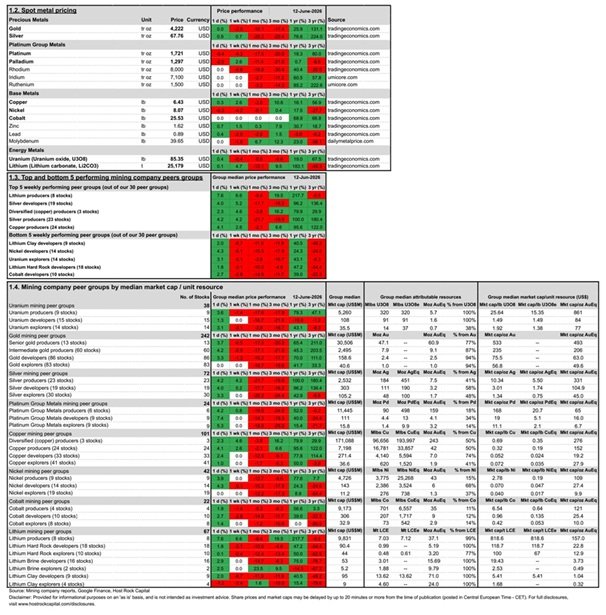
This extensive research ultimately became the Metals Mining Peer Table, a comprehensive benchmarking platform designed to provide investors with valuable insights into mining company valuations and sector trends. The platform tracks metal prices, company performance, valuation multiples, peer group rankings, and market trends across multiple commodities and stages of advancement.
Through Host Rock Capital, John continues to address one of the industry’s most significant challenges: helping quality mining companies communicate their value more effectively while providing investors with transparent, data-driven tools to make informed decisions. His work reflects a commitment to improving market understanding, increasing visibility for emerging companies, and strengthening the connection between mining projects and the capital required to develop them.
Figure 1: Except from Host Rock Capital’s Metals Mining Peer Table, showing (a) metal pricing, (b) top and bottom weekly performing peer groups, and (c) average peer group valuations by market cap per unit resource, for the platform’s 30 groups.
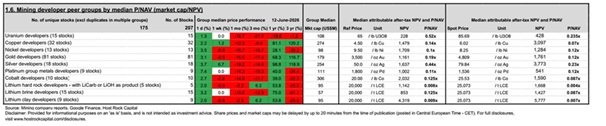
Figure 2: Except from Metals Mining Peer Table, showing average developer group valuations by price-to-net-asset-value (P/NAV), for the platform’s10 developer groups.
Building an Ecosystem Beyond Capital
Host Rock Capital has grown well beyond a traditional advisory firm under Mitchell John. Beyond corporate finance mandates, the firm is engaged in private placements with a select group of co-investors, assists mining companies with property transactions, and provides strategic consulting services across the precious metals and critical minerals sectors.
The firm’s growing digital footprint has been a major driver of its growth, especially its weekly and monthly Rundown newsletters with insights from the Metals Mining Peer Table. The publication is circulated primarily via professional networks on LinkedIn and reaches investors, mining executives, bankers, engineers, geoscientists, and industry professionals across North America and international markets.
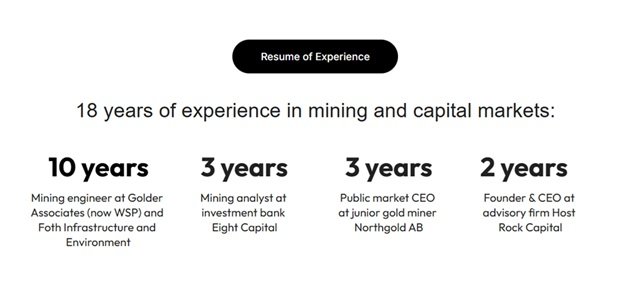
Mr. Vanderydt has built a community that extends far beyond traditional mining finance, tapping into relationships he has built over his eighteen-year professional career. The network is a hub for knowledge sharing, market intelligence and industry collaboration.
Instead of competing with brokers and dealers, Mitchell has carved out a complementary role for Host Rock Capital in the mining ecosystem. The firm publishes some of its Metals Mining Peer Table publicly through its newsletters and social media, offering average valuation metrics and broader market insights but reserving company-specific data for premium subscribers.
The goal is to increase transparency in the market, allow informed decision making and increase visibility in the junior mining sector. Host Rock Capital aims to increase transaction activity, improve deal flow and enhance capital allocation across the industry by offering more accessible peer group valuation information, as he believes deal flow in the sector is relative to the quantity and quality of information available to investors and junior mining companies
John sees the health of the precious metals and critical minerals sectors as central to the future of industrial development, technological progress, and economic growth at its core. He believes that access to reliable supplies of raw materials remains vital to underpinning global population growth, infrastructure development, and long-term economic sustainability.
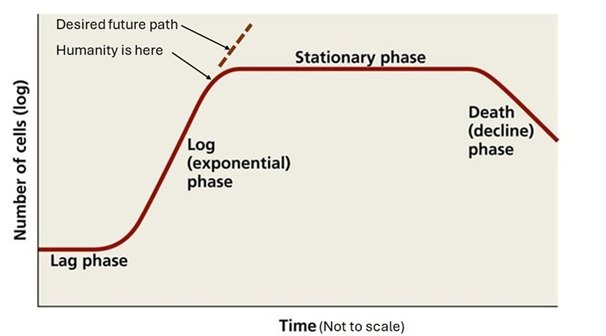
This position is partly based on his scientific background. As an undergraduate, he studied the growth patterns of bacteria and how living systems ultimately hit limitations when resources run out. John often draws analogies between these biological principles and the global economy, where agricultural products, energy resources, and critical minerals are considered fundamental inputs that sustain human development.
In this perspective, the discovery of new sources of essential resources and the support of companies developing them assume ever greater importance. Through his independent advisory firm Host Rock Capital, John continues to be a strong advocate for investment, innovation, and responsible resource development as being critical factors in economic growth, industrial development, and future prosperity.
One example of this expanding advisory role is John’s involvement with the Sierra Mojada silver-zinc project in Mexico. Engaged by the project owner as a sub-consultant through Covorti Consulting, John contributes his experience in mining finance, market analysis, and strategic project positioning to an asset distinguished by both its scale and advanced stage of development. The engagement emerged through a professional connection formed at a mining conference in London, reflecting the international network that continues to shape Host Rock Capital’s work.
Sierra Mojada is particularly notable as a large, silver-dominant project at a time when development-stage assets of comparable scale are relatively scarce. With few major silver projects approaching construction readiness globally, projects capable of contributing meaningful future supply are becoming increasingly important. This is especially relevant as demand continues to grow across both traditional investment markets, including coins and bars, and industrial applications such as solar energy technologies.
For John, the project represents the intersection at the centre of his work: connecting technically promising mineral assets with the market understanding, strategic direction, and capital relationships required to move them closer to production.
Figure 3: Classic microbial growth curve applied to the growth of the global human population
Source: Pearson Education Inc., Host Rock Capital
Betting on the Next Metals Supercycle
John believes both precious metals and energy transition metals are equally important to underpin future industrial growth, technology advancement and global economic development. “Critical minerals and energy transition metals are the essential raw materials needed to build modern infrastructure and power the energy transition and precious metals remain the foundation of the financial system,” he said.
Both sectors have had years of underinvestment, he says, creating supply shortages that are worsening with rising demand. This supply/demand imbalance, along with growing permitting challenges, may set the stage for a long-term bull market across the mining sector.
John has dedicated much of his career to preparing for what he believes could be the next major upcycle, having closely studied previous commodity cycles, in particular the metals boom of the early 2010s. His academic research into the history and cyclical nature of metals markets only solidified his belief that both precious and critical metals will be necessary for the future growth of the economy.
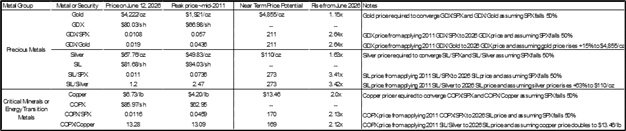
Looking forward, John expects mining stocks to outperform broader markets over the next few years. In particular, he says, mining companies active in silver, gold and copper are profiting from higher commodity prices and a greater investment in resource development. Ultimately, the pace of growth will be determined by market conditions and monetary policy, but the long-term outlook for both precious metals and energy transition metals remains very positive, he added.
Figure 4: Summary of gold, silver, and copper metal and mining stock prices and forecasts
Source: tradingview.com, Host Rock Capital
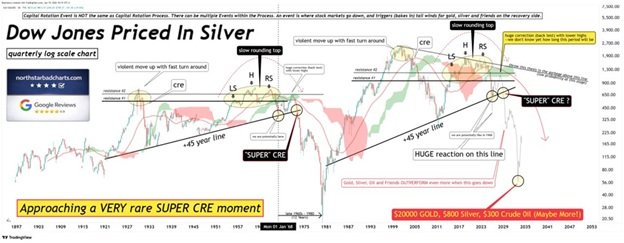
Figure 5: Chart and technical analysis of Dow Jones priced in silver, showing the trend move along a 45 year support line which it looks poised to breakdown from in the near-mid term
Source: northstarbadcharts.com
John says the world´s current situation of fiat currency debasement (or loss of purchasing power) and sharply rising demand for precious metals is nothing new, as he pointed out in an article titled “The History of Gold as a Currency” which he recently resurrected from a strategy field study he did with a group of students back in 2016 with former senior gold producer Goldcorp, as part of his MBA studies at the Schulich School of Business in Toronto—as preparation for his career in corporate leadership in the gold mining sector.
As John points out, we have been here before many times throughout history, including during the fall of the Roman Empire during the 4th century, when a shortage of precious metals had caused early medieval kingdoms to move away from the gold and silver (species) coins standard and rely on copper coins to conduct smaller-scale transactions. During that time, gold had been hoarded by the elite, namely kings and the Catholic ChurchAnd in the high to late middle ages (1000-1500 AD), following the discovery of the silver-lead-copper Rammelsberg deposit in Germany in 938 that was mined for more than 1,000 years—a silver rush ensued which increased the availability of silver coins and caused an economic revolution leading to the construction of cities, castles, ports, canals, and palaces. And as competing European nations began to prosper, the search for GOLD accelerated and its mining increased substantially with the first sizeable gold strike in Slovakia in 1320—followed by discoveries in Germany, France, Italy, and Britain, and resulting in a gold rush that caused the EMANCIPATION OF THE MINER whose services were in demand across Europe.
When Capital Meets Complexity
John believes that one of the greatest challenges facing junior mining companies is securing capital and gaining market visibility. Many emerging exploration and development companies struggle to communicate their value propositions effectively, limiting their ability to attract investment and advance their projects.
He also points to market pressures that can negatively affect investor confidence and company valuations. In his view, successful capital markets are built on long-term value creation, collaboration, and economic growth rather than short-term speculation.
Beyond financing challenges, permitting has become increasingly complex across several jurisdictions. Environmental assessments, community consultations, and regulatory requirements often extend project timelines significantly. While John strongly supports responsible environmental stewardship and community engagement, he believes that regulatory processes can become more efficient while maintaining high environmental standards and community protections.
The Metals Shaping Tomorrow
John sees significant opportunities across both precious and critical minerals. He identifies silver and platinum group metals, including platinum and palladium, as particularly compelling due to their dual roles as both monetary assets and industrial materials.
Silver continues to benefit from growing demand in electronics and renewable energy technologies, while platinum and palladium remain essential for automotive applications. He also highlights gold as an important asset during periods of currency depreciation, copper as a critical material for electrification and energy infrastructure, and uranium as a long-term beneficiary of expanding nuclear energy programs.
In his view, years of underinvestment and supply constraints across these sectors create favorable long-term fundamentals for investors.
Mining with Responsibility
John believes modern mining has made substantial progress in environmental protection and social responsibility. Advances in engineering, water management systems, environmental safeguards, and community engagement have significantly improved industry practices.
He emphasizes that mining plays an important role in sustainability by supplying the metals required for infrastructure, clean energy technologies, and industrial development. At the same time, mining projects create employment opportunities and contribute to local economies.
While historical mining practices have contributed to negative perceptions of the industry, John believes today’s mining companies are increasingly focused on balancing resource development with environmental stewardship and community interests.
Looking Beyond the Resource Estimate
According to John, investors evaluating junior mining companies should look beyond resource size and grade alone. Project economics, development costs, permitting prospects, jurisdictional risks, and environmental considerations all play critical roles in determining long-term value.
He also stresses the importance of management teams. Companies led by experienced leaders with proven track records of resource growth, project advancement, and mine development often possess stronger long-term potential. A clear strategic vision and a realistic development plan can significantly increase a company’s ability to attract both investors and potential acquisition interest from larger mining companies.
From Discovery to Production
A mineral discovery is rarely transformed into an operating mine through a single breakthrough. It progresses through a long sequence of exploration, discovery, resource definition, economic assessment, permitting, financing, construction, and production. Each stage introduces different technical and financial risks, while requiring increasing amounts of capital to advance.
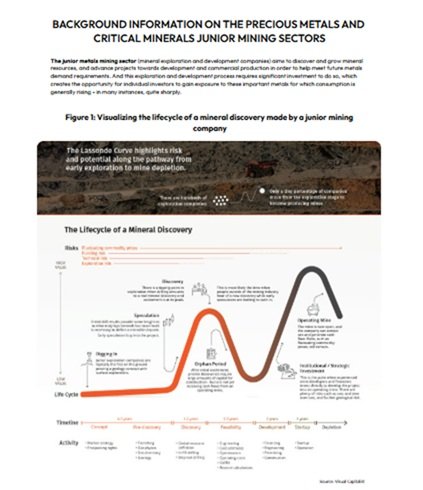
John often views this journey through the Lassonde Curve, a model that illustrates how the market value of a junior mining company may change throughout the lifecycle of a mineral discovery. Early exploration can generate excitement as geological potential begins to emerge, particularly when drilling produces a significant discovery. However, the years that follow can be more difficult. As companies undertake engineering studies, environmental assessments, permitting, financing, and project development, investor attention may decline even as the project itself continues to mature.
This period between discovery and production is sometimes described as the development gap. Although much of the early excitement may have faded, companies must continue raising capital and completing the technical work required to transform a mineral resource into a viable mine. For investors, understanding where a company sits along this curve can provide valuable context for evaluating its risks, capital requirements, and long-term potential.
The model also illustrates why junior mining companies require sustained access to investment. Discoveries alone cannot meet future demand for metals. They must be evaluated, permitted, financed, constructed, and eventually brought into production. Supporting companies throughout this journey is therefore essential to maintaining the long-term supply of the materials required by modern economies.
Figure: The Lassonde Curve illustrating the lifecycle of a mineral discovery, from early exploration and discovery through development, production, and eventual depletion. Source: Visual Capitalist
The Hidden Importance of Junior Miners
John believes one of the greatest misconceptions about the mining industry is the underappreciation of the importance of junior mining companies. In his view, junior miners serve as the research and development arm of the global mining sector, discovering and advancing the deposits that eventually become future producing mines.
He argues that many world-class deposits began as small exploration companies before attracting larger producers. Successful examples within the gold and uranium sectors demonstrate that today’s major mining assets often originate from relatively small companies with promising discoveries.
For John, supporting junior mining companies is essential not only for the industry’s future but also for maintaining the supply of critical resources required for economic growth and industrial development.
Technology Rewriting the Mining Industry
John sees technological innovation as one of the most transformative forces affecting mining and investment today. The use of drone-based geophysics, artificial intelligence, and advanced data analysis is helping reduce exploration costs while improving targeting accuracy.
Artificial intelligence is also lowering costs across engineering, consulting, accounting, and corporate services. Mining companies increasingly use digital tools to improve management processes, streamline communications, and enhance operational efficiency.
Within investment markets, AI-driven trading and analytical systems are becoming increasingly influential. These technologies can process market information rapidly, making accurate, transparent, and clearly communicated corporate disclosures more important than ever before.
Geography as an Investment Variable
John believes geopolitical factors continue to play a major role in mining investment decisions. Established mining jurisdictions such as North America, Australia, and parts of Northern Europe generally offer greater regulatory certainty, experienced workforces, and stronger legal frameworks.
Emerging jurisdictions often provide higher growth potential but can also introduce additional risks related to regulatory changes, taxation, permitting, political stability, and environmental governance.
For investors, understanding jurisdictional risk has become just as important as understanding geology or project economics.
Building Wealth Through Resources
Education and investor coaching remain central to John’s philosophy. He generally encourages new investors to begin with lower-risk exposure through physical metals or exchange-traded funds before gradually expanding into established producers.
As investors gain experience, they may consider mid-tier producers, growth companies, and eventually selective exposure to junior mining companies. John acknowledges that junior mining investments carry substantial risk but also offer significant upside potential for informed and diversified investors.
He personally finds value in researching smaller companies and identifying emerging opportunities, viewing junior mining not only as an investment opportunity but also as a way of supporting an industry that supplies the raw materials needed by future generations.
For experienced investors, John believes that understanding corporate strategy is essential. Management quality, operational execution, capital allocation, and long-term vision often separate industry leaders from their peers. His own research and analytical frameworks have focused heavily on identifying these characteristics and understanding how they contribute to long-term investment success.
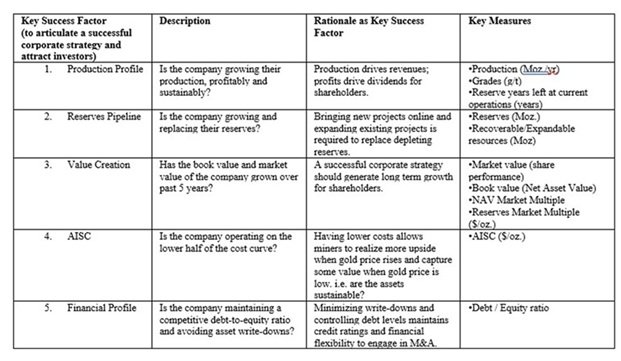
Figure 6: Key success factors for senior producers
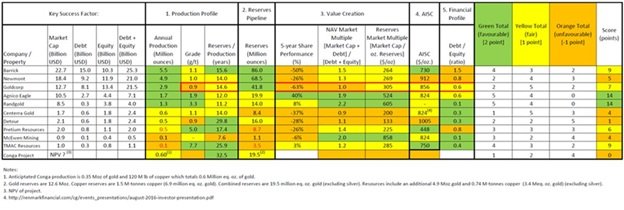
Figure 7: Investment Criteria Model to Evaluate Mining Companies and Potential Acquisition Targets according to the Five (5) Key Success Factors
For more detail on strategies of senior mining producers, see my article titled “The Corporate Strategy of a Senior Gold Producer”.
Article: The Corporate Strategy of a Senior Gold Producer
I am recycling this 2016 research paper that I wrote for a strategy field study (group project) that I did with Goldcorp (later acquired by Newmont) under then CEO David Garofalo, as part of my mining-specialized MBA at the Schulich School of Business at York University in Toronto—and as preparation for my career as a corporate leader in the gold mining sector. This paper and culminating strategy field study had followed and been informed by my prior MBA specialization courses on mining strategy & economics, led by Mr. Richard Ross (former CEO of senior copper producer First Quantum Minerals), and by my then eight (8) year career as a mining engineer (after completing a Bachelor of Engineering Science in Civil and Environmental Engineering at The University of Western Ontario).
A senior gold producer’s ability to meet these five (5) key success factors is typically reflected in its share price performance and market cap. Breaking down a company’s performance into these five distinct differentiators can help management better understand what is influencing it’s share price or market cap, and can act as a tool to inform their decisions. The (5) key success factors of a senior gold producer are described in Exhibit 1.
2. Gold Mining Jurisdictions
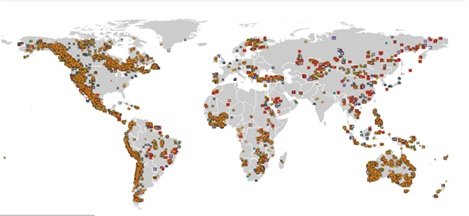
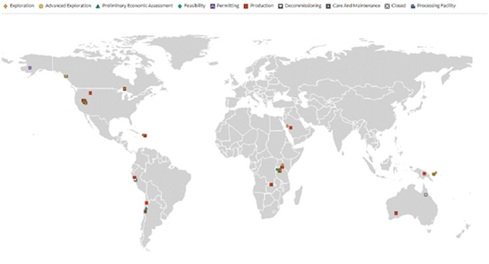
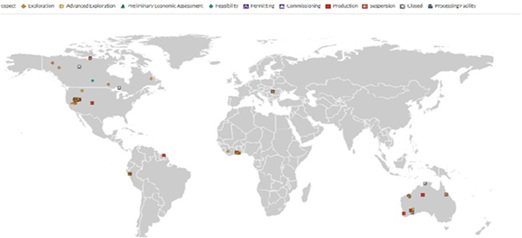
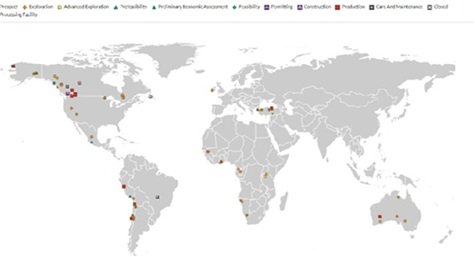
There are gold mining assets scattered across the globe, especially in the mining friendly Americas and Australia where commercial mining has become well established over the past century, and increasingly in Africa and Asia in recent decades. And some mines still operate in Europe, which has been mining for thousands of years. The low geo-political risk in the Americas and Australia is attractive to gold producers, many of which choose to operate strictly/primarily in these regions. Whereas other companies internationalize to gain some exposure to the riskier growth jurisdictions in Africa and Asia.
Internationalization of mining companies has been an industry trend for centuries. It was the exhaustion of European reserves of gold and silver in the 15th century that motivated the British, French, Spanish, and Portuguese to explore the globe in search of more gold (see prior article on history of gold as a currency: https://www.linkedin.com/pulse/history-gold-currency-mitchell-john-vanderydt-0iwle). For example, De Beers Consolidated Mines ( De Beers Group) was founded by a group of British financiers in 1888 who internationalized into Africa in search of diamonds[1], whereas Teck Resources Limited (Teck) has been mining gold and bulk metals almost strictly in Canada since the early 20th Century, with some internationalization into USA and Latin America in recent decades.
Article Exhibit 2: Global Mineral Assets
Source: InfoMine Intelligence (exported in 2015-16)
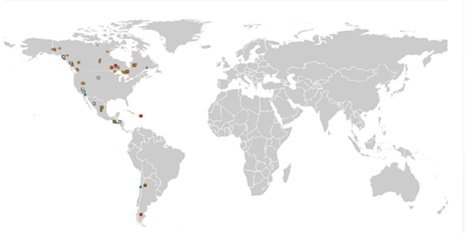
Article Exhibit 2A: Goldcorp Mineral Assets (in 2015-16)
Source: InfoMine Intelligence (exported in 2015-16)
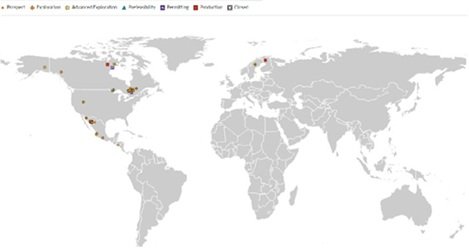
Article Exhibit 2B – Agnico Eagle Mines Limited Mineral Assets (in 2015-16)
Source: InfoMine Intelligence (exported in 2015-16)
Article Exhibit 2C – Barrick Mining Corporation Mineral Assets (in 2015-16)
Source: InfoMine Intelligence (exported in 2015-16)
Article Exhibit 2D – Newmont Corporation Mineral Assets (in 2015-16)
Source: InfoMine Intelligence (exported in 2015-16)
Source: InfoMine Intelligence (exported in 2015-16)
3. Key Core Competencies for Senior Gold Producers as part of a 3-Prong Strategy
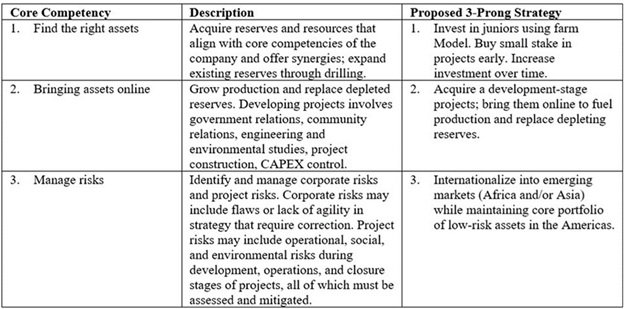
As discussed, the five (5) key success factors are criteria that must be met by senior gold producers to articulate a successful corporate strategy and attract investment. These factors must be carefully considered by senior management when executing their companies’ strategies, that generally involve three key (3) core competencies:
Find the right mineral assets
Bring mineral assets online
Manage risks
Each senior producer may approach these objectives differently. For example, different producers may structure their investments differently, or acquire juniors at different stages in the exploration/development process. And the geo-political risk tolerance of different companies may vary. Internationalization for some producers may be localized, or it may be global. But all senior producers must do these three things to some degree. A successful corporate strategy should address each of these three (3) core competencies while meeting as many of the five (5) key success factors as possible to differentiate themselves from competitors and attract investment. The three (3) key core competencies of senior gold producers are described below alongside an associated 3-prong strategy.
Article Exhibit 3: Key Core Competencies of a Senior Gold Producer and Associated 3-Prong Strategy
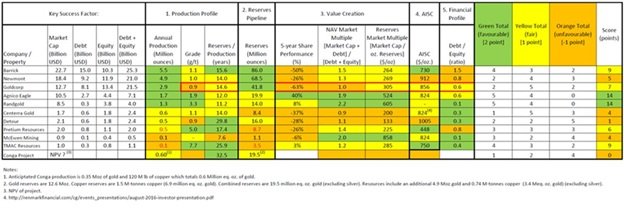
A comparative assessment of select gold miners (circa 2016) in terms of the five (5) key success factors is provided in Exhibit 4. The comparative assessment breaks these differentiators down into nine (9) measurable metrics, each corresponding to a qualitative or quantitative assessment with a score assigned to it:
“Favourable” key success measures are indicated by the colour green, reflect highly desirable & optimal characteristics, and are assigned a score of +2.
“Fair” key success measures are indicated by the colour yellow, reflect somewhat less desirable characteristics (albeit still desirable), and are assigned a score of +1.
“Unfavourable” key success measures are indicated by the colour orange, reflect undesirable characteristics, and are assigned a score of -1.
Exhibit 4: Investment Criteria Model to Evaluate Mining Companies and Potential Acquisition Targets according to the Five (5) Key Success Factors (circa 2016)
Agnico Eagle Mines Limited and Randgold were flagged as the most attractive gold producers back in 2016 (by a large margin), according to this proprietary investment criteria of mine. Agnico Eagle went on to outperform the sector by a substantial margin in the decade since 2016, and Randgold was acquired by Barrick in a transformational transaction a few years later (in 2019).
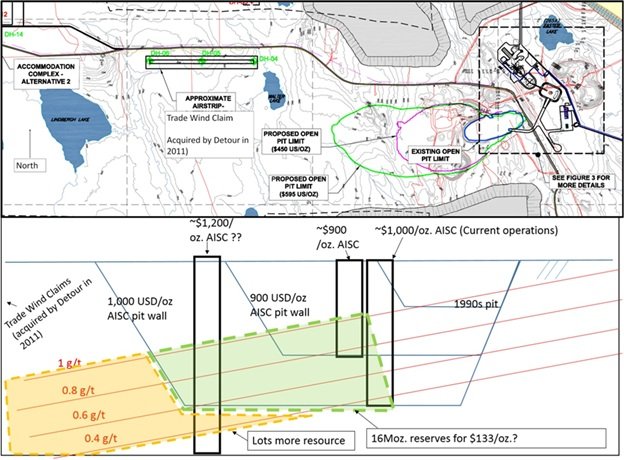
And one of the development stage projects we had proposed to Goldcorp in 2016 was Detour Lake Mine (which I had worked on as an engineer during its development in 2009-2011). And although Detour had not ranked very high in this assessment back in 2015-16, I had correctly flagged the mine’s lower grade potential at depth dipping to the west (see Exhibit 5)—as I tend to be quite strong at visualizing shapes in 3D, helped by my subsurface modeling experience from my engineering days. Kirkland Lake Gold later brought this low-grade potential into fruition after acquiring the mine in 2020 for C$4.9 billion, before drilling out this highlighted lower grade potential and expanding the pit shell along with its reserves (helping to substantially lower the pit’s strip ratio and per tonne operating costs, and improve overall economics), in conjunction with a low-grade ore stockpiling strategy (all helped by higher gold prices), before the company merged with Agnico Eagle Mines (in 2022).
Exhibit 5: Plan view and Schematic Longitudinal Cross Section of the Detour Lake Mine Open Pit During its Development in 2010-12.
Source: Detour Gold Corporation historic company reports, Host Rock Capital
The Next Generation of Mining Investment
Looking ahead, John believes that one of the most important forces shaping the future of precious metals, critical minerals, and energy transition investments will be the arrival of a new generation of investors. Many younger investors have experienced technology and cryptocurrency booms but have not yet witnessed a major mining or metals bull market.
He expects increasing awareness and education around natural resources to attract a broader investor base to the sector. As younger generations become more involved, mining companies and investment firms may need to adopt new approaches to communication and investor engagement.
Social media, digital content, and virtual interactions are likely to play a growing role in the distribution of market information and corporate communication. John believes these platforms align naturally with the preferences of younger investors, while traditional communication methods such as press releases, phone calls, emails, and in-person meetings will continue to remain important for more established investors. As a result, he sees a balanced and multi-channel communication strategy becoming increasingly necessary across the industry.
Artificial intelligence is another trend he expects to have a significant impact. As investors increasingly rely on AI-powered tools and digital assistants to analyze information and support investment decisions, access to accurate, transparent, and timely information will become even more important.
Within mining operations, John also anticipates a gradual increase in automation and autonomous technologies. Autonomous equipment has the potential to improve safety, increase efficiency, and reduce operating costs. However, he believes adoption will occur at different rates depending on the nature of individual operations, with remote and large-scale mines likely to implement such technologies more quickly than operations located near communities that rely heavily on mining employment.
Building a More Connected Mining Industry
When considering the legacy he hopes to create, John envisions a mining investment community that is more transparent, inclusive, and investor-focused. Through Host Rock Capital, he hopes to encourage greater adoption of modern communication strategies, particularly the use of social media and digital platforms to connect mining companies with investors.
He believes the industry can benefit from supporting a broader range of junior mining companies rather than concentrating attention on only a small number of established relationships. By improving access to information and expanding investor engagement, he hopes to contribute to a stronger and more dynamic mining ecosystem.
Looking ahead, John also expresses an interest in returning to a corporate leadership role within a major mining company, where he could apply many of these principles on a larger scale. His broader goal is to help foster a culture centered on long-term value creation, collaboration, and industry growth.
Ultimately, John hopes his work will contribute to a mining sector that places greater emphasis on education, investor engagement, and collective progress while encouraging an industry mindset built on creating opportunities and expanding value for all participants.
Quotes:
“Discovery alone is not enough. A development strategy is near-equally as important in building successful mining companies.”
“Selling to a major producer is not a junior mining strategy. The majors want to see that you have the right team in place with the know-how to get the mine built.” “Many promising mining companies do not fail because of geology. They fail because theycannot attract the visibility and capital needed to advance their projects.”
“Thegreatest challenge in junior mining is not discovering resources. It is helping the market understand their value.”
“The future of mining belongs to companies that can combine technical excellence with transparent communication and investor engagement.”
“While I played an integral role in Northgold’s journey, its success was never mine alone. It was built through the expertise, trust, and commitment of the people who believed in our vision.”
“The strongest ventures are rarely built by one individual; they are shaped by people who bring different strengths together around a shared purpose.”
“My journey with Northgold reinforced my belief that meaningful progress is driven not only by strategy and capital, but also by trusted relationships.”
“The support of our founding shareholders gave us more than a strong foundation; it provided the expertise and confidence needed to turn ambition into measurable progress.”