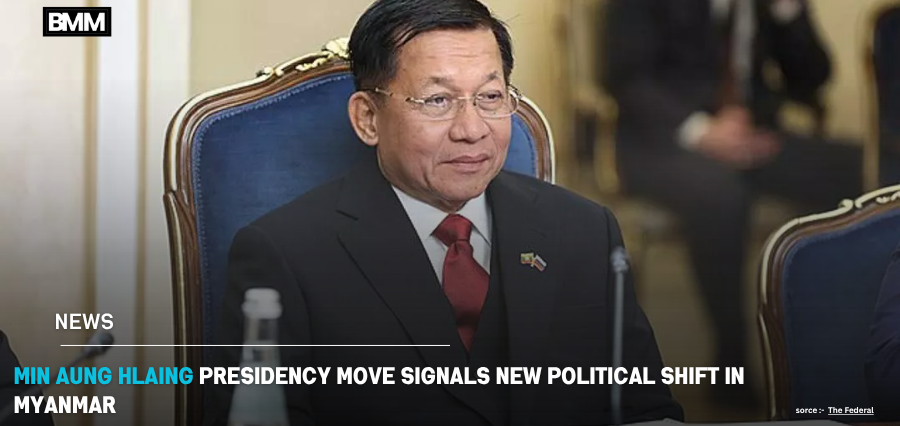
Myanmar’s political crisis entered a new phase on Monday as junta chief Min Aung Hlaing was formally nominated for the parliamentary process that will elect the country’s next president. The development has intensified global attention on the possible Min Aung Hlaing presidency, a move widely seen as an attempt to transition military control into a constitutional political role.
Lawmakers from Myanmar’s newly convened lower house nominated the senior general as one of two vice-presidential candidates, setting the stage for a later parliamentary vote that will select the president from among three nominees.
Parliamentary Process Begins
The nomination marks the beginning of Myanmar’s formal presidential selection process under the 2008 military-drafted constitution.
The lower house has put forward two candidates for vice president, while the upper house is expected to nominate a third. Parliament will later vote to select one of the three as president, although an official date for the final vote has not yet been announced.
This process has fueled expectations of a Min Aung Hlaing presidency, as analysts believe the military-backed parliament structure strongly favors his elevation to the top office.
A Long-Standing Political Goal
Political analysts have long indicated that the Min Aung Hlaing presidency has been one of the key objectives of the military takeover in the 2021 coup.
The coup ousted the democratically elected government headed by Aung San Suu Kyi drowning the nation into civil unrest and isolation by other countries.
This has been followed by the military government headed by Min Aung Hlaing, who has been coordinating a strictly controlled political system to maintain military superiority.
The nomination has now been viewed by the observers as a strategic shift of direct leadership of the military to a constitutionally approved civilian president, without significantly weakening the power base of the military.
Controversial Election Background
The action is taken soon after a highly debated election that was conducted between December and January.
The vote was won by the military-backed Union Solidarity and Development Party, which the United Nations and various governments in the west deemed the election as not being legitimate.
Much of Myanmar has been a venue of violence since the 2021 coup, and armed opposition groups and ethnic militias still continue to challenge the military administration.
According to the critics, the election, as well as the prospective presidency of Min Aung Hlaing, are a piece of a bigger puzzle to entrench military rule under the guise of civilian rules.
Constitutional and Military Implications
The constitution of Myanmar denies the active-duty military staff the right to hold the presidency.
This implies that to continue with the Min Aung Hlaing presidency, he is supposed to resign as the commander-in-chief of the armed forces.
This expectation has been reinforced by the recent indications by the military of a potential leadership restructuring.
Analysts consider that this shift would enable him to have effective control as he gets into a political office with wider domestic and international legitimacy.
What Comes Next?
It became one of the most anticipated political situations in Southeast Asia with the approaching parliamentary vote.
Should the Min Aung Hlaing presidency be elected, the new form would be a significant change but most analysts reckon that the new form would not change the content of military-run governance of Myanmar.
In the meantime, the world is observing whether this change of handover is the beginning of a new political order or just an extension of the military rule and under a presidential name.
Also Read :- China NeurIPS Boycott Conference Amid Escalating AI Research Restrictions