
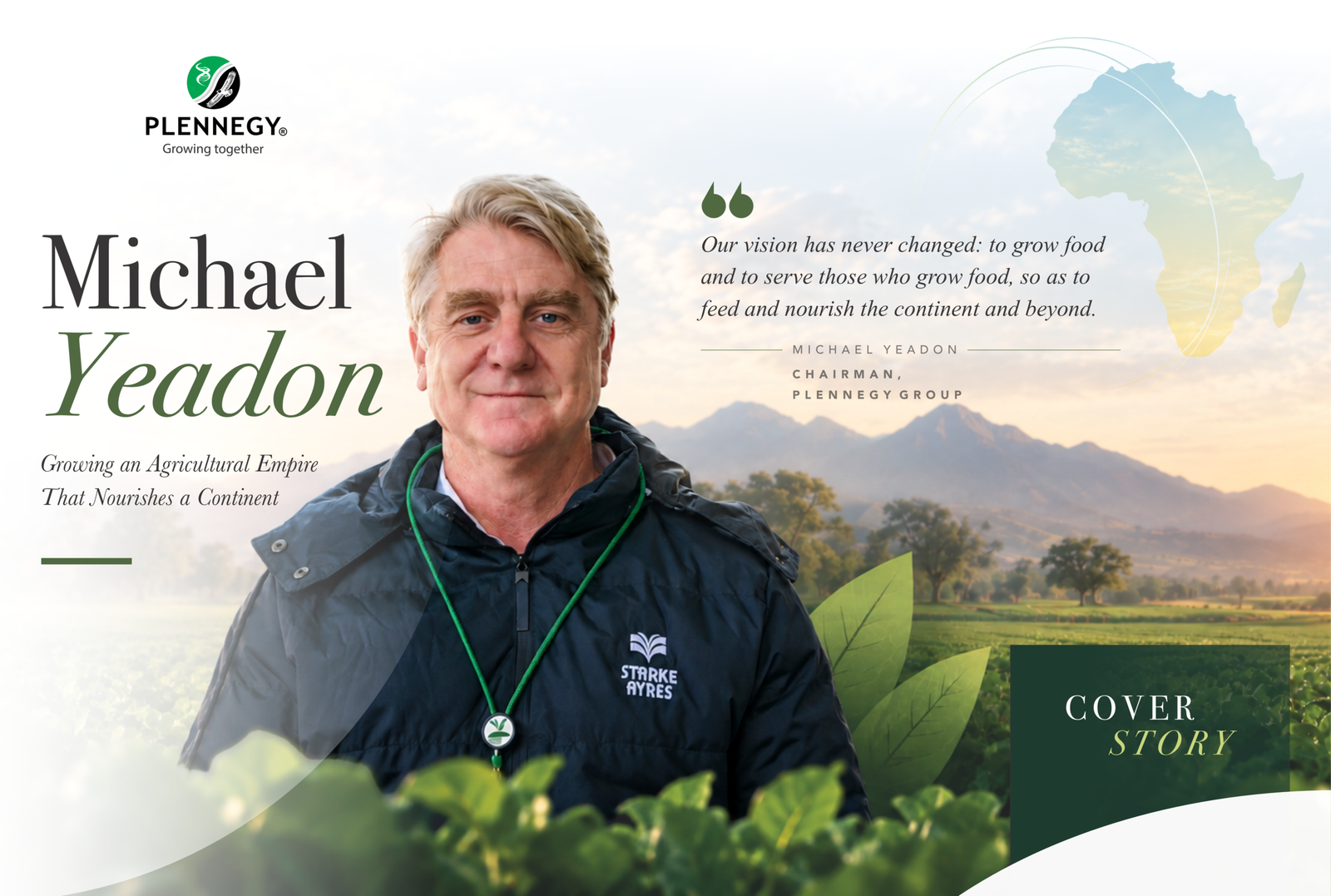
Agriculture rarely succeeds in isolation. A high-performing seed requires years of research before it reaches a field. A successful harvest depends on machinery, agronomic expertise, logistics networks, and the resilience of farmers navigating changing climates and market conditions. Behind every productive farming region is an ecosystem of businesses, technologies, and people working together to turn potential into food. As Africa’s demand for food continues to grow, the organizations creating these interconnected systems will play an increasingly important role in shaping the continent’s agricultural future.
For nearly seven decades, Plennegy Group has been building exactly that kind of ecosystem. What began as a seed business founded in 1958 has evolved into a diversified agricultural enterprise serving farmers across multiple African markets through seed innovation, farming operations, agricultural equipment, logistics, fuel solutions, and specialised support services. At the helm is Michael Yeadon, a leader whose journey has been defined by balancing heritage with progress. Under his stewardship, the Group has continued to invest in advanced plant breeding, digital transformation, research capabilities, and regional expansion while remaining committed to its founding purpose of supporting those who grow food.
Leading with Authenticity and Responsibility
Michael believes that leadership begins with self-awareness and is strengthened through compassion, decisiveness, active listening, logical thinking, intuition, and the willingness to take on any task, regardless of its size. Throughout his career, he has consistently emphasized the importance of authenticity and trust, viewing them as the foundation of meaningful leadership. Drawing inspiration from the words of Stephen Covey and Benjamin Franklin, he regards trust as an asset that takes years to build and moments to lose.
His personal leadership philosophy is encapsulated in the principle of saying what he means and meaning what he says. For Michael, authenticity is not always easy, but it is essential. Equally important is responsibility, a value deeply influenced by the late Brian Corbishley, founder of the Group, who often reminded him that leadership ultimately means doing what is necessary. While maintaining an open-door approach, Michael has also established structured systems that allow the organization to operate efficiently while remaining accessible. He firmly believes that no task is beneath a leader and that humility is integral to effective leadership.
Honoring Heritage While Embracing Innovation
For Michael, Plennegy’s legacy is deeply personal. Founded in 1958 by his stepfather, Brian Corbishley, the business was built on the mission of feeding Africa while maintaining commercial sustainability. Having joined the organization in 2002 after a successful career in law and structured finance, Michael has spent more than two decades helping shape the Group’s direction and preserving its founding vision.
While the company’s purpose remains unchanged, the methods of achieving it have evolved significantly. Under his leadership, Plennegy has invested heavily in digital transformation, implementing enterprise-wide technology platforms, cloud infrastructure, telematics solutions, and proprietary mobile applications. At the same time, the company continues to celebrate its heritage, preserving symbols of its history that remind employees of the values upon which the business was built.
Michael views legacy and innovation as complementary forces. He highlights the extensive research capabilities within Starke Ayres, where experts work at the forefront of plant breeding, bioinformatics, pathology, seed technology, and advanced breeding techniques. Through partnerships with universities, technology firms, and industry innovators, the Group remains agile in adopting new technologies while carefully evaluating long-term strategic decisions.
Africa’s Next Great Agribusiness Opportunity
Michael sees the future of agribusiness growth firmly rooted in Africa. He points to the increasing success of the Group’s vegetable seed operations across countries including Kenya, Zambia, Zimbabwe, Malawi, Uganda, Mozambique, and Namibia, while also identifying promising opportunities in North and West Africa.
He believes that Africa’s growing agricultural sector presents immense potential, particularly in vegetable production. Drawing on observations from international markets such as the United States, Brazil, Colombia, Thailand, and Kenya, Michael sees significant opportunities for crops like onions, tomatoes, butternut, and sweetcorn. For him, feeding Africa and expanding agricultural productivity across the continent represents both a business opportunity and a meaningful mission.
Building a Unified Agricultural Ecosystem
Plennegy’s diversification strategy has been guided by a clear and consistent purpose. Michael explains that every business within the Group contributes to the same agricultural value chain, whether through seed production, farming operations, agricultural machinery, logistics, fuel services, or supporting business functions.
Rather than pursuing diversification for its own sake, the Group has expanded into areas that strengthen its ability to support food production and the farmers who drive it. This shared purpose enables the various businesses to operate cohesively while creating value at multiple stages of the agricultural journey.
Innovation as a Driver of Agricultural Progress
Michael regards research and development as one of the most important drivers of long-term success in agriculture. He highlights how advancements in machine learning, artificial intelligence, drones, imaging technologies, speed breeding, and double haploid production are transforming plant breeding by improving selection accuracy and shortening development cycles.
Beyond research, the organization has invested in data management systems that ensure accurate, reliable information supports decision-making across the Group. In processing operations, advanced technologies such as X-ray quality assurance systems help maintain high product standards. According to Michael, every innovation is ultimately designed to deliver greater efficiency, stronger products, and improved outcomes for farmers.
Understanding the Evolving Needs of Farmers
Over the years, Michael has witnessed significant changes in the way farmers operate. He notes that increasing operational scale, technological advancement, and growing efficiency demands have reshaped modern agriculture. In some regions, additional pressures relating to land policy and food security have created further challenges for farming communities.
To remain aligned with customer needs, Plennegy actively engages with farmers through field days, demonstration events, and direct interactions. These initiatives provide valuable opportunities to showcase solutions while gathering feedback from those working on the ground. Michael believes the company’s close relationship with farmers is strengthened by the fact that many of its customers operate family businesses, creating a shared understanding of long-term commitment and stewardship.
Lessons in Resilience Across Diverse Markets
Operating across multiple African markets has taught Michael valuable lessons about resilience. From severe droughts and energy shortages to rising fuel costs, currency fluctuations, and infrastructure challenges, the business has faced numerous external pressures.
He believes resilience is built through adaptability, disciplined management, strategic partnerships, and trust in local teams. By collaborating with established dealers, diversifying products and markets, and empowering employees closest to the challenges, the Group has developed the flexibility needed to navigate uncertainty and continue growing in complex environments.
Balancing Sustainability and Commercial Success
Michael sees environmental responsibility and commercial success as mutually reinforcing objectives. He emphasizes the importance of sustainable agricultural practices such as soil health management, crop rotation, cover cropping, and integrated pest management, all of which support long-term productivity.
The Group’s forestry operations further contribute to environmental sustainability through reforestation efforts, biodiversity enhancement, and soil conservation. Equally important, Michael believes sustainability extends to people. Employee wellbeing initiatives play a critical role in maintaining a healthy and productive workforce. For him, true sustainability means creating a business capable of thriving economically while preserving natural and human resources for future generations.
The Technologies Shaping Agriculture’s Future
Looking ahead, Michael identifies artificial intelligence, machine learning, drones, imaging systems, speed breeding, and advanced genetic technologies as among the most influential developments in agriculture. He also highlights the growing impact of precision farming, telematics, and data-driven decision-making tools.
Within Plennegy, technologies such as fleet telematics systems and proprietary mobile applications have already improved operational efficiency, communication, and resource management. However, Michael believes that technology’s ultimate value lies not in the tools themselves but in how effectively organizations integrate and apply them to solve real-world challenges.
The Enduring Strength of Family Ownership
As Chairman of a second-generation family enterprise, Michael sees family ownership as a powerful advantage in building long-term success. Together with family members actively involved across the business and community initiatives, he has helped guide the Group while preserving the values established by its founder.
He believes family ownership encourages decisions focused on continuity rather than short-term gains. This perspective fosters stronger relationships with employees, customers, suppliers, and international partners. Michael notes that shared family values have often strengthened business opportunities, with several international companies choosing to partner with Plennegy because of the trust, ethics, agility, and long-term commitment associated with family-owned organizations.
For Michael, trust remains the defining currency of lasting relationships. Whether engaging with global partners, supporting farming communities, or planning for future generations, he believes family ownership provides both the agility and resilience required to sustain a business dedicated to feeding Africa for decades to come.
The Turning Points That Forged a Legacy
Reflecting on his career, Michael identifies several pivotal moments that have significantly influenced both his personal development and the growth of the Plennegy Group. Among his early achievements, he considers earning an LLB and later an MCom in Financial Management while simultaneously building a demanding career in law and structured finance as particularly formative. These academic and professional experiences provided the foundation for the strategic and commercial perspective he continues to rely on today.
Another defining decision came in 2002 when, after initially declining several invitations from his stepfather, Brian Corbishley, to join the family business, Michael chose to leave his independent career path and become part of the organization. Together with his wife, Louise, he embraced what would become a lifelong commitment to the family enterprise.
A major turning point occurred when the American company DuPont acquired Pannar Seed, the original business founded by Brian Corbishley. During this transition, Michael was appointed Managing Director to lead the process. Following the family’s complete exit from Pannar, attention shifted toward building what would eventually become the diversified Plennegy Group.
However, Michael regards the passing of his stepfather a decade ago as the most defining moment of all. As the founder, leader, and guiding force behind the family business, Brian’s absence created both a personal and professional challenge. Despite being one of the younger members of the family, Michael stepped forward to help guide the organization through this critical period. Supported by his brother Colin, sister Karen, wife Louise, and brother-in-law Simon, he helped ensure stability and continuity during a time of significant transition.
That same year also marked a deeper commitment by Michael and Louise to Wembley College, where they became increasingly involved in supporting the institution’s long-term development. He views both the business and the school as enduring commitments that require ongoing dedication rather than finite achievements.
Another important strategic milestone was the sale of the Group’s John Deere business, which strengthened the organization’s balance sheet and released capital for future growth. This positioned the Group to accelerate investment across key areas, including its property portfolio, African Starke Ayres operations, Triton Express logistics business, and fuel and motor divisions.
An Enduring Vision for Future Generations
The vision for Plennegy continues to be based on the purpose for which Plennegy was founded in the first place; which is that of producing food, and aiding those who produce food, in order to feed Africa, and the rest of the world. In the role of Chairman of Plennegy, Michael views it as his main responsibility to continue this tradition by assuring sustainability in order to maintain a profitable company that will endure many generations ahead, and which would ensure the wellbeing of employees and family members.
However, the notion that a company should make some contribution other than being profitable is what Michael believes in. This principle applies not only to Plennegy, but also to the decade of investment into Wembley College, where, apart from providing for academic education, Michael and Louise aim at giving people more opportunities, namely through building sporting, cultural, educational, and equestrian facilities.
Moreover, Michael sees it as his duty to make sure that businesses are active participants in the development of the community and not merely rely on government programs. Another important aspect of doing business is developing future leaders.
Inspired by Nelson Mandela’s belief that meaningful change comes through action rather than rhetoric, Michael approaches both business and community engagement with a focus on tangible impact. Ultimately, the legacy he hopes Plennegy will leave is one of positive transformation, where employees, farmers, partners, and communities can confidently say that the organization improved lives, strengthened opportunities, and left the world better than it found it through consistent action and enduring commitment.
“Our vision has never changed: to grow food and to serve those who grow food, so as to feed and nourish the continent and beyond.”
“Someone has to do what is necessary. That’s leadership in one sentence.”
“If you think a task is beneath you, you’re in the wrong organisation.”
“Feeding Africa and beyond isn’t a slogan for us; it’s where the growth is.”