
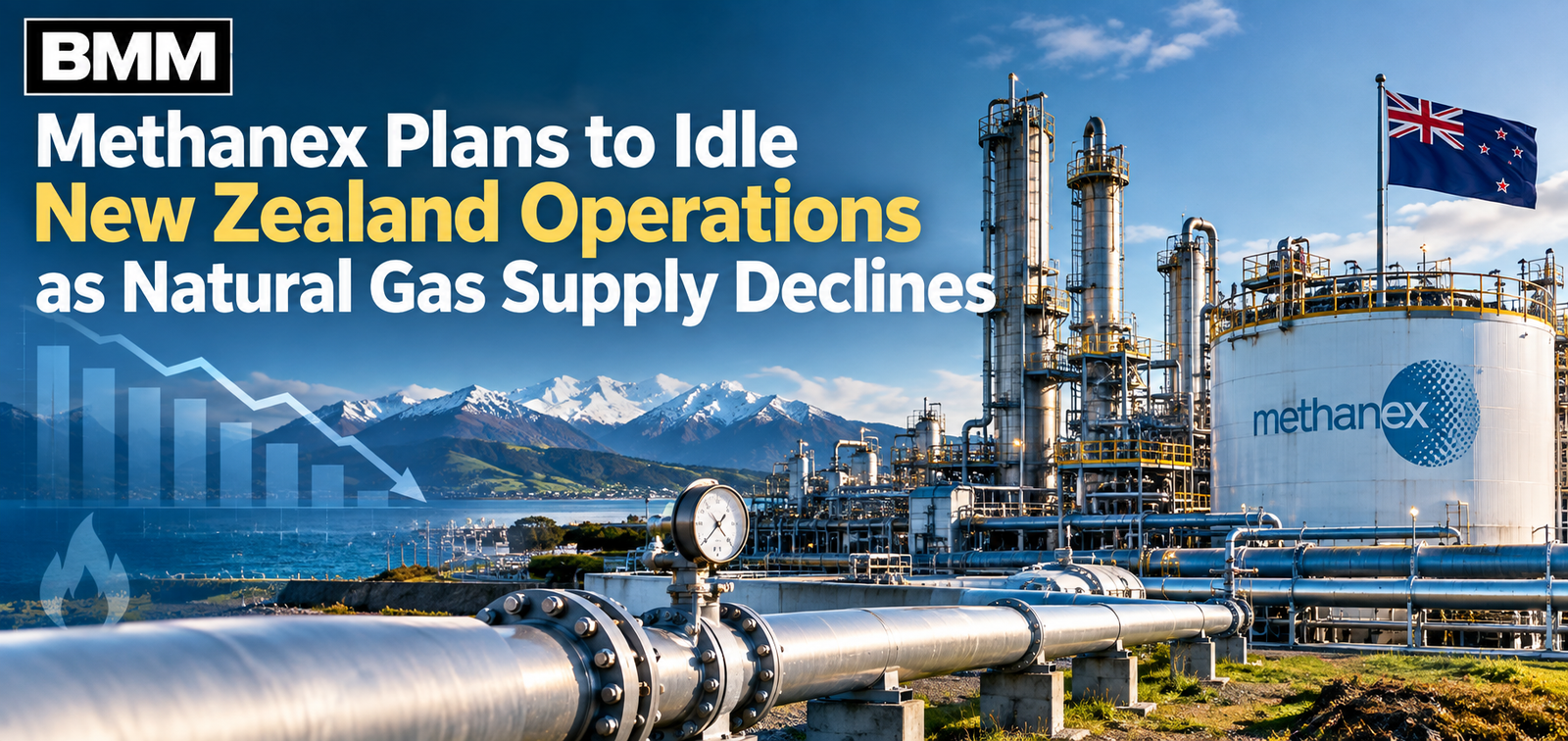
New Zealand’s energy sector is facing a significant turning point as Methanex, one of the country’s largest industrial gas users, has announced plans to idle parts of its operations due to declining natural gas supplies. The decision reflects broader challenges facing the nation’s energy landscape, where dwindling gas reserves, increasing demand pressures, and uncertainties surrounding future exploration are creating difficult conditions for both industrial users and policymakers.
For decades, natural gas has played a critical role in New Zealand’s economy, supporting electricity generation, manufacturing, agriculture, and export-oriented industries. Methanex, a global producer of methanol, has been one of the largest consumers of natural gas in the country, converting gas into methanol for international markets. The company’s decision to reduce or suspend operations highlights the growing concerns surrounding energy security and raises important questions about the future of New Zealand’s industrial sector.
Understanding Methanex’s Role in New Zealand
Methanex Corporation has had a strong presence in New Zealand over the past few decades. The corporation has served as a significant source of employment, foreign earnings, and industrial production in the region due to its operations in Taranaki.
The production process of methanol is highly dependent on natural gas. While most other industries use natural gas as a means of energy, Methanex uses it as a raw material in the production process.
For the last few decades, New Zealand’s sources of natural gas have provided Methanex with opportunities to produce large amounts of methanol which are exported to various parts of the world and contribute to New Zealand’s trade performance and industrial production.
However, reduced production of natural gas in the country has posed problems for the company.
Why Natural Gas Supplies Are Declining
The problem facing Methanex is not a singular issue but one that forms part of a trend developing within the country’s energy industry.
There are several reasons behind the decreasing levels of natural gas in the country. For example, mature gas reserves that have been feeding the country’s needs for decades have seen their output decrease due to diminishing levels of reserves. At the same time, there is little investment in the exploration and development of new reserves.
The geological nature of these reserves and changing priorities of the government in regard to environment and energy production have also led to difficulties with gas exploration and development.
As a result, increasing scarcity leads to greater competition for gas from different sectors of the country’s economy.
The Decision to Idle Operations
In choosing to shut down some of its manufacturing operations, Methanex recognizes that it is operating in an atmosphere where feedstock supply is becoming less and less predictable.
In order for a manufacturer to operate in its industry, steady supply of raw materials is absolutely necessary. If the supply becomes unreliable or insufficient, then the manufacturing company may find itself in difficult economic circumstances as it tries to operate. In such circumstances, a company may simply decide to put the whole operation on hold until the situation changes.
Although the effects will depend on how much gas is being supplied and the general market situation, the message conveyed by the announcement is that the supply levels at the moment are not enough to allow complete production.
Economic Implications
The consequences of this decision go beyond just Methanex Corporation.
Industrial plants are involved in a large number of supply chains, involving contractors, transport services, engineering firms, maintenance firms, and local companies. As such, low activity in major plants could impact various economic entities.
There is another consequence of reduced production of methanol that could affect New Zealand as a whole, which is reduced revenue from exporting methanol.
Furthermore, Taranaki is one of the places where energy industry plays a key part in its economy. This means that any reductions in operations could have an impact on the region’s economic situation.
Even though the consequences of the decision would not be severe right now, there could be other economic consequences should a natural gas shortage become prolonged.
Implications for New Zealand’s Energy Security
The news from Methanex Corporation has prompted a discussion of energy security in New Zealand.
Energy security pertains to the ability of a country to ensure reliable and sustainable access to energy resources. Though most of the time attention is given to the development of renewable sources of energy, the transition to a lower-carbon economy will also mean that other aspects of energy security will need to be considered.
At the moment natural gas is one of the sources of electricity in New Zealand which plays its role in times of peak demand and during low production of renewable energy because of the weather.
The shortage of natural gas has effects beyond the impact on the production process and includes the effect on energy markets and prices.
It is crucial for the government to find a balance between sustainable objectives and reliable energy sources.
The Broader Debate Around Natural Gas
The changes in Methanex’s operations have also sparked discussions regarding the role of natural gas in New Zealand’s future.
Those who advocate for continued use of gas say that natural gas is still needed as transitional fuel to support the economy until the capacity of renewable energy systems is developed further. According to this viewpoint, the availability of enough gas is essential in order to achieve energy stability and competitiveness of the industry.
Others state that the decrease in gas deposits highlights the urgency of developing renewable energy and electrifying production. This way, the reduction of dependence on fossil fuels could lead to greater sustainability and security from supply issues.
However, the problem here is finding ways to make a transition without economic disruptions.
The case of Methanex shows how hard this task can be when industries rely on increasingly scarce natural resources.
What It Means for Industrial Businesses
The problems that have been encountered by Methanex may act as a wake-up call for other industries within the energy sector in New Zealand.
In order for manufacturing companies and firms to plan investments in the future, they will need stable energy supply. This is because uncertainty about the energy supply in the future may pose challenges to competitiveness, expansion, and investment strategies.
The firms may start seeking other sources of energy to reduce reliance on natural gas. It should be noted, however, that diversification to other sources of energy may take quite some time to execute and cost a lot of money.
Other firms may not have many options besides natural gas in the short run.
Opportunities Amid the Challenge
Despite all the challenges posed by the situation, there might also be some opportunities for innovation and even transformation.
With increasing pressure on natural gas supplies, the world can expect an accelerated adoption of renewables, energy storage, hydrogen, and industrial electrification. Companies and politicians can be motivated to try out different ways to decrease reliance on depleting resources, while at the same time facilitating economic development.
New Zealand already has great experience in generating power through renewable energy sources such as hydroelectric and geothermal power. Such potential can prove helpful in terms of developing resilience in the long run.
Finally, there is a possibility of increased cooperation on behalf of government, businesses, energy companies, and technologists that can solve not only economic but also environmental issues.
Looking Ahead
The future of Methanex’s operations in New Zealand will be largely dictated by the presence of natural gas and the overall trend of energy policies in the country. The problem of natural gas shortage can force industries to make tough decisions for a very long time.
However, the current problem is also a reminder of the need to plan ahead when it comes to energy needs. Energy sources are an essential part of the productivity of any industry and the prosperity of the economy as a whole.
Since New Zealand is moving towards a low-emission future, energy availability will remain an important question to address in the process of making this change.
Conclusion
The idling of parts of the New Zealand operations by Methanex is a notable event for both the corporation and the New Zealand energy industry. It is a manifestation of the increasingly tough situation posed by natural gas shortages. At the same time, this issue reflects the complicated interrelations between energy security, competitiveness of business, and sustainability objectives.
Although the most obvious aspect of this situation relates to Methanex operations, its wider implications are much more profound, touching upon the country’s economic and energy sectors. This case can become a vivid lesson that any transition to new sources of energy requires well-balanced solutions to achieve sustainable development goals.
FAQ
1. Why is Methanex planning to idle its New Zealand operations?
Methanex plans to idle its New Zealand operations because declining natural gas supplies are making it increasingly difficult to maintain reliable and economical production.
2. What does Methanex produce in New Zealand?
Methanex produces methanol, a chemical used in products such as fuels, solvents, adhesives, plastics, and other industrial applications.
3. How does declining natural gas supply affect Methanex?
Natural gas is a key feedstock for methanol production. Lower gas availability can increase production costs and reduce the ability of Methanex’s plants to operate consistently.
4. Which Methanex operations in New Zealand are affected?
The planned idling affects Methanex’s methanol production operations in New Zealand as the company responds to constraints in domestic natural gas availability.
5. What is causing New Zealand’s natural gas supply to decline?
New Zealand has experienced declining domestic natural gas production, with reduced output from existing fields contributing to tighter gas availability for industrial users.
6. Could Methanex restart its New Zealand operations?
A restart could depend on future natural gas availability, production economics, and broader market conditions. Methanex can adjust its operations if circumstances change.
7. How could Methanex’s decision affect New Zealand’s economy?
Idling production could affect industrial activity, employment, energy demand, and the wider supply chain associated with Methanex’s New Zealand operations.
8. What does Methanex’s decision mean for New Zealand’s energy sector?
The decision highlights concerns about declining domestic natural gas supplies and the challenges facing energy-intensive industries that depend on reliable gas availability.
9. Could the move affect methanol prices or supply?
Changes in Methanex’s New Zealand production may influence regional methanol supply, although the overall impact will depend on global production, demand, inventories, and market conditions.
10. What is the long-term outlook for Methanex in New Zealand?
Methanex’s long-term presence in New Zealand will depend largely on natural gas availability, energy costs, production economics, and developments in the country’s energy market.