
The race for artificial intelligence leadership is often portrayed as a contest of bigger models, faster chips, and larger investments. Yet the countries and organizations that will shape the future are likely to be those that focus on something less visible but far more important: building the foundations that allow innovation to scale, talent to thrive, technology to be trusted, and value to compound over time. The conversation is no longer about whether AI will transform economies and industries.
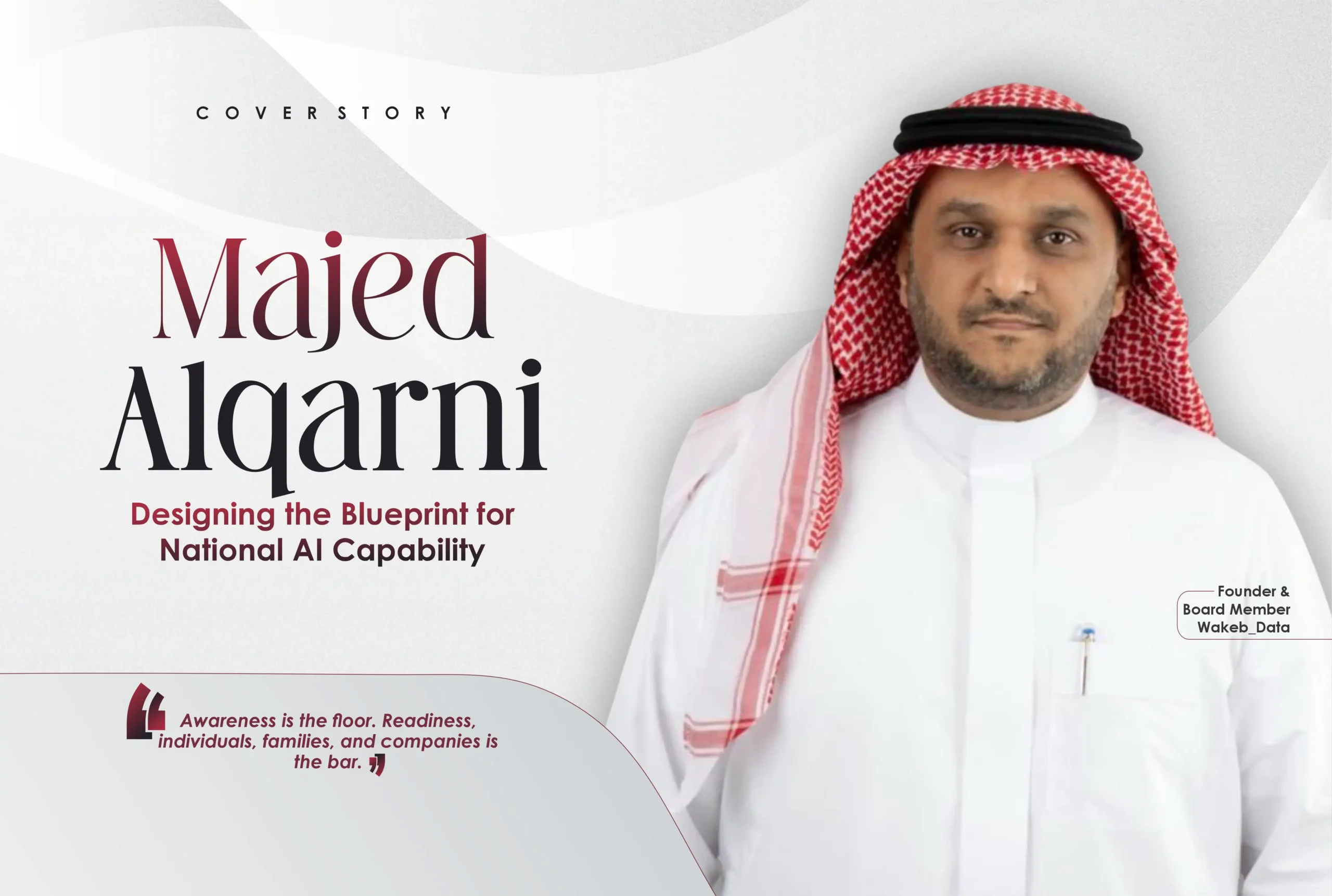
That challenge demands a broader perspective, one that connects infrastructure with research, safety with innovation, adoption with readiness, and ambition with execution. It requires looking beyond individual breakthroughs and understanding how every layer of the AI ecosystem contributes to long-term success. Few leaders articulate this vision as comprehensively as Majed Alqarni. Through his work across government leadership and the private sector, he advocates an approach that treats artificial intelligence not as a standalone technology, but as a strategic capability capable of accelerating economic growth, strengthening sovereignty, and shaping the future of entire industries.
Building an AI Nation with Depth
Majed Alqarni believes that emerging AI nations must look beyond the simplistic narrative of the global AI race and instead develop a nuanced understanding of the entire technology stack. In his view, the United States approaches AI development from the infrastructure layer upward, beginning with chips and progressing toward models and applications, while China often advances from applications down toward foundational models. Both, however, operate across every layer of the ecosystem.
For countries seeking meaningful participation in the AI economy, he argues that success lies not in selecting a single layer but in building complementary strengths across multiple domains. He advocates for deeper investment in areas such as hyperscale data centers, highly targeted model post-training, Arabic language optimization, AI harness platforms, memory and knowledge systems, physical AI, and vibrant open-source communities. By linking local ecosystems with global leaders while nurturing disruptive startups, nations can create sustainable and compounding value within the AI economy.
Building Sovereignty Before the Spotlight
Long before artificial intelligence became a mainstream priority, Majed and his team at WAKEB recognized its transformative potential. This early commitment enabled the organization to build indigenous systems with sovereign capabilities that addressed real-world challenges rather than remaining confined to research environments.
A significant portion of this work focused on autonomous systems capable of sensing, making decisions, and acting with minimal human intervention across operational and data-driven environments. Alongside these efforts, WAKEB invested heavily in accelerating AI startups, identifying promising founders and connecting them with infrastructure, customers, and practical deployment opportunities.
According to Majed, the combination of sovereign technology development and startup enablement produced one of the region’s most mature AI deployment ecosystems. Rather than creating isolated demonstrations, the organization generated long-term value across multiple sectors through practical implementation and sustained innovation.
AI as the Multiplier of National Ambition
For Majed, artificial intelligence represents far more than a technological advancement; it is an economic multiplier capable of transforming national productivity and competitiveness.
He sees AI as a critical enabler of Saudi Arabia’s Vision 2030 agenda and its broader economic diversification goals. By embedding intelligence into workflows, industries, and decision-making processes, AI can dramatically expand productivity without requiring proportional population growth. In his assessment, this creates a pathway for the Kingdom to significantly increase its economic output while accelerating progress across strategic sectors.
Majed envisions Saudi AI capabilities becoming a foundational driver of Industry 4.0 throughout the MENA region. From industrial operations to digital services and global events such as the 2034 FIFA World Cup, he foresees AI-powered systems and intelligent digital personas transforming experiences at scale while strengthening the country’s position as a regional technology leader.
Earning a Place at the Frontier of AI Research
Majed believes that discussions around AI competitiveness often focus too narrowly on infrastructure. While training-grade AI data centers are essential, he argues that genuine leadership in AI research requires a far broader ecosystem.
His vision includes attracting world-class researchers through access to advanced computing resources, strong academic partnerships, research laboratories, sponsorship programs, and supportive intellectual property frameworks. Competitive compensation, predictable access to computing resources, sovereign data assets, and a high-trust scientific environment are equally important components.
In his view, when these elements come together, attracting leading talent becomes achievable, and breakthrough innovation follows naturally. True participation in frontier AI research, therefore, becomes less a matter of aspiration and more a matter of execution.
Building the Guardrails of Intelligence
While AI safety is often viewed as a regulatory requirement, Majed sees it as both a necessity and a major economic opportunity.
He emphasizes that safety must function as a horizontal layer spanning the entire AI stack, protecting systems from both external and internal risks. Without robust safety mechanisms, even the most advanced AI strategies remain vulnerable.
Beyond risk mitigation, however, he believes Saudi Arabia has an opportunity to establish itself as a global leader in AI safety. By developing evaluation frameworks, benchmarking systems, red-teaming platforms, and assurance tools, the Kingdom could create solutions adopted internationally by governments and enterprises alike.
For Majed, AI safety represents not merely a protective measure but a growing sector within the AI value chain, one capable of generating economic value while supporting responsible innovation.
From Experimentation to Confident Deployment
Urgency is one of the strongest messages Majed has for business leaders. He thinks companies need to move beyond experimentation and make AI a core operating capability.
“It’s not a question of whether AI can provide value anymore,” he said. The challenge now is one of organizational change. Success involves assessing readiness, establishing clear adoption roadmaps, and shifting cultural mindsets from proof-of-concept efforts to full-scale deployment.
I think those organizations that wait risk falling behind,” he says. “AI capabilities get better with use and with continuous refinement. Applications are the layer where value is ultimately captured, and businesses that deploy intelligently today will be best positioned to benefit from tomorrow’s breakthroughs.”
The Evolution of Work in the AI Era
Instead of seeing artificial intelligence as a force that eliminates jobs, Majed sees it as a catalyst for the creation of entirely new roles and responsibilities.
He cites the advent of jobs that combine traditional skills with AI ability. Existing roles evolve rather than disappear, requiring workers to acquire new skills while applying their domain knowledge in new ways. Operational specialists become trainers of intelligent systems. Governance professionals become AI compliance experts. Software developers expand into designing intelligent architectures.
AI will create more levels of opportunity across industries, rather than replace the workforce of the future, he says.
Preparing People for the Intelligence Age
“Real understanding is still rare, even though more and more people are excited about AI,” Majed says. He separates awareness of AI from being prepared to use AI effectively, responsibly, and strategically.
He highlights a number of concerning adoption trends, such as overdependence on AI systems, over-sharing of private information, misplaced faith in generated outputs, and inadequate awareness of the limitations of generative models. He also points out that AI-generated studies and reports often have no institutional accountability and should be treated as such.
To address these challenges, he calls for a new generation of AI-ready individuals, families, and organizations. This demands not only technical literacy but also critical thinking, risk awareness, and a deeper understanding of how AI systems operate. For Majed, the future is with those who know how to use AI wisely, not just those who use it.
A Vision Rooted in Sovereignty and Scale
Throughout his career in government leadership and the private sector, Majed Alqarni’s perspective is always the same: artificial intelligence should be considered a national capability, not a standalone technology.
His vision is about creating sustainable value that compounds over time, whether it’s about sovereign AI systems, startup ecosystems, frontier research, safety frameworks, or workforce transformation. He believes Saudi Arabia is uniquely positioned to both consume AI technology and be a global player in the development, governance, and deployment of AI.
For Majed, the future of AI isn’t just about models or infrastructure. It is defined by the ability to combine innovation, sovereignty, talent, and execution into a coherent strategy that can shape economies, industries, and societies for generations to come.
“Sovereignty isn’t a slogan; it’s why the value keeps compounding.”
“Safety isn’t a constraint to absorb, it’s a market to lead, and a sector to grow.”
“Awareness is the floor. Readiness, individuals, families, and companies is the bar.”
Also Read: Business Minds Media for more information