
Sub-Saharan Africa is a continent mid-sentence, its story propelled by the youngest population on the planet. Every year, millions of young people stream into classrooms, training centres, universities, and job markets, carrying with them ambition that outpaces infrastructure and expectation that challenges tradition. School gates open to swelling enrolments, start-ups emerge from dorm rooms, creative studios hum in urban backstreets, and rural communities log on to global conversations for the first time. This demographic swell is not simply about numbers; it is about velocity. Economies must stretch, institutions must mature, and systems must adapt quickly enough to convert youthful energy into meaningful opportunity.
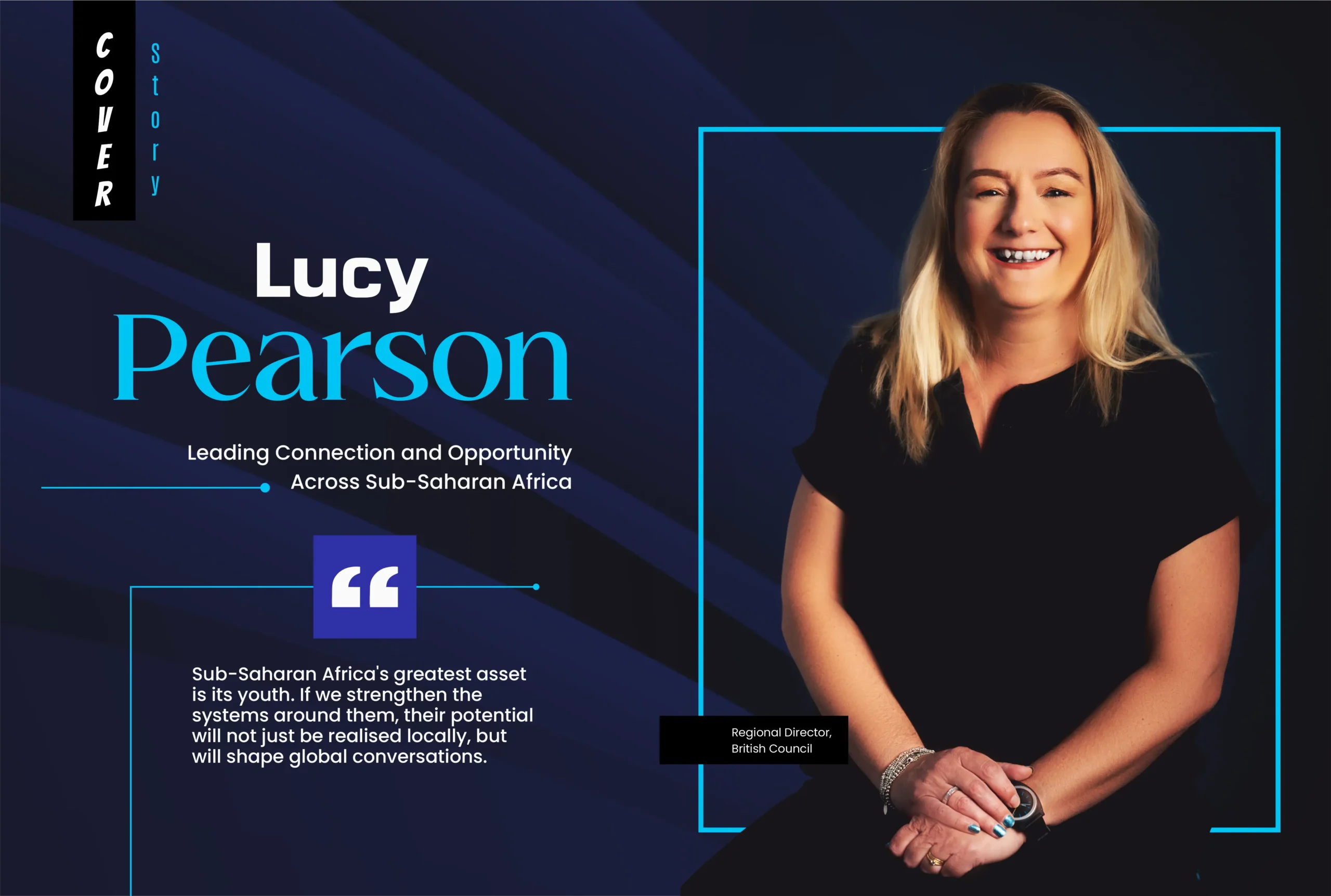
It is within this surge of potential that Lucy Pearson steps forward as a steward of connection and capacity. As Regional Director for Sub-Saharan Africa at the British Council, she operates at the intersection of education, culture, and partnership, aligning institutional reform with youthful ambition. Her work strengthens schools, universities, and creative industries so they can carry the weight of a generation determined to participate fully in the global economy while remaining rooted in local identity.
A Vision Rooted in Confidence, Capability, and Connection
Lucy Pearson’s vision for Sub-Saharan Africa is anchored in confidence, capability, and connection. She sees a region where young people, institutions, and creative sectors are equipped to thrive in an increasingly interconnected world while remaining grounded in local realities. For Lucy, Africa is entering a decisive moment shaped by demographic growth, rapid digital acceleration, and shifting geopolitical dynamics. These forces are redefining how societies function and how economies expand.
She believes that such global shifts require organizations like the British Council to move beyond traditional delivery models and invest in long-term system strengthening. Rather than focusing solely on programme outputs, Lucy prioritises depth over volume, partnerships over transactional engagement, and sustainability over short-term visibility. In her view, the British Council’s role is not to dominate spaces but to connect expertise, create enabling platforms, and facilitate exchanges that reinforce national priorities and regional ambition.
At the centre of Lucy’s strategy is trust. She wants the British Council to be perceived across Africa as credible, relevant, and dependable. That trust, she believes, is built through consistency, mutual respect, and a commitment to strengthening institutions in ways that endure beyond any single project cycle.
Lucy Pearson Reimagining Youth Engagement in a Connected Africa
Lucy approaches youth engagement with the understanding that young people are not a single, uniform audience. She sees them as creators, learners, entrepreneurs, innovators, and emerging leaders navigating vastly different realities. This nuanced perspective has shaped how she is reimagining engagement across Sub-Saharan Africa.
Digitally, Lucy is championing blended and hybrid models that combine online access with local facilitation. She views digital not merely as a channel but as an ecosystem that must be designed responsibly and equitably. Whether through English language learning, teacher development or employability programmes, she ensures that digital inclusion goes hand in hand with quality and accessibility.
The creative economy represents another cornerstone of her engagement strategy. Lucy recognises the power of fashion, music, film, design, and cultural heritage as engines of both expression and livelihood. Under her leadership, initiatives support young creatives in building viable enterprises by providing access to skills development, mentorship, policy dialogue, international networks, and market opportunities, particularly in connection with the United Kingdom.
Youth mobility is also being reshaped. Lucy emphasises equitable exchange over simple physical relocation. She supports models that include virtual collaboration, short-term fellowships, institutional partnerships, and skills-based mobility frameworks that broaden participation and reduce barriers.
Delegation, Trust, and the Power of Distributed Leadership
Lucy’s tenure as Country Director in Nigeria profoundly shaped her leadership approach. Leading one of the British Council’s largest and most complex operations reinforced for her that scale magnifies both strengths and weaknesses.
She learned the importance of clarity, delegation, and trust. Lucy understood that empowering colleagues to represent the organisation externally, manage relationships, and make critical decisions fosters resilience beyond any individual leader. This philosophy of distributed leadership continues to guide her at the regional level.
Nigeria also deepened her belief in empathy as a core leadership principle. Lucy acknowledges that complex environments require decisiveness, but they equally demand humanity. When leaders create space for colleagues to feel heard and supported, she observes that teams respond with creativity, courage, and sustained commitment even under significant pressure.
Embedding Change That Lasts
Lucy’s earlier work in global transformation programmes instilled in her the understanding that change only takes root when people believe in it. She recognises that a compelling vision must inspire ownership and agency among those responsible for delivery. When people feel invested in change, she notes, commitment and motivation follow naturally.
She places strong emphasis on listening and adaptation. Lucy integrates learning loops into programmes so they can evolve in response to feedback and shifting realities. Local partners play a central role in this approach. She values their contextual knowledge and sees them as critical friends who challenge assumptions and refine strategies.
For Lucy, transformation is not a one-off intervention. It is a continuous cycle of listening, testing, and refining. That mindset enables her to drive impact in African markets while remaining responsive to local nuance.
Resilient Learning in a Restless World
Lucy views education and English language skills as foundational pillars of opportunity, but she insists they must evolve to stay relevant. Her approach emphasises flexibility, localisation, and employability.
Blended learning models, modular pathways, and alignment with labour market needs are central to her strategy. Lucy positions English not merely as a language skill but as a gateway to education, entrepreneurship, and global collaboration.
In schools and teacher development, she supports systems that prioritise quality, inclusion, and professional growth. In higher education, Lucy works with universities to strengthen teaching excellence, research collaboration, and innovation capacity.
Her commitment to contextual responsiveness is reflected in programmes such as Language for Resilience, implemented in countries including Nigeria, Ethiopia, and Sudan. Through partnerships with local organisations, this initiative embeds English learning within community-based responses for young people facing displacement, conflict, or economic vulnerability. It combines language development with wellbeing, digital skills, and pathways to livelihoods. For Lucy, such programmes exemplify how education must be rooted in lived realities while equipping young people to navigate uncertainty and build sustainable futures.
Co-Creating the Future
Lucy believes partnership is the only path to meaningful scale and sustainability. Through initiatives such as Going Global Partnerships and Innovation for African Universities, she works with governments, Technical and Vocational Education Training institutions, universities, employers, and international collaborators to co-design solutions that extend access and relevance.
In the vocational sector, Lucy supports green skills development, renewable energy training, and industry-aligned curricula. In higher education, she strengthens innovation ecosystems that connect research, entrepreneurship, and digital capability.
She also highlights the Skills for Digital Inclusion Programme, which expands access to digitally enabled skills training for young people, particularly women and marginalised groups in underserved communities. Through collaboration with training providers, technology companies, and employers, the programme integrates industry-relevant skills, flexible delivery models, mentorship, and peer networks. Lucy sees such partnerships as vehicles for widening access to opportunity while reinforcing shared ownership and long-term impact.
Cultural Relations in an Entrepreneurial Era
Lucy observes that cultural relations in Africa are becoming increasingly reciprocal and entrepreneurial. As creative economies mature, artists and practitioners seek agency, ownership, and fair value rather than exposure alone.
Her role, as she sees it, is to support ecosystems that enable creatives to thrive locally while engaging globally. This includes engagement in policy dialogue, market access, intellectual property protection, and cross-border collaboration.
Through programmes such as Creative DNA, Lucy supports emerging fashion entrepreneurs in building sustainable businesses and connecting with global networks. She views cultural relations not only as dialogue but as economic resilience, reinforcing mutual understanding while strengthening livelihoods.
Safe Spaces in Fragile Times
Lucy has witnessed firsthand how arts and education create safe spaces for dialogue where formal mechanisms struggle. Through the European Union-funded Enabling University Peace Education programme, delivered in Nigeria, Ethiopia, Sudan, South Sudan, and Somalia, locally led approaches to peacebuilding and social cohesion were strengthened.
The initiative aligned with European Union priorities on conflict prevention and inclusive governance. By combining skills development, cultural engagement, and platforms for dialogue, it supported young people and civil society actors in addressing drivers of conflict and promoting peaceful coexistence. Lucy believes such work demonstrates the transformative potential of cultural and educational programming in fragile contexts.
The Anatomy of Enduring Change
Drawing on her global change experience, Lucy identifies purpose, participation and patience as the three pillars of successful change management. People must understand why change matters, feel included in shaping it, and trust that leadership will remain committed.
In Africa’s diverse markets, she emphasises flexibility. While strategic coherence is essential, one-size solutions rarely work. Lucy champions the need for adaptation to context while maintaining clear direction. Transparency and communication are equally critical, as change must feel owned rather than imposed.
Steady Hands in Complex Times
Lucy is clear that ambition without realism yields little. She balances aspiration with disciplined planning, strong governance, and scenario thinking. In fragile or complex environments, she prioritises continuity, safety, and incremental progress over speed.
By working closely with local teams and partners, Lucy ensures agility while remaining anchored in long-term outcomes. She believes that doing the right thing, in the right way, at the right time, is more impactful than rushing toward short-term milestones.
The Discipline of Inclusive Leadership
Lucy describes her leadership philosophy as rooted in self-awareness and inclusive leadership. She believes effective leadership begins with understanding one’s place within a system and setting a compelling vision with clarity and direction.
Her experiences across the United Kingdom, Nigeria, and Kenya have strengthened her belief in emotional intelligence. Listening deeply, understanding context, and recognising diverse motivations are essential in multicultural environments.
Lucy also acknowledges that leadership requires adaptability. While her natural style is collaborative, she recognises that different situations demand different approaches. Over time, she has learned to blend empathy and humility with strategic clarity and ambition, creating environments where teams feel both supported and inspired.
A Commitment Beyond Programmes
For Lucy, trust remains the British Council’s most valuable asset. Sustaining it requires consistency, relevance, and equitable partnership. She emphasises the importance of being present during both stable and challenging times.
Building trust with governments, communities, and young people depends on transparency, mutuality, and respect for local knowledge. Lucy believes that relationships grounded in these principles endure beyond individual programmes.
Looking ahead, she sees trust not as a static achievement but as a dynamic commitment. Through relevance, shared ownership, and sustained presence, Lucy is determined to ensure that the British Council continues to serve as a trusted partner across Sub-Saharan Africa for the decade to come.
Also Read :- Business Minds Media For more information
“Sub-Saharan Africa’s greatest asset is its youth. If we strengthen the systems around them, their potential will not just be realised locally, it will shape global conversations.”
“Demographic growth is not a challenge to manage; it is an opportunity to invest in with intention and foresight.”
“Trust is not built through visibility alone. It is built through consistency, humility, and showing up when it matters most.”