
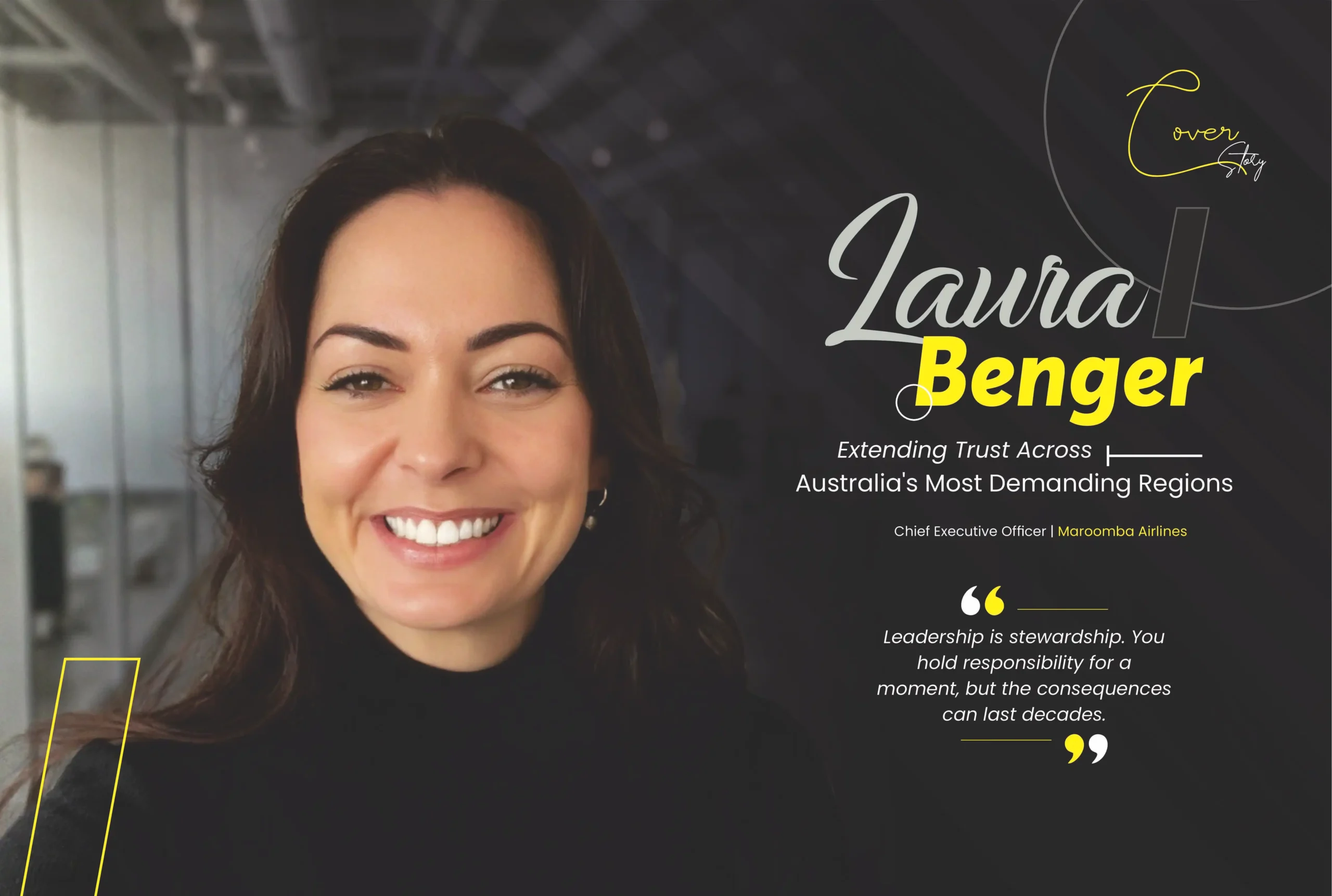
Aviation is one of the few industries where leadership decisions do not stay on paper. They travel into the air, onto gravel runways, into mining camps, and back to families waiting at home. In remote and regional operations, aircraft are not symbols of mobility. They are continuity. A delayed decision can stall production. A poor one can change lives. This is an environment where safety is not a department, reliability is not negotiable, and trust is earned flight by flight.
Laura Benger carries that responsibility as Chief Executive Officer of Maroomba Airlines. She leads an organisation that operates where conditions are unforgiving and expectations are absolute, supporting industries and communities that depend on aviation as essential infrastructure. What sets Laura apart is the way she leads under that pressure.
Laura Benger Stewardship Where Decisions Carry Weight
Laura Benger’s leadership philosophy has been shaped less by formal titles and more by the weight of responsibility carried across complex and high-stakes environments. Throughout her career, she has operated in sectors where decisions have immediate consequences and, in some cases, lifelong implications for individuals, families, and entire communities.
Her experience spans aviation, mining, healthcare, manufacturing, and the not-for-profit sector, often within organisations navigating transformation, heightened risk, or operational disruption. Across these contexts, one principle became clear early on: leadership is fundamentally an act of stewardship. Leaders are entrusted with organisations for a finite period, yet the choices they make can shape outcomes for decades.
In systems where margins for error are thin, Laura believes the leader’s role is not to have all the answers, but to create clarity, psychological safety, and strong decision-making frameworks. These conditions allow others to perform at their best, particularly under pressure. For her, effective leadership is defined by the quality of questions consistently being asked, rather than the authority of answers being given.
Laura Benger Serving as both a CEO at Maroomba Airlines and as Chair of Miners’ Promise sharpened her understanding of organisations as living systems, where culture, governance, operations, and capability are deeply interconnected. Her non-executive experience further refined her ability to distinguish between activity and impact, and to challenge the status quo in ways that build long-term resilience rather than short-term gains. She routinely tests decisions against deeper questions: what behaviours they reinforce, what systems they strengthen, and whether they improve the organisation’s capacity to make sound decisions under pressure in the future.
At Maroomba Airlines, this perspective is essential. Operating in remote and demanding aviation environments, where customers and communities rely absolutely on consistent performance, requires leadership grounded in calm, discipline, and humanity. Laura’s experiences prepared her to lead with an acute awareness of the responsibility that comes with putting people in the air.
Protecting Heritage Through Evolution
Maroomba Airlines has built trust over more than four decades, particularly in remote and regional operations where reliability underpins economic activity and community continuity. For Laura, heritage is not something to preserve unchanged, but something that must be protected through evolution.
Trust, she believes, is the organisation’s most valuable asset. In environments where there is little margin for error, reliability is not a preference but a mandate. That trust, earned over many years, can be lost quickly if change is introduced without care and respect for operational realities.
Laura approaches this balance by being explicit about what must never change and what must evolve. Commitments to safety, operational discipline, and reliability are non-negotiable. However, the way those commitments are delivered must continuously adapt. Fleet capability, systems, governance structures, and leadership approaches all need to evolve in line with changing risks, technology, and operational complexity.
For Laura, transformation is not about speed or disruption for its own sake. It is about strengthening the organisation’s ability to perform under pressure today and in the future. In aviation, standing still is not neutral; it introduces risk. At the same time, moving too quickly without respecting deep operational knowledge can be equally dangerous.
As a result, Maroomba approaches change deliberately. The organisation listens closely to those who operate the system every day, tests decisions against long-term resilience rather than short-term efficiency, and ensures that transformation enhances reliability rather than undermines it. In this way, evolution becomes a means of honouring Maroomba’s legacy, not diluting it.
When Safety Becomes Belief?
For Laura Benger , safety cannot be enforced. It must be believed.
While compliance is essential, she views it as the minimum standard rather than the ultimate goal. A genuinely safe organisation is one where people speak up early, challenge respectfully, and feel a personal sense of responsibility for outcomes that extend beyond their individual roles.
This belief has been deeply reinforced through her work with Miners’ Promise, where she has seen the human reality behind workplace fatalities. Exposure to the lifelong impact on families and communities transforms safety from an abstract system requirement into a profound leadership obligation.
At Maroomba Airlines, safety is embedded through three interconnected lenses: leadership behaviour, systems, and culture. Leaders set the tone through how they respond to risk reports, incidents, and near misses. Defensive or dismissive reactions discourage reporting. Listening, acting, and closing the loop fosters trust and shared accountability.
Safety is deliberately linked to the organisation’s values of accountability, one team, empowered and shared success. It is not confined to a safety function or department. It shapes decisions across the business, from flight scheduling and maintenance planning to customer interaction and operational prioritisation.
Crucially, safety conversations are treated as opportunities for learning rather than fault-finding. This shift changes behaviour at a fundamental level. When people trust that reporting risk leads to learning rather than blame, the quality of information improves, and so do outcomes.
For Laura, this approach is inseparable from leadership responsibility. When an organisation is entrusted
with people’s lives, safety must be embedded in daily decision-making, not treated as a periodic obligation or regulatory exercise.
When Values Carry Weight?
For Laura, values-led leadership becomes most visible when decisions are uncomfortable. It is precisely in moments of tension, when commercial pressures, operational realities, and human considerations collide, that values move from statements to standards.
At Maroomba Airlines, values are not aspirational ideals displayed on walls. They function as practical constraints that define how decisions are made. Accountability, Shared Success, One Team, and Empowered are not outcomes to be achieved later, but boundaries within which leadership choices must sit.
Accountability, in Laura’s view, means making decisions even when information is incomplete and risk is real. Delay, she believes, often shifts responsibility rather than reducing it. Leadership therefore requires clarity about ownership, trade-offs, and consequences, as well as the discipline to stand behind decisions once they are made.
Empowerment is expressed through trust and structure rather than control. Laura Benger focuses on creating conditions where sound decisions can be made without unnecessary escalation. Clear intent, defined authority, and confidence in frontline judgement allow the organisation to respond effectively in complex operating environments.
Shared Success requires resisting optimisation of individual functions at the expense of the system as a whole. In safety-critical industries, local efficiency can introduce broader risk. Laura consistently evaluates decisions through a system-wide lens, ensuring that performance gains in one area do not compromise safety, reliability, or resilience elsewhere.
One Team reflects a commitment to enterprise-level thinking. This often means making decisions that may be unpopular within individual groups but serve the organisation and its stakeholders more broadly. Laura emphasises that leadership includes prioritising what is right over what is comfortable, including at senior levels.
Her work with Miners’ Promise has further reinforced the importance of considering second- and third-order consequences in safety-critical environments. Values-led decisions may be commercially uncomfortable in the short term, but trading values for immediate outcomes does not eliminate risk. It merely redistributes it within the system. For Laura, consistency is what ultimately builds trust, even when decisions are difficult.
Beyond Transport and Into Responsibility
In remote Australia, Laura Benger views aviation not as a service but as enabling infrastructure. For Maroomba Airlines, responsibility extends far beyond moving people from one location to another.
The resources sector forms a foundational pillar of the Australian economy, much of it operating in regions where aviation is the only viable means of access. Maroomba Airlines sits within that critical supply chain, supporting the movement of people required to operate, maintain, and govern mining activity across vast and isolated areas.
Reliability, schedule integrity, and operational resilience directly influence workforce safety, production continuity, and the stability of regional and remote communities. When aviation performs well, economic activity is supported seamlessly. When it fails, the consequences are immediate and far-reaching.
Laura Benger approaches this responsibility through system-level thinking. Decisions around fleet capability, maintenance planning, crew management, and contingency readiness create ripple effects across mining operations, government services, and local communities. These second- and third-order impacts are central to how leadership decisions are evaluated.
Her own experience as a fly-in fly-out worker, combined with her work with Miners’ Promise, has deepened her understanding of the human consequences of operational failure. Disruption affects not only businesses but families and communities connected to them. This perspective reinforces a long-term approach that prioritises safety, reliability, and trusted partnerships over short-term efficiency.
Maroomba Airlines, under Laura’s leadership, sees itself as part of a national system that enables remote industry to operate safely and sustainably. Its role is not simply to connect locations, but to strengthen the continuity and resilience of the ecosystems that depend on those connections.
Alignment Before Applause
Being named finalists in multiple categories at the 2025 Australian Aviation Awards reflects, for Laura, collective alignment rather than individual achievement. Recognition signals that strategy, leadership behaviour, and execution are moving in the same direction.
Clarity has been the most significant leadership choice underpinning this alignment. In complex and safety-critical environments, people perform best when priorities are clear, decision authority is understood, and expectations are consistent. Laura has been deliberate in simplifying what matters, being explicit about focus areas, and ensuring leadership behaviour reinforces stated priorities.
Another key decision has been investing in leadership capability alongside technical capability. While aircraft and systems are essential, Laura believes alignment ultimately depends on decision quality at every level. Developing leaders who can think systemically, communicate clearly, and take responsibility reduces unnecessary escalation and strengthens organisational resilience.
Consistency has also been critical. Uneven application of standards or values quickly erodes trust. When accountability, values, and expectations are applied consistently, alignment follows naturally, even when decisions are difficult.
Finally, Laura places strong emphasis on closing the loop. Listening without acting creates frustration. Acting without explanation creates uncertainty. Explaining decisions and outcomes reinforces shared understanding and collective ownership. For her, the true outcome is not awards, but an organisation moving forward with a shared understanding of purpose and contribution.
Developing Capability as a Safety Strategy
For Laura, training and mentoring are not optional investments. In aviation, capability itself is a safety control.
While aircraft and systems can be acquired, judgement, confidence, and leadership maturity must be developed. In safety-critical environments, the quality of decisions made at every level directly influences outcomes. As a result, people development becomes a strategic priority rather than a discretionary initiative.
From a leadership perspective, training and mentoring build organisational resilience. Well-developed individuals are better equipped to manage complexity, adapt to change, and make sound decisions under pressure, particularly in remote operations where autonomy is essential.
Maroomba Airlines has deliberately linked development to real responsibility. Mentoring focuses not only on transferring knowledge, but on building decision confidence, situational awareness, and accountability across technical, operational, and leadership roles.
Laura’s work with Miners’ Promise has reinforced her belief that failures in safety-critical industries often stem from gaps in judgement, communication, or leadership rather than a lack of procedures. Developing people is one of the most effective ways to reduce these risks over time.
Ultimately, Laura views investment in people as an investment in sustainability. An organisation’s long-term performance is shaped by the decisions made when supervision is limited and conditions are challenging. Building that capability sits at the centre of her role as CEO.
Judgement Before Urgency
In high-risk and high-responsibility environments, Laura deliberately resists the instinct to move faster simply because pressure is high. Her decision-making process begins by slowing the moment down, not accelerating it.
Urgency, she believes, often introduces noise. Before action is taken, Laura focuses on clarifying the true nature of the problem being solved, identifying underlying causes rather than reacting to visible symptoms. This discipline helps ensure that decisions address systemic risk rather than offering short-term relief that may create fragility elsewhere.
Her approach integrates data, operational insight, and frontline perspective. Quantitative information is essential, but it is rarely sufficient on its own. Decisions improve markedly when leaders understand how choices will play out in practice, particularly in complex and remote operating environments where conditions are less forgiving.
For Laura, clarity and empathy are complementary rather than competing forces. Clear decisions reduce uncertainty, while empathy grounds those decisions in the lived experiences of the people affected by them. Engaging openly and respectfully, especially when messages are difficult, strengthens trust and improves execution.
Her work with Miners’ Promise has reinforced the importance of considering second- and third-order consequences. In environments where failure carries human impact, decision-making must account not only for immediate outcomes but for how risk is redistributed across the system. In her view, strong decisions strengthen systems over time, while short-sighted ones can introduce new points of vulnerability.
Alignment Through Clarity
Leading diverse teams across different locations and operational realities requires more than proximity. For Laura, alignment is created through shared clarity rather than uniform experience.
People do not need identical conditions to work effectively. They need a common understanding of purpose, priorities, and decision boundaries. Laura places emphasis on being explicit about what matters most, what is non-negotiable, and where local judgement is expected. This clarity allows the organisation to operate coherently as scale and complexity increase.
Trust, she notes, is built through consistency. When standards, values, and decision principles are applied evenly, people are more willing to exercise judgement and take responsibility within their roles. Inconsistent leadership behaviour creates fragmentation far more quickly than distance or diversity ever could.
Laura and her leadership team invest time in understanding how decisions land across different operational environments. Frontline realities vary significantly, particularly in remote and safety-critical contexts. Alignment depends on recognising these differences rather than assuming a single perspective applies universally.
Her experience leading globally dispersed teams, reinforced by her work with Miners’ Promise, has shaped her belief that clarity and trust are essential where people operate under pressure. When proximity is limited, leadership behaviour and decision frameworks must do more of the work. Ambiguity introduces risk. Clarity reduces it.
Designing for Decision Quality
Laura’s leadership purpose centres on enabling people to make great decisions and recognise the significance of their role within the system. She embeds this belief by designing the organisation around decision quality rather than dependency.
At a leadership level, this means being clear about intent, boundaries, and expectations while deliberately avoiding over-centralisation of authority. When people understand the purpose behind decisions, the constraints within which they operate, and the consequences of their judgement, they are far more capable of acting independently and responsibly.
Leadership development, therefore, is less about directing behaviour and more about building confidence in judgement. Laura focuses on helping leaders think systemically, assess risk, and understand how their decisions affect outcomes beyond their immediate scope. It is through this understanding that people begin to recognise the significance of their contribution.
In everyday interactions, this philosophy shapes how problems are addressed. Laura often responds with questions rather than answers, not as a test, but as a way of reinforcing ownership. Over time, this approach shifts decision-making away from escalation and toward accountability.
Her work with Miners’ Promise has highlighted that many failures in safety-critical environments stem not from poor intent, but from people underestimating the reach and weight of their decisions. Helping individuals understand that responsibility, without fear, is central to effective leadership.
Defining Sustainability Under Pressure
Laura defines sustainable success in aviation as the ability to operate safely, reliably, and responsibly over the long term, particularly in environments where failure has immediate and far-reaching consequences.
Sustainability, in her view, is not a standalone initiative or reporting exercise. It is the cumulative outcome of disciplined decision-making across safety, operations, financial management, and people capability. An airline that cannot sustain its safety standards, workforce, or customer trust cannot be considered sustainable, regardless of short-term performance.
Operating in remote and safety-critical environments requires resilience by design. Laura emphasises investment in fleet capability, maintenance discipline, leadership development, and contingency planning so the organisation can absorb disruption without compromising standards.
Accountability sits at the centre of this approach. Sustainable organisations are clear about ownership, transparent about risk, and consistent in applying standards. This consistency builds trust with regulators, customers, and the communities that rely on reliable aviation services.
Her work with Miners’ Promise has reinforced the importance of defining sustainability by how organisations perform under pressure, not during favourable conditions. Managing risk responsibly, building capability over time, and remaining fit for purpose as conditions evolve are what ultimately define long-term success.
The Next Chapter and the Measure of Legacy
Looking ahead, Laura’s vision for Maroomba Airlines is clear. She aims for the organisation to be recognised as Australia’s number one aviation partner, defined by trust, performance, and reliability.
That position, she believes, can only be earned through delivery. It means being the operator customers rely on when conditions are demanding, timelines are critical, and tolerance for failure is low. It requires consistent, professional performance regardless of circumstance.
Achieving this vision demands discipline. Maroomba Airlines will continue to strengthen its foundations across safety, operational reliability, governance, and people capability. Growth will be deliberate and precise, ensuring capability always leads expansion rather than being forced to catch up.
In response to increasing customer demand, the organisation is introducing new aircraft capability and refining its offering to meet the growing scale and complexity of customer operations. This evolution reflects both confidence in the organisation and a clear understanding of its responsibility to remain fit for purpose as customer requirements evolve.
For Laura, customers judge outcomes, not intent. Being the leading aviation partner means anticipating needs, operating as an extension of critical supply chains, and earning trust repeatedly through performance rather than promises.
When it comes to legacy, her focus is not on milestones or growth figures. It is on leaving behind an organisation that consistently makes good decisions under pressure, applies standards fairly, and remains trusted long after individual leaders move on. If Maroomba Airlines is recognised as the benchmark partner because of how it operates and responds when the stakes are high, Laura believes the legacy will be self-evident.
Also Read :- Business Minds Media For More information
“Leadership is stewardship. You hold responsibility for a moment, but the consequences can last decades.”
“In safety-critical environments, decisions don’t stay theoretical. They affect people, families, and communities.”
“Our role is not just to connect places, but to protect continuity for the communities that depend on us.”