
An airport is often described by what can be seen: runways stretching towards the horizon, aircraft arriving from distant cities, and terminals carrying thousands of journeys forward. Yet beneath every departure is an invisible digital pulse. Networks exchange information, operational systems coordinate movement, security platforms guard access, and data travels continuously across technologies that cannot afford uncertainty. In this environment, cybersecurity is not confined to protecting screens and servers. It helps preserve the rhythm of an entire airport, ensuring that safety, communication, passenger services, and critical operations continue even when digital systems are tested.
For Khuslen Munkhbayar, IT Division Manager and CISO at New Ulaanbaatar International Airport LLC, protecting that invisible foundation carries a personal significance. Having contributed to the airport’s development as an Airport IT Engineer from the early stages of construction through its completion, he returned in 2024 with a broader responsibility: to lead the IT Division and strengthen the cybersecurity of one of Mongolia’s most critical infrastructure hubs.
A Return with a Greater Responsibility
Khuslen’s connection with New Ulaanbaatar International Airport began long before he assumed leadership of its IT Division. He joined the airport construction project as an Airport IT Engineer during its earliest stages and remained involved until its completion in 2021. Contributing to the development of an international airport from the ground up gave him a comprehensive understanding of how networks, communication infrastructure, operational platforms, and digital systems work together to support safe and efficient airport operations.
After gaining broader experience in IT leadership, Khuslen returned to the airport at the end of 2024 to lead its IT Division and cybersecurity function. The return carried a deeper sense of responsibility. He was no longer approaching the airport solely as an engineer responsible for maintaining technology, but as a leader entrusted with protecting one of Mongolia’s most critical pieces of national infrastructure.
His arrival also coincided with an important period of technological and regulatory change. Mongolia’s Cybersecurity Law had introduced greater responsibilities for organizations operating critical infrastructure, while several of the airport’s core systems were approaching a decade of service. Khuslen recognized an opportunity to modernize technology and strengthen governance together.
His vision extends beyond introducing newer systems. He aims to build a secure, resilient, and well-governed digital airport where cybersecurity is embedded into everyday operations and supports passenger safety, business continuity, regulatory compliance, and future innovation.
Security That Passengers Never Have to Notice
At an airport, every cybersecurity decision can influence real operations. A security measure that disrupts passenger check-in, baggage handling, aircraft turnaround, or emergency response may create challenges of its own.
For this reason, Khuslen begins with operational risk rather than technology. He believes cybersecurity should enable airport operations without introducing unnecessary barriers. Systems are evaluated according to their operational importance, allowing the airport to apply controls suited to the responsibilities and risks of each environment.
Passenger-facing platforms must remain accessible and dependable while maintaining appropriate protection. Critical operational systems require stronger network separation, continuous monitoring, controlled access, and clearly documented recovery procedures.
Khuslen also considers resilience as important as prevention. Although strong safeguards can reduce risk, critical infrastructure cannot operate under the assumption that every incident can be avoided. The ability to detect issues quickly, respond effectively, and restore essential services with minimal disruption is equally important.
For him, successful airport cybersecurity often works beyond public view. Passengers should experience convenience and efficiency without noticing the layers of protection supporting their journeys.
Strengthening the Systems Behind Every Journey
When Khuslen returned to the airport at the end of 2024, his first priority was to develop a clear understanding of its overall technology maturity. Since many of the airport’s essential IT systems had been installed nearly a decade earlier, the assessment extended beyond hardware. It also examined governance, operational procedures, documentation, cybersecurity preparedness, and organizational responsibilities.
One of the most significant initiatives under his leadership has been the implementation of ISO/IEC 27001:2022. Rather than approaching cybersecurity as a collection of separate technical projects, Khuslen is helping establish a structured information security management system built around risk assessment, clear policies, defined responsibilities, organizational awareness, and continual improvement.
Strengthening cyber resilience has been another major focus. Khuslen developed a bilingual Cyber Incident Response Playbook that provides airport personnel with practical guidance for responding to incidents affecting critical systems. The playbook includes clear escalation procedures, coordination requirements, and manual fallback measures designed to support continuity during disruption.
These governance initiatives are accompanied by infrastructure improvements across firewall security, airport networks, WiFi modernization planning, Active Directory, access control, CCTV systems, and standardized IT asset governance.
Together, these efforts are strengthening both operational reliability and the airport’s long-term cybersecurity maturity.
The Digital Foundation of Airport Safety
Airport safety depends not only on what happens on runways or inside terminals. It is also supported by the digital systems that keep information available, communication reliable, access controlled, and operations connected.
Khuslen approaches this responsibility through governance, operational resilience, infrastructure protection, and organizational awareness.
The implementation of ISO/IEC 27001:2022 is helping formalize how the airport identifies risks, establishes controls, assigns responsibility, and strengthens accountability. This structured approach enables cybersecurity to become proactive rather than reactive.
Khuslen’s Cyber Incident Response Playbook also provides frontline personnel with practical procedures for detecting, reporting, escalating, and containing cyber incidents. It includes manual fallback measures that can support essential operations when digital systems are disrupted.
Infrastructure hardening remains equally important. The IT Division focuses on network and firewall security, segmentation, access control, endpoint protection, identity and domain governance, system monitoring, and careful vendor evaluation.
Khuslen also emphasizes employee awareness because technology alone cannot protect critical infrastructure. Effective security depends on people understanding their responsibilities and recognizing how their actions contribute to the airport’s wider safety mission.
Building Readiness into Every Layer
For Khuslen, protecting airport systems, operational networks, and information requires more than deploying cybersecurity products. It requires creating an organization that understands risk, prepares for disruption, and knows how to respond when essential systems are affected.
Governance provides the foundation. Through ISO/IEC 27001:2022, the airport is developing clear policies, structured risk management processes, defined responsibilities, and mechanisms for continual improvement.
Incident preparedness is strengthened through the bilingual Cyber Incident Response Playbook developed by Khuslen. Aligned with ISO/IEC 27001, ICAO Annex 17, and the NIST Cybersecurity Framework, it provides practical response procedures for six critical airport systems and includes reporting processes involving CERT MN.
Infrastructure security is also being advanced through network segmentation, firewall hardening, identity management, system monitoring, vendor governance, and technology lifecycle planning. As several components approach a decade of operation, modernization has become essential to both cybersecurity and operational reliability.
Yet Khuslen believes every employee remains part of the airport’s defence. Awareness, preparation, and the ability to respond appropriately are necessary for building resilience across the entire organization.
Innovation with a Clear Flight Plan
Khuslen sees considerable potential for artificial intelligence, automation, biometric systems, and smart surveillance within airport operations. However, he believes innovation should begin with a clearly defined operational need rather than enthusiasm for a particular technology.
Artificial intelligence and automation could strengthen monitoring, reporting, decision support, service desk efficiency, and cybersecurity analysis. Smart surveillance and advanced access control could improve situational awareness and enable faster responses. Biometric technologies may support smoother passenger movement and stronger identity assurance when aligned with regulatory, privacy, and operational requirements.
However, every innovation introduces responsibilities that must be considered before implementation. Cybersecurity, personal data protection, system integration, vendor risk, reliability, and business continuity all influence whether a technology is appropriate for the airport environment.
Khuslen’s roadmap, therefore, prioritizes controlled and practical adoption. His goal is to help the airport become more intelligent and efficient while remaining secure, transparent, and resilient.
For him, innovation creates meaningful value only when it improves service without introducing unmanaged risk.
The Technology Behind a Smoother Journey
Much of the technology shaping passenger experience operates quietly in the background. Reliable WiFi, stable check-in systems, accurate flight information displays, secure payment platforms, effective communication systems, and responsive technical support all contribute to a journey that feels seamless.
Khuslen is focused on strengthening the digital infrastructure supporting these services. Network modernization, improved WiFi, standardized hardware and software governance, and stronger monitoring can make passenger-facing technologies more stable, scalable, and dependable.
The airport is also exploring how automation and intelligent systems could improve operational visibility, accelerate responses to technical issues, strengthen access control, and enable better integration between platforms.
Khuslen believes a future-ready airport is not defined solely by the number of advanced technologies it adopts. Its digital systems must remain dependable, secure, and aligned with the needs of passengers, airlines, airport personnel, and operational teams.
When the technological foundation is reliable, passengers may never notice the systems working behind their journey. They simply experience an airport that functions with greater consistency and confidence.
Turning Technical Risk into a Shared Language
Cybersecurity at an international airport cannot remain confined to the IT Division. It requires collaboration among engineering, operations, safety, security, administration, finance, legal, human resources, airlines, technology vendors, and government stakeholders.
Khuslen recognizes that each department understands risk through a different operational lens. Bringing these perspectives together allows the airport to develop policies and controls that are practical rather than purely theoretical.
For major initiatives such as ISO/IEC 27001:2022 implementation, incident response planning, and infrastructure modernization, relevant teams are involved from the early stages. This creates stronger alignment and ensures that cybersecurity decisions reflect operational realities.
Khuslen also places importance on translating technical risks into language that connects with each department’s responsibilities. Rather than focusing only on malware, network ports, or security controls, he explains how a cyber incident could affect passenger check-in, access control, flight information, passenger movement, regulatory reporting, and business continuity.
When people understand how cybersecurity relates to their own work, collaboration becomes stronger, and responsibility becomes shared.
Protecting Critical Infrastructure with Practicality
Cybersecurity at an airport entails more obligations than a typical corporation. The cybersecurity process directly contributes to ensuring aviation safety, operational continuity, and Mongolia’s linkage with other countries.
The recently passed Cybersecurity Law of Mongolia in 2021 set higher requirements for organizations running critical infrastructure and hence sped up the necessity for good governance, risk management, compliance, and preparedness.
Another important issue that needs to be taken into account is the lifecycle management of technologies. All critical information systems of the airport were installed during the airport’s construction almost a decade ago. While all the systems still work fine, aging technology needs to be considered properly and planned.
Available resources can play a role in decision-making. Emerging market companies have to manage their limited budget resources and maximize the use of current infrastructure while making smart investments.
Khuslen considers the above-listed factors to require pragmatic leadership, good governance, proper vendor management, and inter-departmental collaboration. Sustainable success can never rely solely on big investments in technology. It should be achieved through the right decisions, considering many aspects including security, operational needs, regulation, and resilience.
A Culture Built for Pressure
According to Khuslen, organizational culture emerges from the practice of things rather than from slogans.
In order to build resilience, Khuslen’s team relies on preparation in the form of documentation, incident response plans, manual fallback, ownership, and lessons learned from actual incidents. Khuslen motivates his team members to think about the ways to make sure systems survive in case something happens, not only how to build them.
As far as innovation is concerned, he sees many possibilities for improvement in small-scale steps. The digital transformation does not necessarily have to be a massive program. Streamlining a process, enhancing monitoring, standardization of the tools used, eliminating manual errors, or finding a better way to assist the user would all be valid innovation opportunities.
As far as accountability is concerned, Khuslen emphasizes its significance, starting from clear ownership of processes and systems. Uncertainty about who owns what is the reason for delays and confusion in serious situations in IT and cybersecurity.
Training and awareness are key elements of his organizational culture. People work better when they know why they need to do certain things.
A Smarter Gateway Built on Strong Foundations
Khuslen sees New Ulaanbaatar International Airport as a secure, resilient, and digitized gateway for Mongolia.
Many international visitors have their first impressions and last impressions of the country from the airport. Digitalization affects passengers’ experience, confidence, services provided, and connectivity.
For Khuslen, digital transformation requires the establishment of a solid base. Infrastructure, reliable systems, governance, people, and risk management should be in place prior to developing more sophisticated skills.
Following such a base, an airport may then develop intelligent operations, automation, integration, better passenger services, and advanced data analytics.
Also, he aims to prove that infrastructure in developing countries can be modern, innovative, and secure but still pragmatic. Not all trendy technologies should be used; Khuslen thinks that airports need to choose technologies that provide value in operations, implement them at the right time, and govern them properly.
The main purpose is not the use of technologies itself. The objective is a digital airport able to serve Mongolia reliably.
The Discipline Behind Digital Resilience
Khuslen inspires those who wish to pursue careers in IT and cybersecurity to gain technical skills in addition to an operational understanding.
Cybersecurity professionals working within critical infrastructures cannot be limited to technical knowledge alone. It is important for them to be aware of their environment and the impact that their decisions might have on safety, continuity, compliance, and human factors.
He advises emerging professionals to gain a thorough understanding of networking, systems, identity, risk, response, and governance. Equally crucial is the skill of conveying technical threats to executives and operational staff.
Khuslen also inspires emerging professionals to stay modest. Reliability comes before arrogance in the world of critical infrastructures, and documentation, cooperation, discipline, and preparation matter as much as innovation.
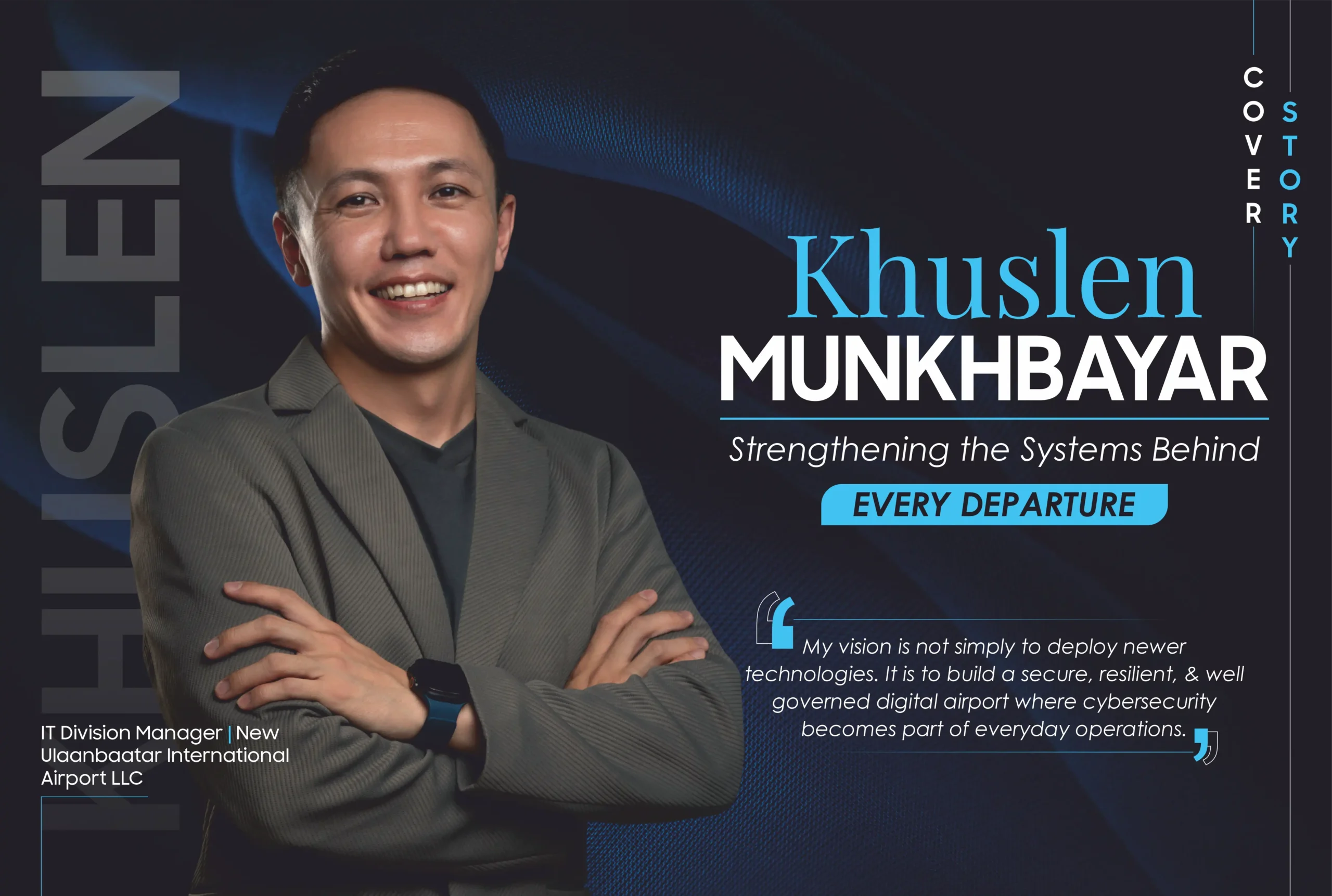
“My vision is not simply to deploy newer technologies. It is to build a secure, resilient, and well-governed digital airport where cybersecurity becomes part of everyday operations.”
“Security should enable airport operations, not create unnecessary obstacles.”
“I believe resilience is just as important as prevention.”
“When security is properly designed, convenience and protection can coexist.”