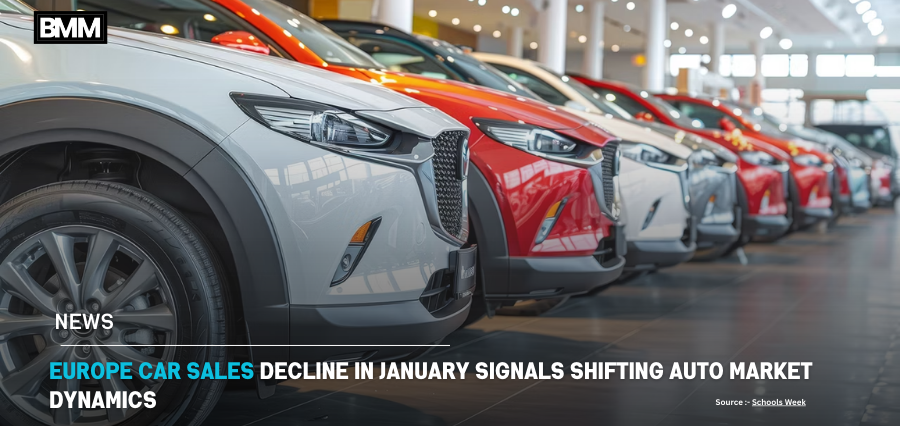
Europe’s automotive sector opened the year on a cautious note as Europe car sales decline figures revealed the first year on year drop since June. According to data released by the European Automobile Manufacturers’ Association, registrations fell across several key markets, reflecting mounting pressures on traditional automakers and a rapidly evolving consumer landscape.+
The European Automobile Manufacturers’ Association released data that showed that new car registrations in the EU, the UK, Switzerland, Norway, and Iceland fell 3.5% in January, bringing the total to 961,382 vehicles. The downturn shows how the car industry in Europe is changing in a big way.
Major Markets Drive the Europe Car Sales Decline
The latest Europe car sales decline was largely driven by weaker demand in major economies such as Germany, France, Belgium and Poland. These markets traditionally anchor regional automotive performance, making their contraction particularly significant.
Norway, on the other hand, saw the biggest drop, with registrations dropping by about 76% compared to January 2025. Analysts who keep an eye on consumer trends have long seen Norway as a bellwether for the adoption of electric vehicles, so this big drop is interesting.
Germany and France also saw big drops, especially in the number of new petrol vehicles registered. The slowdown shows that demand is weak on a cyclical basis and that people’s buying habits are changing in a bigger way.
Petrol Cars Lose Ground Rapidly
One of the most striking elements of the Europe car sales decline is the rapid fall in petrol car registrations. Across the region, petrol powered vehicle registrations dropped by about 26 percent year on year.
In France, the number of petrol registrations dropped by 49 percent, and in Germany, they dropped by 30 percent. Because of this, the share of petrol vehicles in the European market went down from almost one third last year to just over one fifth this January.
This big drop shows that people are moving away from cars with internal combustion engines in favor of electric ones. Automakers that rely heavily on gasoline models are now under more pressure to change how they make cars.
Electrified Vehicles Gain Momentum
While overall volumes reflect a Europe car sales decline, electrified vehicles continued to gain traction. Battery electric vehicle registrations rose roughly 14 percent compared to the previous year. Plug-in hybrid vehicles surged 32 percent, while hybrid electric models grew 6 percent.
In January, battery electric, plug-in hybrid, and hybrid vehicles made up 69% of all new registrations, up from 59% a year earlier. This surge shows that Europe’s shift toward low-emission transportation is speeding up, even though the market is unstable in the short term.
Even as policymakers change the timelines for decarbonization and governments look at how to change subsidy frameworks, the change is still happening. As charging stations become more common and more models are available, people seem to be more willing to use hybrid and electric technologies.
Competitive Pressures Intensify
The broader context behind the Europe car sales decline is the ongoing transformation of the continent’s automotive sector. Traditional European carmakers are grappling with rising competition from more affordable Chinese electric vehicle brands, which have been expanding their footprint across European markets.
Manufacturers are also dealing with changes to the supply chain, stricter emissions standards, and delays in policies that would lead to full decarbonization. As a result, the market is changing, and older companies must find a way to make money with combustion engine models while also making big investments in electrification.
At the same time, people in some markets still don’t trust the economy because of rising prices, higher borrowing costs, and uncertainty about the future. These big-picture factors are making the changes in structure happen faster.
Outlook for the European Auto Sector
Although January figures show a Europe car sales decline, industry observers caution against reading the data as a long term contraction signal. Instead, it reflects a complex interplay between economic cycles and technological transformation.
The fact that electrified vehicles are doing so well suggests that demand isn’t going away, but rather changing categories. Automakers that quickly adjust to this changing demand structure may come out stronger, while those that are slow to do so may face long-term problems.
As 2026 goes on, people who watch the market will keep a close eye on whether car sales in Europe keep going down or level off in the next few months. A lot will depend on how confident consumers are, how clear the rules are, and how quickly manufacturers can adapt their product lines to Europe’s electrified future.
Also Read : –US–China Tariff Dispute Escalates After Supreme Court Ruling