
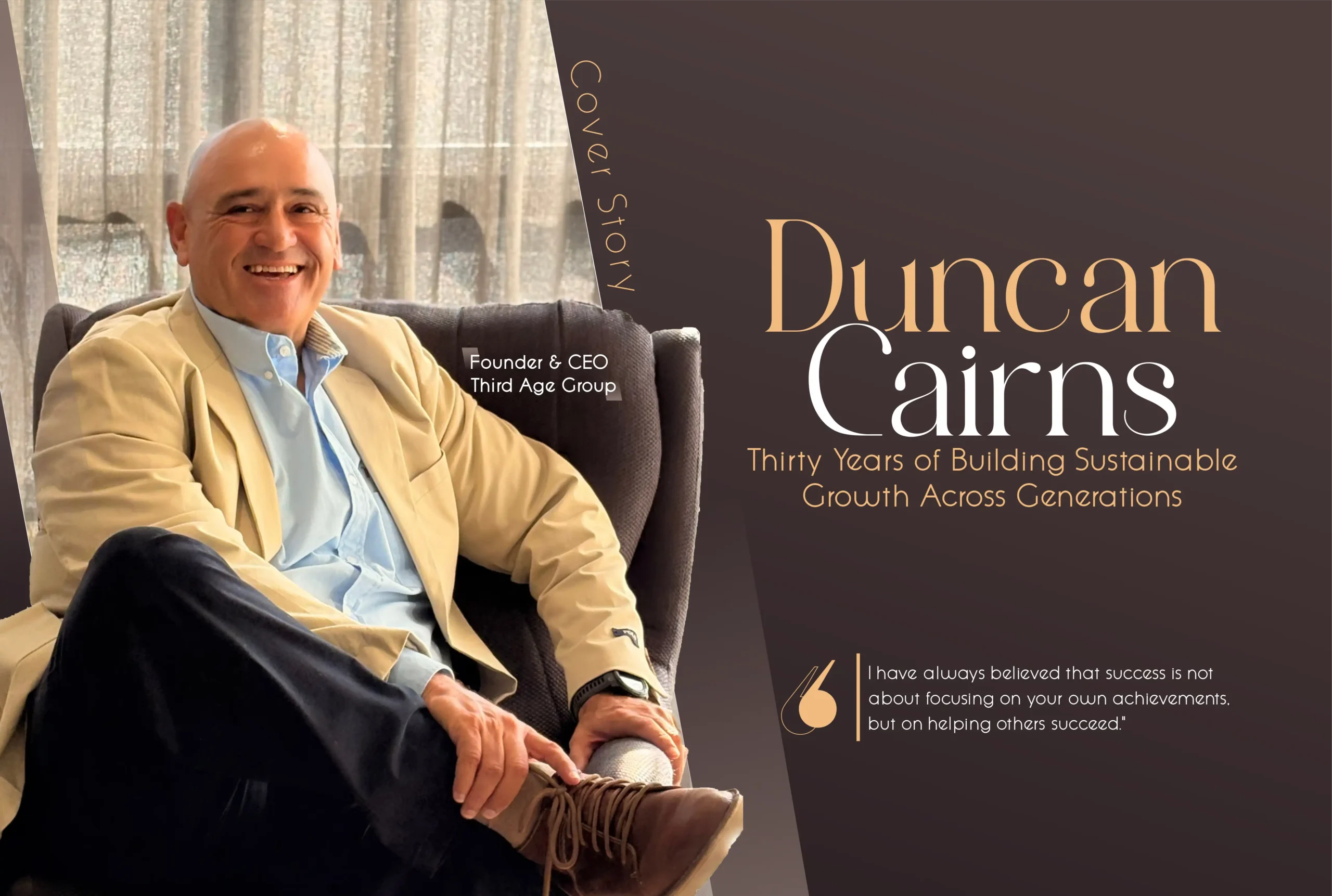
Very few people spend thirty years building the same dream and still speak about it with gratitude rather than exhaustion. Time usually changes people. Ambition softens, priorities shift, and success slowly reveals itself to be far more complicated than wealth or status ever promised. Businesses rise, markets collapse, crises arrive without warning, and entire seasons of uncertainty test whether a vision was built on conviction or convenience. What survives those seasons is rarely strategy alone. It is a belief. Belief in people. Belief in purpose. Belief that something meaningful can still be created even during the hardest chapters.
Duncan Cairns’ journey reflects exactly that kind of endurance. Since founding the Third Age Group in 1996, he has dedicated his life not simply to growing a business, but to building something capable of carrying meaning across generations. Through financial crises, operational reinvention, and decades of transformation, he remained focused on creating an organisation where people could grow, families could build futures, and leadership could outlive titles.
At the helm of Third Age Group is visionary founder and CEO Duncan Cairns, a leader whose passion for people, purpose, and long-term impact has shaped one of South Africa’s most dynamic investment houses. What began as a vision to help individuals prepare meaningfully for their “third age” has grown into a thriving group of companies that today includes brands such as Stepp, BSG, Prism, iF Capital, Rhythm Finance, Rhythm Wealth, Yield Agri Investments, Yield Meatmasters, and many more under the Third Age umbrella.
Building Beyond Profit, Leading Beyond Generations
Success often begins with ambition. In the early stages of business, it is measured through survival, growth, financial stability, and the pursuit of opportunity. Yet for some leaders, time reshapes the meaning of achievement entirely. What once revolved around numbers gradually becomes centered on people, purpose, and the responsibility of building something that outlives the individual who started it. The true test of leadership is not simply the ability to create wealth, but the ability to create impact that continues across generations. Over the past three decades, Duncan has built his journey around this belief, transforming not only a business but a culture rooted in long-term vision, resilience, and human growth.
A Leadership Philosophy Built for Generations
Duncan’s leadership journey began on 1 July 1996, when the foundations of what would later become the Third Age Group were first established. What started as an entrepreneurial venture soon evolved into a deeply personal journey of growth, learning, and transformation. Over the years, his role as CEO changed significantly. While strategy and financial oversight remained important, Duncan increasingly focused on inspiring people to believe in the larger vision being built together.
At the heart of the organisation were strong family values that shaped both its culture and direction. Duncan understood that businesses capable of lasting across generations require more than operational success. They require people who genuinely believe in the purpose behind the work. Much of his leadership, therefore, became centered on energising individuals around shared values and helping them understand that they were contributing to something designed to endure far beyond immediate success.
Even as the group expanded and matured into a professionally managed organisation, Duncan remained closely connected to areas where his strengths and passion naturally aligned. Entrepreneurship, innovation, strategic thinking, and identifying new opportunities continued to fuel his leadership approach. Rather than stepping away from growth creation, he focused increasingly on developing new ventures while ensuring the organisation remained aligned with its long term purpose and culture.
Growing Alongside Clients and Communities
One of the defining aspects of Duncan’s journey has been the parallel growth experienced alongside many of his clients. In the early years, many clients shared similar life stages, ambitions, and financial goals. Duncan often found himself helping others pursue the same aspirations he personally understood and valued at that point in his own life.
As time passed, both his perspective and the needs of clients evolved. Financial success, once viewed as the primary marker of achievement, gradually gave way to deeper reflections surrounding legacy, family, responsibility, and generational impact. This shift influenced the way the business itself evolved. Rather than focusing solely on short term financial outcomes, the organisation began developing solutions designed around long-term sustainability and life stage transitions experienced by clients and families.
For Duncan, business became increasingly connected to human journeys rather than transactions alone. The company evolved alongside its clients, reflecting shared experiences of growth, responsibility, parenthood, succession planning, and long-term vision. This ability to evolve together strengthened relationships and deepened the organisation’s sense of purpose within the communities it served.
Building a Culture Rooted in People
Throughout Duncan’s leadership philosophy, one principle remained constant: success is created through people. While financial growth and strategic expansion are essential, he strongly believes that the true strength of any organisation lies in its ability to develop individuals both personally and professionally.
Creating employment opportunities became about far more than salaries or operational necessity. Duncan viewed work as a pathway toward dignity, confidence, growth, and long-term empowerment. One of the greatest rewards throughout his journey has been witnessing people achieve goals they once considered impossible and watching employees grow into leaders over many years.
This people-centered philosophy became deeply embedded within the organisation’s leadership culture. Duncan consistently emphasized that real success is not measured through personal achievements alone, but through the ability to help others succeed. By investing in people, serving them well, and creating opportunities for growth, the organisation built a culture where collective success mattered more than individual recognition.
Leadership development eventually became one of the company’s highest priorities. Duncan recognised that human resources are often the most complex aspect of business because people bring diverse personalities, motivations, and challenges. Yet he also understood that people remain the most valuable asset within any organisation. Inspired by leadership principles found in the book Good to Great, the company focused on ensuring that the right people occupied the right roles. Technical competence mattered, but so did cultural alignment, loyalty, passion, and shared values.
Over time, the organisation learned that many of its strongest leaders were best developed internally. Individuals who grew within the company naturally understood its culture, vision, and purpose on a much deeper level. As regional expansion occurred, trusted leaders from the core culture were positioned within new divisions and offices, allowing the organisation’s values to spread organically across the group.
Strength Built in Seasons of Uncertainty
Like many enduring organisations, Duncan’s journey was shaped not only by periods of growth but also by moments of significant adversity. Over the years, the business weathered major global and economic crises, including the 1998 emerging markets crisis, the global financial crisis of 2008, and the uncertainty created during the COVID-19 pandemic.
In spite of the fear and uncertainty that comes with such a situation, Duncan had a different mindset which was that of seeing opportunities even in tough situations. The organization concentrated on what can be constructed or enhanced while under such conditions. This approach made him one of the toughest leaders since he was able to stay focused and disciplined while in such situations.
The hardest times for the company came in 2015 when there was a need to overhaul the company structure because of many challenges that it faced. With careful execution and a lot of discipline, the firm was able to come out stronger and achieve tremendous growth.
Such instances further solidified Duncan’s understanding that difficult times can help reveal true strength in both organizations and individuals. Such hard times helped improve relationships, build more loyalty, and foster teamwork and resilience. Growth of the firm occurred in some of its toughest times.
Planting Seeds for Future Generations
As the organisation matured, Duncan’s perspective on business sustainability evolved into something deeply generational. According to him, sustainability requires much more than just being concerned about short-term success and the next generation. It requires continuous development of leadership at all organisational levels.
Another aspect of sustainability that he emphasized relates to remembering and maintaining the history of the organisation. He thinks that companies grow bigger and bigger and forget what got them there in the first place. This includes remembering sacrifices that have been made and stories behind those sacrifices.
From a financial point of view, this kind of long-term outlook means allocating enough funds for reinvestment rather than pursuing profits in the here and now. In other words, Duncan believed that any successful company needed to put its efforts in the creation of a better tomorrow through creating opportunities, building up infrastructures, and making sure that growth will be sustained.
Finally, the importance of implementation became an essential part of Duncan’s vision. He did not believe in big ideas alone and understood the need for continuous implementation of these ideas on a daily basis.
Building a Life Beyond Financial Success
Over the course of three decades, Duncan’s personal understanding of success changed profoundly. Starting with very little, naturally, financial success a strong early motivator. Yet as the years passed, he came to understand that wealth alone cannot provide genuine fulfillment.
Purpose, legacy, family, and meaningful contribution gradually became far more significant. Duncan holds the conviction that true fulfillment can be achieved through creating something that leaves a positive effect on humanity for generations. Providing opportunities, fostering collaborations, creating communities, and creating memorable moments came to be the key aspects for him.
Legacy does not end with structures that have been built and achievements that can be measured financially. Legacy also involves experiences, values, relationships, and culture that are passed on to subsequent generations. All these factors contribute to the foundation that is carried forward.
Duncan leads with the knowledge that growth takes on deeper meaning when it is not just about profits but about purpose as well. This approach has become instrumental not only for his personal development but also for the culture of the company that is built by him for the coming generations.
“A major part of our purpose has always been creating opportunities for people.”
“I have always believed that success is not about focusing on your own achievements, but on helping others succeed.”
“I believe true satisfaction comes from building something that impacts people positively for generations.”
Also Read: Business Minds Media for more information