
A home is rarely just a property. It is the place where parents measure their children’s height against a wall, where retirement plans are quietly built over kitchen tables, where risk and hope often sit side by side in a single signature. Real estate carries the emotional weight of belonging, security, and legacy. Behind every sale is not simply an asset exchanged, but a chapter of someone’s life being protected, surrendered, or begun. That is why the industry asks for something far greater than negotiation skills. It asks for trust, for responsibility, and for leaders who understand that the value of real estate is measured as much in human lives as it is in numbers.
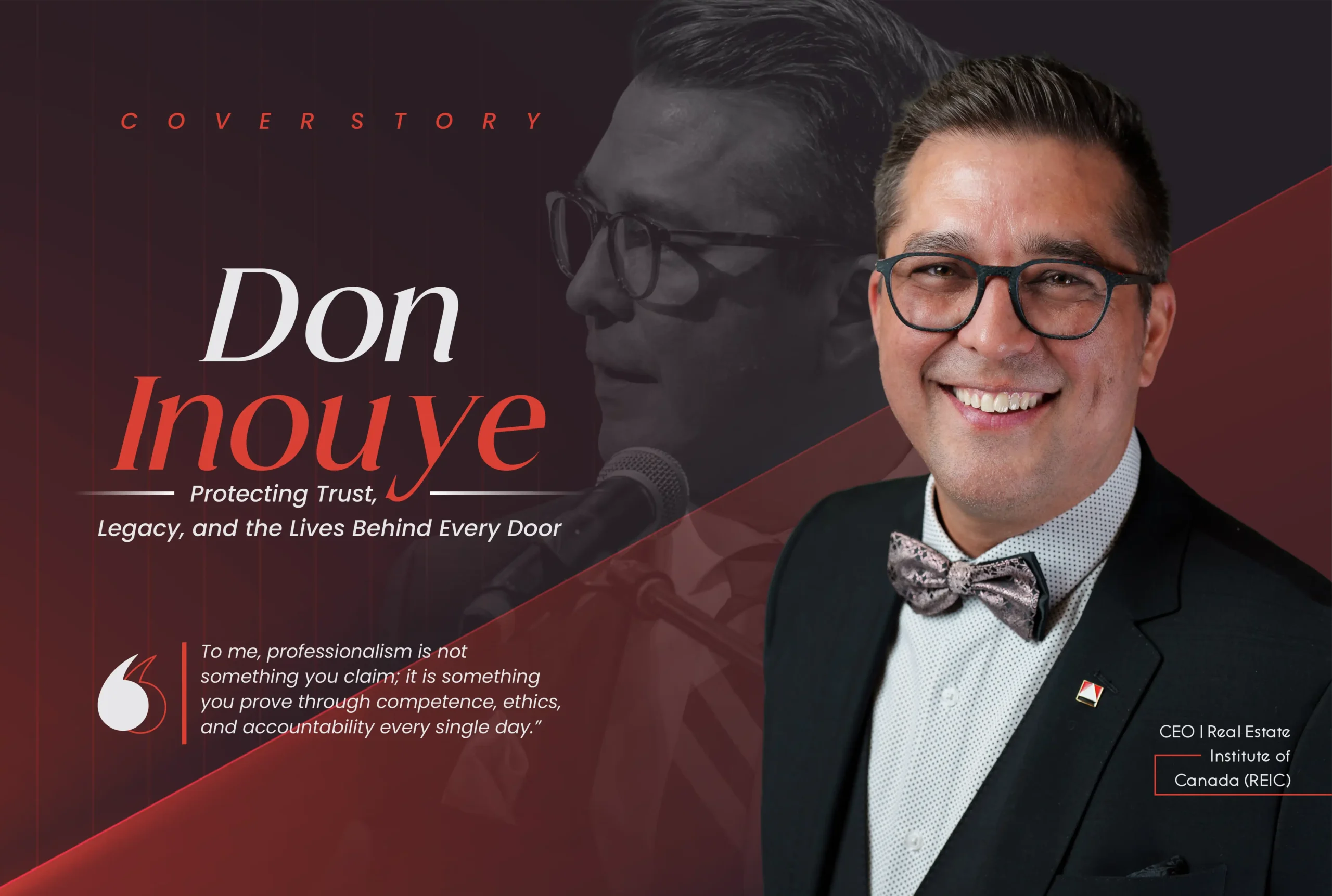
For Don Inouye, this understanding defines the purpose of his work. As CEO of the Real Estate Institute of Canada, he is committed to ensuring that real estate remains a profession worthy of that trust. His focus is not on transactions, but on the people behind them, creating stronger standards, deeper accountability, and a culture where ethics are lived rather than promised.
Building a Profession Rooted in Trust and Excellence
For Don, the core vision behind leading the Real Estate Institute of Canada is to elevate real estate into a profession defined by competence, ethics, and public trust rather than simply transactions between people. He believes real estate decisions shape families’ financial futures, community stability, and long-term wealth, noting that nearly 70 percent of Canadians derive their wealth from real estate gains. Because of this, he sees a responsibility to operate at a far higher standard than merely meeting minimum regulatory requirements.
He views professionalism as something that must be intentionally built, not automatically assumed. This means creating clear pathways for lifelong learning, measurable competency, and governance-focused leadership. It also means strengthening ethical practice as a practical discipline by preparing professionals to navigate conflicts, legal ambiguity, and complex decision-making with consistency and integrity.
His broader goal is to create an industry where excellence is visible, portable, and verifiable, where clients can clearly identify trusted professionals, organizations actively invest in higher standards, and practitioners understand ethics as leadership rather than risk management. For Don, improving professionalism is not only about reputation, but about making better decisions, reducing harm, and strengthening the long-term credibility of Canadian real estate.
Confronting the Ethical Pressures Shaping Real Estate
Don believes the most pressing ethical challenges in real estate are structural rather than individual, shaped by market volatility, information asymmetry, and the enormous financial stakes involved. He identifies conflicts of interest and unclear fiduciary boundaries as a major concern, particularly when referral arrangements, ancillary services, or competing loyalties can shift professionals away from a client’s best interests. For him, the true ethical test lies in ensuring informed consent and complete transparency.
He also points to transparency in pricing, representation, and disclosure as a critical issue. Misrepresentation is often not obvious dishonesty, but rather selective disclosure, omission, or what he describes as optimism bias. Ethical practice, in his view, means slowing down enough to ensure clients fully understand material facts.
Consumer vulnerability is another major concern, especially for first-time buyers, seniors, newcomers, and financially stressed clients. Don believes the ethical standard should rise wherever the risk of harm is greater, protecting clients from pressure tactics, predatory behavior, and decisions they do not fully understand.
He also highlights data ethics, privacy, and the growing use of artificial intelligence as emerging challenges. As the industry becomes increasingly digital, risks involving privacy breaches, misuse of consumer data, opaque algorithms, and automation bias continue to grow. Ethical leadership, he argues, requires governance systems that ensure innovation remains accountable and transparent.
Equity and fair access remain equally important. Discrimination, whether overt or systemic, still appears in who receives opportunities, how advice is framed, and how suitability is judged. For Don, ethical professionalism requires measurable standards and continuous education, not assumptions or slogans.
When Integrity Becomes the Foundation of Trust
For Don, trust in real estate is built in the same moments where it is tested, when pressure is high and the right decision is not always the easiest one. He believes organizations and leaders must treat trust as something intentionally designed rather than something they simply hope to maintain.
This begins with clarity around who is being served and what duty of care truly means, especially when market conditions create urgency or fear. Transparency must be the default, whether in explaining representation, compensation, risks, or material facts, so that clients never feel they are discovering important information too late.
He emphasizes that trust does not come from policies stored away in binders, but from how standards are upheld when challenged. Leaders must make accountability visible and consistent rather than performative. When mistakes occur, they should be addressed quickly, lessons should be learned openly, and systems should be improved to prevent recurrence.
He also sees competence as a core trust strategy, noting that many ethical failures begin as capability gaps. By combining rigorous education, clear expectations, and a culture where ethical judgment is practiced under real-world pressure, organizations can build credibility that withstands scrutiny and earns lasting confidence.
Raising the Ceiling of Leadership Through RSG.D
For Don, the inspiration behind the RSG.D designation was not the creation of a new program, but the revival of one with strong foundations. Originally developed years ago by CUES and later set aside, the designation stood out to him as a strategic fit for the industry’s current challenges, including public trust, governance gaps, rising consumer expectations, and growing complexity in risk management.
He believed the industry did not need another credential that simply added letters after someone’s name. Instead, it needed a designation that strengthened how leaders think, decide, and govern when the stakes are high and solutions are rarely simple.
Reviving the RSG.D was about rebuilding it for today’s market, one shaped by greater scrutiny, regulation, data complexity, and reputational risk. Don sees it helping professionals move beyond transactional expertise toward becoming true stewards of trust, capable of demonstrating competence, ethical judgment, and governance-minded leadership in ways clients, boards, and the public can recognize.
In his view, RSG.D does not just raise the bar for leadership, it raises the ceiling while also lifting the baseline of professionalism expected in boardrooms across the real estate sector.
Lifelong Learning as the Foundation of Credibility
Don sees continuous education as essential in an industry where credibility is judged in real time by clients, regulators, media, and an increasingly informed public. Real estate, he explains, is constantly evolving through legal changes, financial shifts, insurance developments, more complex condominium governance, and rapidly advancing technology.
Because of this, credibility is not something earned once and kept forever. It must be renewed through demonstrated competence.
This is why he places strong importance on programs like the Fellow of the Real Estate Institute and the Certified Reserve Planner. For him, these designations do more than provide knowledge. They reflect a mindset that professionalism requires lifelong learning, stronger judgment, and higher standards.
He also connects education directly to ethical practice, pointing out that many issues seen as ethics failures actually begin as knowledge gaps involving duties, disclosure, governance, or client vulnerability. Ongoing learning helps professionals operate confidently in ambiguity, make defensible decisions under pressure, and lead with integrity.
Ultimately, Don believes continuous education protects both the public and the long-term reputation of the industry itself.
Knowledge That Shapes Leadership
Don believes partnerships with institutions such as UBC Sauder School of Business and the University of Alberta play a vital role in raising industry standards because they bring academic discipline and rigor directly into professional practice.
These collaborations ensure that education and designation pathways are not only current, but credible, grounded in research, governance principles, and practical application. In an industry facing increasing public scrutiny, this strengthens competency, improves decision-making under pressure, and signals to the public that professionalism is measurable and continuously improving.
He also sees these partnerships as drivers of innovation by creating a two-way bridge between the classroom and the field. Universities help anticipate emerging risks, changing regulations, the impact of data and technology, and shifting expectations around ethics and leadership.
At the same time, REIC ensures those insights are translated into practical standards and real-world learning. For Don, these collaborations do far more than produce stronger credentials. They help shape a more resilient, future-ready profession prepared for the challenges ahead.
Global Alliances That Raise the Standard
For Don, international collaborations with global brands such as RE/MAX play a significant role in shaping the Canadian real estate landscape because they raise the reference point for professionalism. He believes that when Canadian practitioners operate within a global network, they are exposed to broader expectations around training, service consistency, consumer protection, and reputation management, as the credibility of an international brand must hold strong across multiple markets.
This global perspective helps accelerate the adoption of stronger standards within Canada, not by simply importing universal practices, but by benchmarking what excellence looks like internationally and adapting it to Canadian realities, including its regulatory environment, market structure, and consumer expectations.
He points to Don Kottick, President of RE/MAX Canada and a Fellow of the Real Estate Institute of Canada, as a strong example of how leadership reinforces these values. For Don, such alliances create a two-way platform that allows Canada to adopt proven ideas in innovation, transparency, and risk management, while also giving Canadian leadership and professional standards a stronger voice on the global stage.
Trust, Technology, and the Next Era of Real Estate
Looking ahead, Don believes the next decade of real estate will be shaped by three major forces: radical transparency, verified professionalism, and technology-enabled trust. Consumers, he explains, will increasingly expect real-time information, clearer representation, and smoother transactions, and they will place their trust in professionals who can explain complexity with clarity rather than pressure.
He sees artificial intelligence playing a major role in automating routine tasks and improving client experience, but he also warns that it will raise new concerns around data ethics, privacy, and accountability. In this environment, governance will become just as important as sales expertise.
He also expects a stronger emphasis on credential verification and continuous education, as being licensed alone will no longer be enough in a world where professional reputation is instantly searchable. At the same time, climate risk, affordability pressures, and evolving regulations will demand more disciplined risk management, stronger disclosure practices, and better long term decision making.
For Don, the professionals who will thrive are not necessarily the loudest voices in the market, but the most trusted ones, those who combine modern tools with timeless professional standards.
Innovation Designed Around Trust
Don believes leaders can successfully balance innovation with traditional values such as trust, transparency, and accountability by treating those values as design requirements rather than optional features added later. In his view, the best innovations do not replace ethics, they strengthen and operationalize them.
This means being clear about the purpose behind new tools, identifying where risks and conflicts may arise, and building safeguards from the beginning. He highlights disclosure prompts, audit trails, data privacy standards, and strong human oversight where judgment matters as essential components of responsible innovation.
He also believes success should be measured by more than speed and scale. Leaders should ask whether innovation reduces confusion, improves outcomes, strengthens consumer understanding, and makes decisions more defensible.
For him, technology earns credibility when it makes professionalism more visible, when clients can clearly see competence, understand the process, and feel protected because accountability is built into the system rather than treated as a slogan.
Leadership Shaped by Responsibility and Vision
Don says the experiences that shaped his leadership philosophy most were the repeated reminders that real estate is far more than an industry. It is a transactional representation of major life events. He has spent time with professionals carrying the responsibility of clients’ biggest financial decisions, with volunteers and board leaders trying to govern responsibly, and with learners seeking a clearer and more respected path into the profession.
These experiences taught him that leadership is not about having the loudest opinion, but about building systems that make good decisions easier. Clearer standards, stronger education, better governance, and a culture where ethics appear when it is inconvenient rather than only when it is easy have become central to his philosophy.
He also describes himself as a dreamer, inspired by what the profession could become if it moved beyond minimum compliance and began designing for trust. He is deeply motivated by the idea of making professionalism visible and verifiable, creating credentials that truly matter to the public, and building a national and increasingly global community of practitioners who do more than close deals. They steward confidence.
For Don, leadership is always future-facing: raising the baseline, developing stronger leaders, and leaving the profession stronger than it was found.
A Legacy Built on Trust and Professional Pride
When Don thinks about legacy, he is not focused on plaques, titles, or formal recognition. What he hopes to leave behind through his work at REIC is a lasting shift in what Canadians expect from real estate professionals and what professionals themselves take pride in delivering.
He wants the industry to move from “trust me” to “here’s why you can,” where competence is visible, ethics is practiced daily, and accountability is embedded into the culture rather than added after problems arise. He sees REIC as the place that does not simply teach people how to perform tasks, but helps them become the kind of professionals the public instinctively trusts.
He also speaks passionately about making professionalism feel “cool again,” not through branding or slogans, but through quiet confidence, clarity, and integrity. To him, true professionalism means being able to explain complexity without ego, refusing to hide behind jargon, and showing leadership especially when it is inconvenient.
He believes trust is not a soft value, but an economic engine that reduces friction, lowers disputes, minimizes harm, and strengthens the reputation of everyone doing the right thing. He wants credentials to carry real meaning for consumers, continuous education to be seen as pride rather than punishment, and governance to become part of everyday decision making, not just a boardroom concept.
Building Trust Beyond the Transaction
To the next generation of real estate professionals, Don’s advice is simple: play the long game. He believes reputation is the real commission cheque because once trust is earned, business begins to follow naturally.
He encourages professionals to learn relentlessly, understanding that the market will always change faster than licensing systems can keep up. Technology should be embraced, but never at the expense of personal judgment. Transparency should be maintained even when it slows progress, and accountability should be upheld even when it creates discomfort.
He also warns against confusing busyness with true value, reminding professionals that people do not come seeking a transaction; they come seeking certainty during uncertain moments.
For Don, the real responsibility lies in bringing competence, calm, and character into those moments. Professionals who tell the truth, explain the risks honestly, and protect the dignity of their clients will do more than build successful careers; they will help build a profession worthy of the impact it has on people’s lives.
“I believe real estate is never just about property; it is about trust, security, and the lives people build behind every door.”
“To me, professionalism is not something you claim; it is something you prove through competence, ethics, and accountability every single day.”
“I want the industry to move from asking people to trust us to giving them clear reasons why they should.”
Also Read: Business Minds Media for more information