Senior Chinese Official Meets Disney CEO in Beijing
China’s Vice Premier Ding Xuexiang met with Bob Iger in Beijing on Friday, signalling renewed openness toward US entertainment investment as Disney China strategy takes centre stage once again. Ding reportedly urged Disney to increase its investments in China, which is a significant shift from Beijing’s vow to impose restrictions on Hollywood film imports due to rising US-China trade tensions last year, according to official media.
For US businesses operating in US-China , where political unrest coexists with enormous commercial potential, the gathering takes place at a delicate time. The conversation highlights China’s strategic significance to Disney’s long-term goals for worldwide expansion.
Disney China Strategy Faces a Complex Market Reality
China’s $19 trillion economy offers immense potential, particularly among its young, affluent urban middle class. Theme parks, experiential entertainment, and global franchises continue to resonate with this demographic, making the Disney China strategy especially focused on location-based experiences rather than box-office dominance.
The nation’s strictly regulated film industry, however, continues to be a structural obstacle. Beijing severely restricts the number of foreign films that are allowed to be shown in theaters each year, which limits Hollywood’s influence and shapes Disney’s brand positioning in China.
Hollywood’s Shrinking Box Office Share in China
China has limited Hollywood imports to about ten films per year for almost thirty years, a strategy that has drastically changed the tastes of viewers. According to observers, domestic productions currently control the second-largest film industry in the world, with Hollywood films making up only roughly 5% of all box office receipts.
This shift was underscored last year when Chinese animated blockbuster Ne Zha 2 surpassed Pixar’s Inside Out 2 to become the highest-grossing animated film of all time. Such milestones highlight why the Disney China strategy cannot rely solely on theatrical releases.
Theme Parks Anchor Disney China Strategy
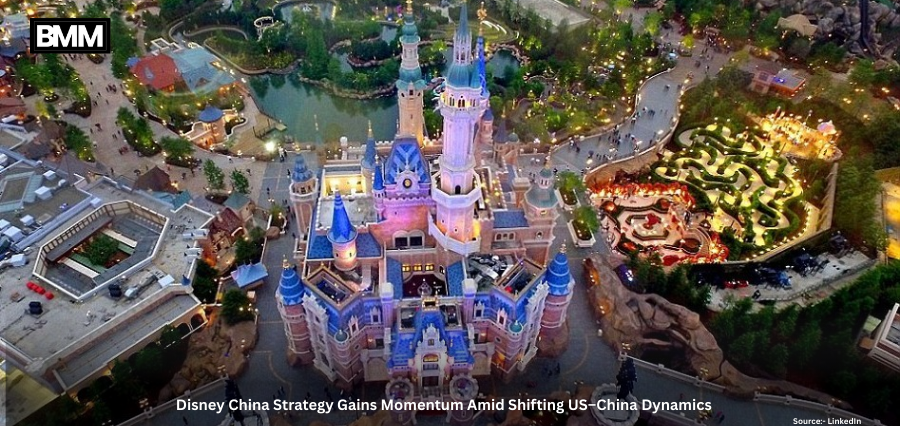
Instead, Disney has increasingly anchored its Disney China strategy around immersive theme park experiences. Bob Iger previously oversaw the opening of Shanghai Disneyland, which has become one of the company’s most successful international parks and a powerful branding engine despite film market limitations.
Similar tactics have been used by Universal Studios with its theme park in Beijing, supporting the notion that physical locations provide a more reliable and politically resilient economic model than just movie distribution.
Iger’s Legacy Shapes Current Engagement
Bob Iger’s visit has also drawn attention to his legacy of expanding Disney’s global media empire. During his tenure, Disney acquired Pixar, Marvel, and the Star Wars franchise—intellectual properties that fuel merchandise, streaming, and theme park attractions worldwide. These assets remain central to the Disney China strategy, even if their cinematic exposure in China is restricted.
According to state media, Iger stated that Disney is “full of confidence in China’s development” and will keep increasing its investment there, reaffirming the company’s long-term commitment in spite of geopolitical challenges.
Speculation Grows Over a Second Disney Park
Iger’s Beijing trip has reignited speculation that Disney may be considering a second amusement park in China. While no official announcement has been made, analysts note that expanding physical infrastructure would align closely with the Disney China strategy, allowing the company to deepen US-China consumer engagement without relying heavily on film approvals.
Such a move would also signal confidence in China’s consumer economy at a time when many Western firms are reassessing their exposure to the market.
Disney China Strategy at a Crossroads
Disney’s ability to strike a balance between diplomacy, regulation, and business ambition will be widely observed as US-China relations continue to be tense. Ding Xuexiang and Bob Iger’s meeting indicates that Beijing believes Disney’s investment is worthwhile for the time being.|
The House of Mouse’s ability to prosper in the second-largest economy in the world may depend on how well the Disney China plan adjusts to China’s changing political and cultural environment.
Also Read :- Character.AI Reaches Settlement in Lawsuits Alleging Harm to Young Users