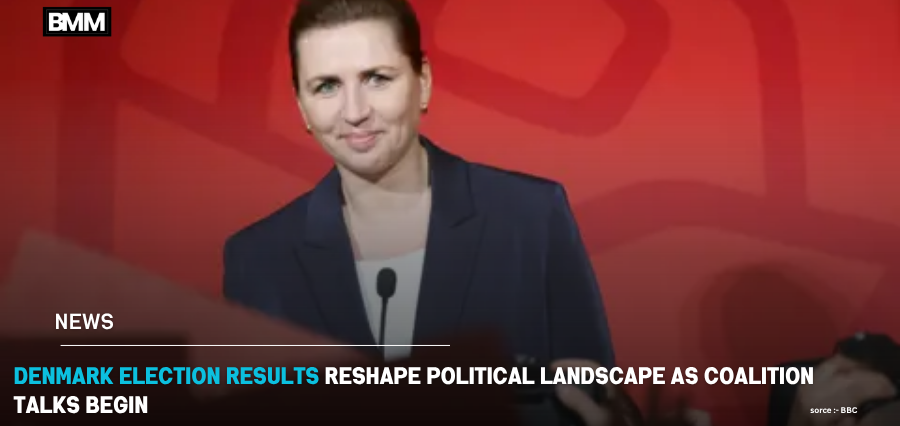
The Denmark election results have triggered a significant political shift as Prime Minister Mette Frederiksen submitted her government’s resignation following a major electoral setback. The announcement, confirmed by the royal palace, marks the beginning of a new phase in Danish politics, with coalition negotiations expected to shape the country’s next government.
Despite remaining the leader of the largest party, Frederiksen now faces a complex path forward as competing blocs struggle to secure a majority.
Denmark Election Results Deliver Historic Setback
The latest Denmark election results dealt a heavy blow to Frederiksen’s Social Democratic Party, which recorded its worst performance since 1903. The party secured just 38 seats in the 179-seat parliament, a sharp drop from the 50 seats it held after the previous election.
This decline reflects growing voter dissatisfaction driven by concerns over immigration, rising living costs, and pressure on welfare systems. While the Social Democrats retained their position as the single largest party with 21.9 percent of the vote, the loss of seats has weakened their ability to govern independently.
A Divided Parliament with No Clear Majority
The Denmark election results have led to a divided parliament where both blocs have not met the 90 seats to have a majority. left leaning bloc got 84 seats and right leaning parties won 77 seats together.
This split brings into the limelight a highly polarized political scenario in which the development of a stable government will necessitate a keen negotiation and compromise. The two blocks are currently fighting to have alliances that can gain parliamentary backing.
Moderates Party Emerges as Kingmaker
Among the greatest consequences of the Denmark election results is the ascendancy of the part of the Moderate Party, which is headed by Lars Lokke Rasmussen. The centrist party secured 14 seats and this makes it a key actor in selecting the next government.
Since the two major blocs do not have a majority, the balance of power lies with the Moderates. Their move or not to vote in favor of Frederiksen will make or break the political style of the country.
This kind of kingmaker position makes Rasmussen rather influential in terms of policy priorities and coalition deals in the next few weeks.
Coalition Talks Set to Define the Future
After the Denmark election results, political parties are making plans that could require long and complicated negotiations in forming a coalition. The talks should start at once, and every party should be looking at potential alliances.
With a successful negotiation of a coalition, Frederiksen still has an opportunity of gaining a third term as prime minister. Other leadership situations are, however, present on the table with the formation of alliances.
The result of these negotiations is what will shape the leadership as well as the policy path of Denmark in the coming years.
Domestic Issues Dominate Voter Concerns
Although international matters did not always feature in the headlines, domestic matters dominated the Denmark election results. The voters paid much attention to the immigration policies, economic pressures due to cost of living, and the sustainability of welfare programmes.
The vehement opposition that Frederiksen gave to Donald Trump concerning his desire to purchase Greenland had no major impact on the voting opinion.
Rather, ordinary economic and social issues were the main problems of the election.
Conclusion Uncertainty and Opportunity Ahead
The Denmark election results has brought an era of confusion and at the same time political rejuvenation. Having no obvious majority and the decisive influence of the Moderates, Denmark has been at the crossroads.
Frederiksen will continue to be in power or a new leader will come to power, depending on the results of the coalition negotiations. The only thing that remains evident is that the political landscape in the country has changed and the decisions that will be arrived at in the days to come will determine the way forward of Denmark.
Also Read :- Michelle Bachelet UN Secretary-General Bid Faces Setback as Chile Withdraws Support