
A single structure today is rarely just a structure. It is a convergence of engineering precision, regulatory oversight, environmental responsibility, and human intent. Multiple stakeholders shape it, advanced systems sustain it, and its lifecycle stretches far beyond its initial blueprint. Yet, beneath all this sophistication lies a fragile truth: without clarity, even the most ambitious projects can drift into uncertainty. A miscalculation, an overlooked detail, or an incomplete dataset can ripple across timelines, costs, and safety. Precision is no longer a technical requirement. It is the foundation on which confidence is built.
This is exactly where David Locker has chosen to focus his work at Plowman Craven. His approach begins with a simple belief that complexity should never be left to assumption. It should be understood, measured, and made visible. At Plowman Craven, that belief translates into turning physical environments into something people can rely on with certainty.
Honoring a 6-Decade Legacy
David has continued to shape Plowman Craven’s vision by building on its strong 60-year foundation while positioning the company at the forefront of the evolving geospatial industry. Throughout its history, the organization has consistently operated at the leading edge, and under David’s leadership, that commitment remains unwavering.
Plowman Craven is the only geospatial company in the world to offer global account coverage for its clients, a competitive advantage David intends to build on further as the business continues to expand internationally.
The company’s vision centers on delivering a smarter and more sustainable built world. Plowman Craven’s vision has been shaped not just from within, but in close collaboration with clients and key strategic partners whose input has been central to defining where the business is headed. This ambition reflects a clear focus on digitizing assets, providing geospatial clarity for clients, and applying technical expertise to solve real-world challenges. Over decades, Plowman Craven has measured thousands of assets, including landmark structures, and contributed to large-scale projects globally. In London alone, the company has mapped a significant portion of the city’s buildings, creating a valuable geospatial archive that continues to support future developments.
The milestone 60th anniversary in 2024 was celebrated at The Gherkin, a symbolic setting surrounded by structures the company has measured over the years. The gathering represented a collective 1,164 years of survey expertise, highlighting the depth of experience within the organization. Innovation remains central to its identity, driving advancements in technology, workflows, and methodologies to consistently deliver value.
The transition to an employee-owned business in 2021 marked a significant cultural shift, giving employees a stake in the company’s future and reinforcing shared responsibility. At the same time, expansion into markets such as North America and Australia, along with a focus on sectors like Energy, Rail, and Industrial, has broadened the company’s reach. The addition of services such as Inspection and Marine further strengthens its capabilities.
David has also overseen the growth of an in-house AI and software development team, leading to the creation of Easl, the company’s geospatial hosting platform. The Easl platform is designed to become the single destination for all data types Plowman Craven captures, reflecting a strategic move toward not just collecting data, but interpreting and presenting it in ways that create meaningful value. With six decades of owned geospatial data now available to be interrogated by AI, David believes the company sits on one of the most valuable built-environment datasets in existence. With operations now spanning five countries and a projected workforce exceeding 300 employees by 2029, Plowman Craven continues to strengthen its global presence while maintaining strong client relationships across borders.
Looking ahead, David is focused on accelerating global expansion, advancing AI-enabled geospatial intelligence, and leveraging the company’s extensive data archive to unlock deeper insights. The ability to digitize assets and deliver enhanced value in a digital landscape remains central to the company’s long-term vision.
A Journey That Built the Leader
Before joining Plowman Craven, David’s career spanned large corporations, running and selling his own businesses, and leading through a private equity-backed growth phase, a breadth of experience that directly shapes how he leads today.
David’s journey within the organization has played a defining role in shaping his leadership approach. Since joining in 2016, he has progressed from Operations Director to CEO in 2024, a transition that coincided with the entry of Agathos as a private equity investor.
This progression provided him with a comprehensive understanding of the business, from operational intricacies to strategic direction. His leadership today reflects both this operational grounding and a forward-looking mindset.
The challenges brought by the COVID-19 pandemic became a pivotal moment for the company. Navigating uncertainty required flexibility, resilience, and a willingness to adapt quickly. These experiences led to the development of a structured five-year plan aimed at driving growth beyond the crisis.
In 2021, the company completed a management buyout, establishing an employee-owned trust and resetting its strategic direction. The organization successfully delivered its five-year plan within three years, demonstrating both execution capability and strategic clarity. The subsequent partnership with Agathos provided the resources to accelerate growth further.
David has since focused on building a strong leadership team, bringing in new expertise and perspectives from across the industry. This infusion of fresh thinking has driven momentum and innovation, enabling the company to evolve while remaining aligned with its core strengths.
Plowman Craven has an unusually high concentration of people who have been with the company for five, ten, twenty, thirty, or even fifty years, working alongside a growing number of senior new joiners who bring fresh expertise, different perspectives, and energy from both inside and outside the industry, a combination that gives the business both the stability of deep knowledge and the momentum of continuous renewal.
Aligning Teams to Deliver Scalable Growth
Managing multiple business units and diverse operations requires a disciplined yet adaptable approach. David emphasizes breaking down complex challenges into actionable initiatives, ensuring that strategic goals translate into practical execution.
Collaboration and shared success are central to this approach. By fostering alignment across teams, the organization is able to move forward cohesively while maintaining focus on long-term objectives, including its 2029 growth targets.
Central to David’s approach has been a deliberate balance between short-term delivery and long-term transformation, running the business day-to-day whilst simultaneously building for the future. Underpinning this is a ‘Good to Great’ philosophy: getting the right people in place first, building strong role models, maintaining clear communication, and fostering the agile thinking that allows the business to adapt and grow.
David is direct about the need to confront brutal truths, avoid perfection paralysis, and embrace the discomfort of change as a catalyst for growth. In his view, these aren’t uncomfortable ideas, they are the conditions under which real progress happens.
A matrix organizational structure supports this strategy, combining functional expertise with sector-focused divisions. This approach enhances cross-selling opportunities and provides a more comprehensive understanding of client needs. Internal systems and analytics further strengthen decision-making capabilities, allowing the organization to operate effectively across multiple markets and datasets.
One of David’s less visible but equally important decisions has been to simplify, a cleaner organisational structure, more clearly defined roles, and a more streamlined IT environment. In a business of growing complexity, clarity of structure is itself a competitive advantage.
Aligning Diverse Sectors Through Shared Capability
Operating across property, rail, and infrastructure sectors presents both opportunities and challenges. David ensures alignment by focusing on shared capabilities that can be applied across different domains.
Encouraging collaboration and knowledge sharing allows teams to learn from each other while maintaining a unified approach. At the same time, the organization balances complexity with practicality, recognizing that not every project requires a highly complex solution.
David emphasizes the importance of both macro and micro perspectives, enabling the organization to address detailed operational requirements while maintaining a broader strategic view. This balance supports both efficiency and innovation across varied sectors.
Reimagining the Future of Geospatial Intelligence
Technological advancement continues to reshape the geospatial industry, and David has positioned Plowman Craven at the forefront of this transformation. Innovations such as BIM, UAVs, and 3D modelling are not only enhancing measurement capabilities but also redefining how data is used.
David recognizes that the true value lies not just in collecting data, but in understanding and applying it effectively. Ownership and accessibility of data are becoming increasingly important, particularly in an AI-driven future.
The organization has evolved beyond its traditional identity as a surveying company, expanding into a multidisciplinary group that includes data specialists, software developers, and AI experts. This shift has accelerated innovation, supported by a dedicated team focused on developing and testing new tools.
Interoperability between systems and technologies is another key focus area, ensuring that different tools work together seamlessly to deliver better outcomes. The company’s independent approach allows it to remain unbiased, enabling innovation that is driven by client needs rather than constraints.
For David, the more significant innovation is not any individual technology but the interoperability between them, the ability to connect multiple systems and data types into a seamless whole. Crucially, Plowman Craven’s independence means it is beholden to no single vendor, allowing it to select and integrate tools based entirely on what delivers the best outcomes for clients.
David also encourages a culture of experimentation, where rapid testing and learning are embraced. This mindset allows the organization to adapt quickly, refine its approach, and stay ahead in a rapidly evolving industry.
Clarity, Collaboration, and the Courage to Choose Right
For David, driving transformation within an established organization begins with clarity. He believes that clearly articulating the goals of the business is essential, as these goals serve as a constant reference point for decision-making. During Plowman Craven’s recent rebrand, this principle became especially important, offering an opportunity to reassess the company’s vision and values as a collective.
He emphasizes that choosing what is right over what is easy creates focus and direction. With a clearly defined roadmap, the organization is able to evaluate daily decisions and challenges against its broader purpose. Vision, mission, and values are not treated as abstract ideas, but as practical tools that guide how the business operates and evolves.
David also recognizes that transformation cannot be achieved in isolation. Partnerships and collaborations play a critical role in scaling capability and responding to client demands. Over the years, the company has built a strong global network of industry experts and partners, enabling it to remain agile and responsive, particularly when managing multiple large-scale projects simultaneously.
Building a Culture Where Collaboration Drives Excellence
With a workforce of over 200 professionals, David has focused on fostering a culture that balances technical excellence with collaboration and innovation. He views the organization as a unified team driven by a shared purpose, where collaboration acts as the engine of success.
Creating an environment where people can succeed is a priority. This includes maintaining a strong commitment to integrity, consistently choosing long-term impact over short-term gains. Diversity and inclusion are also central to this culture, with a wide range of perspectives contributing to stronger decision-making and better outcomes.
David has placed significant emphasis on learning and development, ensuring that employees have access to clear career pathways and opportunities for growth. A structured personal development framework reinforces desired behaviors and values, rewarding those who embody the company’s culture.
Equally important is the development of an accessible and capable leadership team. By reflecting the diversity of the workforce and the communities it serves, leadership becomes more representative, accountable, and effective in guiding the organization forward.
Growing Across Borders with Local Focus
As Plowman Craven continues to expand its global footprint, David maintains a clear approach to balancing scale with local relevance. While the company operates with a global mindset, its execution is tailored to the specific dynamics of each market.
The organization’s four core divisions remain consistent across regions, providing a stable foundation. At the same time, David ensures that efforts are concentrated in targeted areas within each market, often guided by client needs and opportunities.
Local engagement plays a key role in this strategy. By participating in regional events and building local partnerships, the company strengthens its presence and ensures that its services remain relevant and responsive. As the business grows, this approach allows it to deepen expertise while expanding capabilities in line with evolving client expectations.
Embedding Quality and Integrity into Every Project
In an industry where precision and trust are fundamental, David places strong emphasis on maintaining quality and integrity across all projects. This begins with establishing clear standards at the outset of every engagement, supported by formal quality assurance and control processes.
Independent review mechanisms and structured sign-off procedures ensure that work remains aligned with both client expectations and industry best practices. Beyond processes, David highlights the importance of investing in people, training, and culture to uphold standards, even under pressure.
Data management is treated as a core capability, with careful attention to version control, metadata, and traceability. Transparent communication with clients is equally critical, with open reporting of risks and limitations fostering trust and accountability.
Continuous improvement is embedded into the organization through post-project reviews and evolving standards. By involving clients in validation processes, Plowman Craven reinforces its commitment to delivering consistent quality. Over time, this approach has built a strong track record, demonstrating that integrity is not just a principle, but a defining characteristic of the organization.
Data at the Core of Value Creation
For David, data sits at the heart of the company’s value proposition. It is not simply collected, but processed and presented in ways that generate insights and unlock opportunities for clients.
Through the Easl platform, Plowman Craven is developing new ways to democratize access to data, making it more accessible and valuable to a wider range of users. This shift supports a move away from transactional, project-based engagements toward deeper, ongoing client relationships.
The company’s capabilities span the entire lifecycle of a building or asset, from initial design to operation, redevelopment, or end-of-life. By combining expertise in measurement, inspection, monitoring, and digitization with AI-driven tools, the organization is enhancing its ability to deliver accuracy, efficiency, and strategic insight.
This integration of data and technology positions Plowman Craven to continue driving innovation and creating long-term value in the geospatial industry.
Expanding Horizons Through Intelligent Innovation
Looking ahead, David envisions Plowman Craven as a globally influential geospatial brand, building on the foundation established over six decades. He anticipates continued industry consolidation in the UK, alongside significant growth opportunities in regions such as North America, Europe, and Australia.
A key focus will be on accelerating data capture and integrating diverse datasets to deliver richer and more actionable insights. Advanced visualization, interoperability, and strong data governance will enable stakeholders at all levels to better understand opportunities, risks, and value.
David also sees AI and automation as transformative forces within the industry. Rather than viewing them as threats, he considers them tools that enhance human expertise and expand what is possible. While some traditional practices may evolve or become obsolete, the organization’s ability to embrace and apply innovation will ensure its continued relevance.
AI will not replace the expertise that built this industry, but it will interrogate it, accelerate it, and ultimately challenge who controls it. As machines begin to interpret decades of geospatial data faster than any surveyor ever could, the question worth sitting with is this: who ultimately owns the intelligence it creates, and who is responsible for what it gets wrong?”
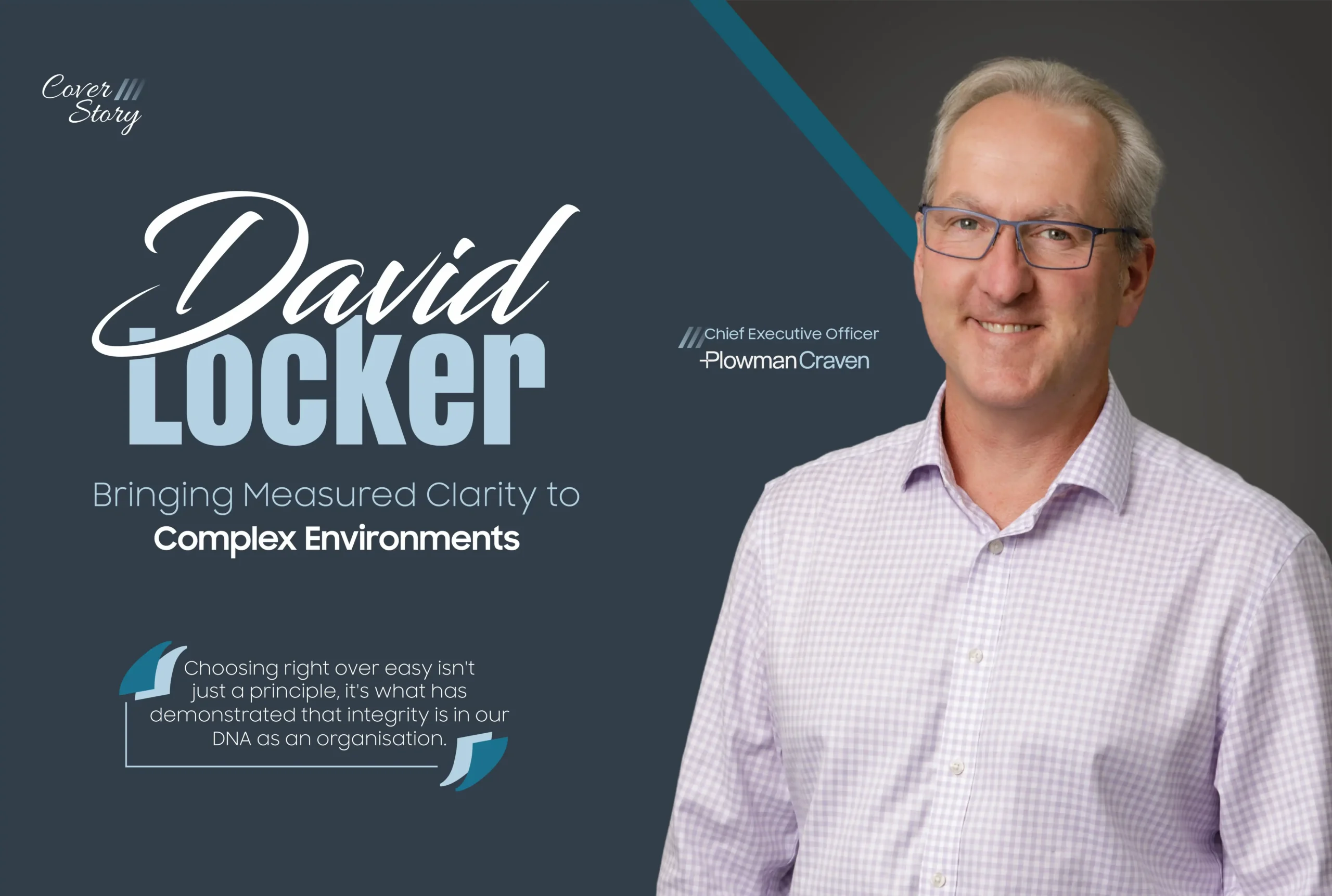
“Choosing right over easy isn’t just a principle, it’s what has demonstrated that integrity is in our DNA as an organisation.”
“We own most of the data we have collected over 60 years. That archive, powered by AI, will offer insights the industry has never had access to before.”
“Some traditional survey practices will evolve, perhaps even become obsolete. But we will continue to succeed as the organisation best placed to promote and utilise technical innovation, rather than fear it or be replaced by it.”
Also Read: Business Minds Media for more information.