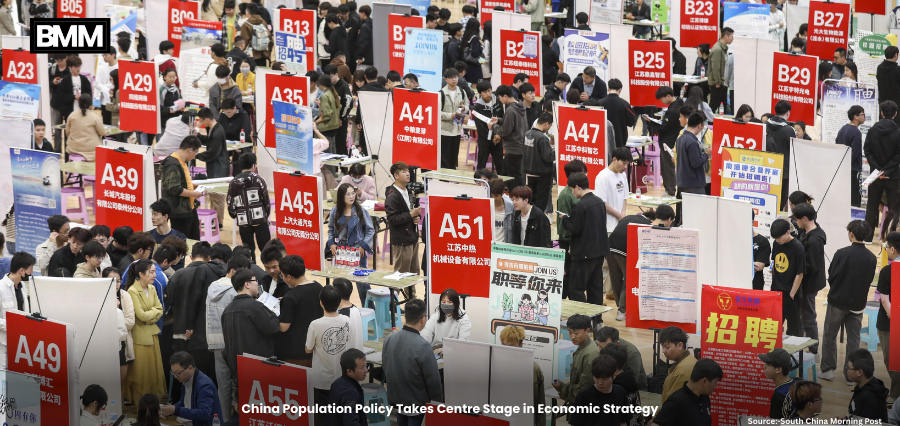
China population policy is emerging as a central pillar of Beijing’s broader economic strategy as authorities roll out their most comprehensive effort yet to reverse a flagging birth rate. Official population data due on January 19 is expected to show China’s population shrinking for a fourth consecutive year, underlining the urgency of the government’s push to boost births.
The renewed focus on China population policy reflects mounting concerns over slowing domestic consumption, a rapidly ageing society, and a shrinking workforce, challenges that threaten long-term economic growth.
$25.8 Billion Push to Boost Birth Rates
Beijing is looking at a total potential cost of around 180 billion yuan ($25.8 billion) in 2026 to support births. The figure includes the cost of a national child subsidy introduced for the first time last year, as well as expected insurance payments tied to pregnancy and childbirth.
As part of the expanded China population policy, the government has pledged that women in 2026 will face “no out-of-pocket expenses” during pregnancy. The national medical insurance fund will pay for all medical costs, including in vitro fertilization (IVF). China’s finance ministry didn’t respond right away to requests for comment, but economists say the estimates are in line with what the government has planned.
Legacy of Population Control and New Economic Pressures
China’s population has been getting smaller since 2022. This is because of strict population control policies that helped lower poverty but changed family structures for good. Today, those old policies make it harder for Beijing to shift the economy toward growth based on consumption.
Under the evolving China population policy, officials are grappling with the reality that hundreds of millions of people are expected to exit the workforce in the coming decades, just as pension budgets are already under strain. Demographers warn that fewer children today could mean fewer households tomorrow, slowing consumption growth and weakening long-term demand.
Experts Warn Policies May Have Limited Impact
Despite the scale of new spending, experts remain sceptical that the revised China population policy will generate a meaningful rebound in births.
“These efforts might have some effect, but their effect is likely to be small. Xiujian Peng, a senior research fellow at Victoria University’s Centre of Policy Studies, said, “Low fertility is a common problem in East Asia.”
Demographers say that China’s fertility rate is about one birth per woman, which is much lower than the 2.1 level needed to keep the population stable. They also say that the rate is likely to drop even more. This trend puts China among the countries with the lowest birth rates in the world.
Demographic Decline Set to Accelerate
United Nations projections suggest that the number of Chinese women of reproductive age, defined as those between 15 and 49, will decline by more than two-thirds to under 100 million by the end of the century. This demographic shift presents a structural challenge that even an aggressive China population policy may struggle to overcome.
Peng said that similar plans in other countries have not worked very well. “Japan, South Korea, and Singapore have put a lot of money into pro-natalist policies, but they haven’t worked very well.” He said, “This experience shows that there is no quick or easy fix.”
Lessons from East Asia’s Pro-Natalist Efforts
China’s birth-support subsidies are similar to those in Japan, but not as high as those in South Korea, which spent about $64.8 billion in 2025 to deal with its fertility crisis. Singapore has also worked hard to help families.
But none of these countries have seen a steady rise in birth rates, which makes people wonder how effective China’s population policy will be in the long run, even though it is making more financial commitments.
Outlook: Structural Challenge for China’s Economy
Beijing is sticking to its population policy in China, and the measures show strong political will, but they face strong social and economic headwinds. Young people still don’t want to have kids because of high living costs, changing views on marriage, and work stress. For China, reversing the decline in population may be one of the most difficult and expensive economic problems it will face in the next few decades.
Also Read :- CK Hutchison Targets $30 Billion Valuation with Dual Listing