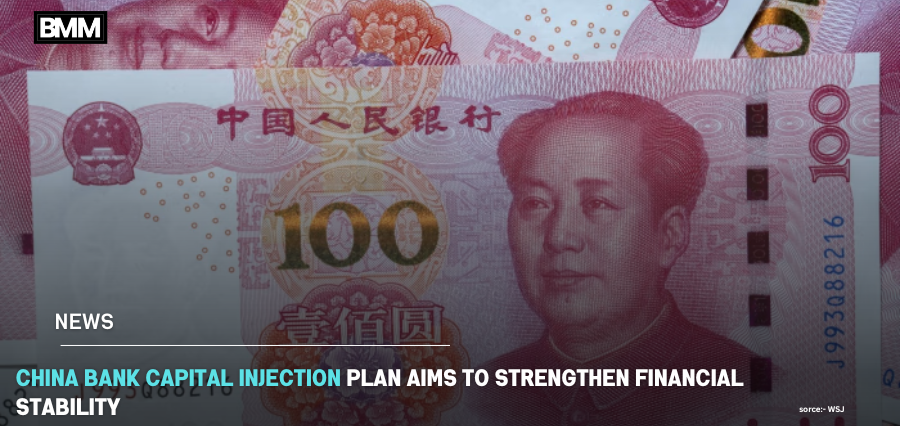
China has announced a major financial measure aimed at reinforcing its banking system and preventing systemic risks within the economy. The government revealed that it will inject 300 billion yuan, equivalent to about $43.6 billion, into major state-owned banks this year. The China bank capital injection will be carried out through a special treasury bond as part of broader reforms targeting the country’s financial sector.
The announcement was included in the annual government work report presented during the opening session of the National People’s Congress (NPC) in Beijing. Authorities say the China bank capital injection will help strengthen the financial system as the country navigates economic challenges such as a prolonged property crisis, weak consumer demand, and deflationary pressures.
Strengthening State-Owned Banks
The planned China bank capital injection is expected to focus primarily on large state-owned lenders. Analysts believe institutions such as the Industrial and Commercial Bank of China and the Agricultural Bank of China are among the banks likely to receive fresh capital support.
These banks play a central role in China’s financial system by providing loans to businesses, local governments, and consumers. However, economic pressures in recent years have placed increasing strain on lenders’ balance sheets.
By injecting additional capital, the Chinese government aims to improve the financial resilience of these institutions. The China bank capital injection will allow banks to strengthen their core capital ratios, absorb potential losses, and maintain stable lending to the broader economy.
Addressing Rising Non-Performing Loans
A key reason behind the China bank capital injection is the rising level of non-performing loans within the banking sector. Financial institutions have been facing increasing credit risks, particularly from struggling real estate developers and financially stressed local governments.
China’s property sector, once a major driver of economic growth, has been experiencing a prolonged downturn. Many developers have encountered liquidity problems, leading to delayed projects and reduced investor confidence.
The government’s work report indicated that authorities will also focus on disposing of non-performing assets in the financial sector. The China bank capital injection will therefore not only strengthen banks’ balance sheets but also support efforts to manage bad loans more effectively.
Part of a Broader Financial Reform Strategy
The China bank capital injection forms part of a broader strategy to reform the country’s financial system and reduce systemic risks. Policymakers are working to improve the structure and oversight of financial institutions, particularly smaller regional lenders that may face greater vulnerabilities.
The government has indicated plans to regulate competition among financial institutions and promote consolidation among small and medium-sized local banks. By encouraging mergers and stronger oversight, authorities hope to create a more stable and efficient financial environment.
These reforms, combined with the China bank capital injection, aim to ensure that the banking system remains capable of supporting economic growth while managing financial risks.
Supporting Investment and Capital Markets
The government is also trying to encourage more long-term investment into the financial markets of China in addition to stabilizing the banking sector. Authorities have declared that they would enhance market accessibility to institutional investors and motivate more capital sources to implement medium and long-term involvement.
The authorities also intend to increase outlets of the private equity and venture capital funds. Through these more adaptable lines of investment, China will be able to spur innovation and increase the involvement of the privatized sector in the economy.
Although the bank lending continues to play a significant role in financing in China, the policymakers are desirous to have a higher proportion of direct financing by equity markets. These efforts will be supplemented with the injection of China bank funds which will make sure that the banks are stable enough to sustain the economic activity during the transition.
Building Confidence in the Financial System
The Chinese economy is already going through the various complicated situations such as the slower growth pace, the poor consumer confidence, and the continued strain in the property market. Under these circumstances, it is important to keep faith in the financial system.
Bank China bank capital injection aims at convincing the markets that the government is ready to take a proactive position to avoid the financial turmoil. The authorities will reduce systemic risk by making banks stronger in terms of their capital structure and overcome the asset-quality issue to ensure credit flow to important sectors.
To investors and financial institutions, the initiative is an indication that Beijing is still determined in ensuring that the stability of its banking system is eased as it engages in a larger financial reform.
Outlook for China’s Financial Sector
With the second-largest economy in the world trying to adapt to the changing world and domestic environment, financial stability will be a primary concern of policymakers. The China bank capital injection is a major move towards strengthening the banking system of this country.
Although other challenges like property sector debt and slow economic growth may still occur, better banks may have a significant role to play in recovery. Through capital support and regulation reforms and investment programs, China will establish more balanced and sustainable financial systems in the future.
Also Read :- Middle East War and the Global Economy: IMF Warns of Rising Energy Price Shock