
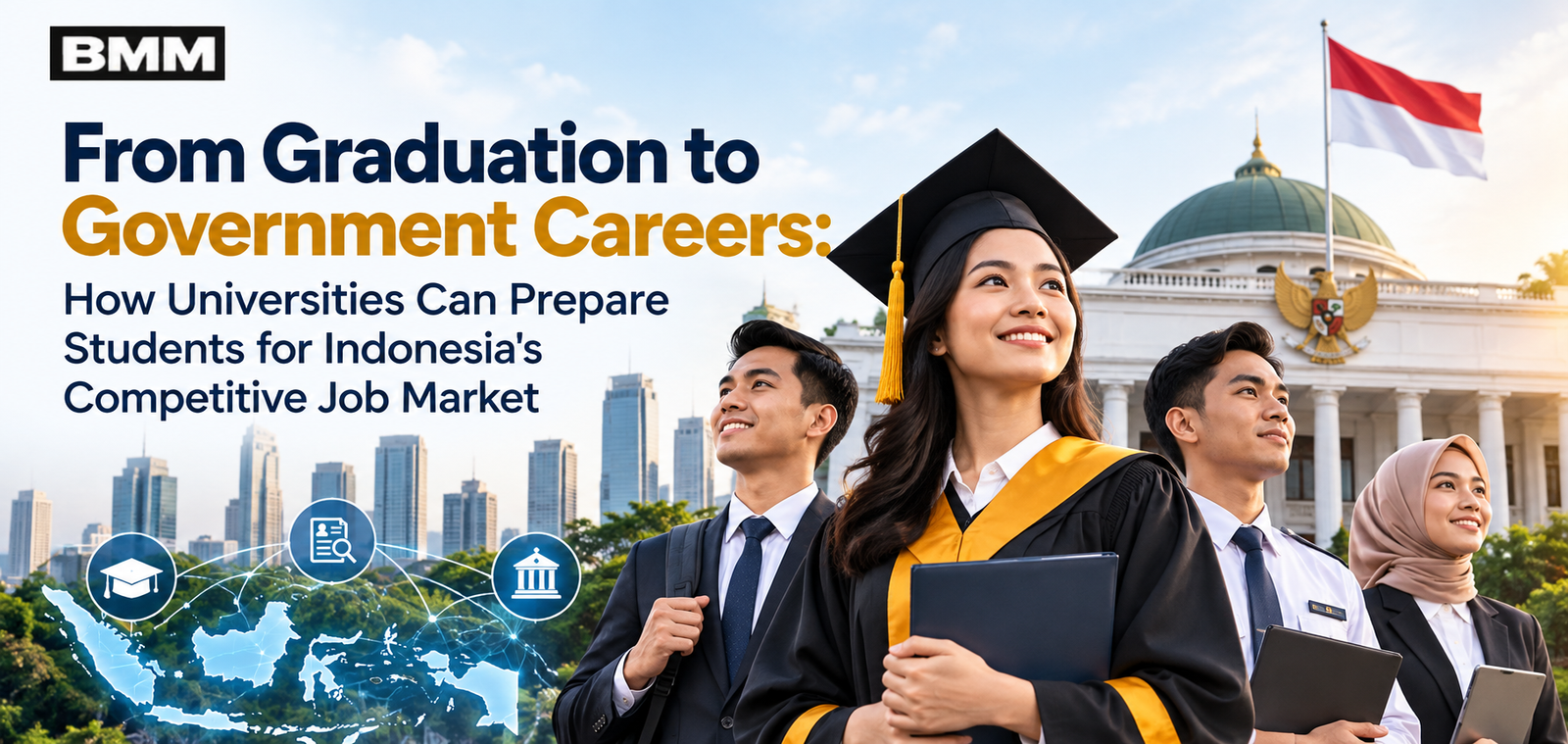
Indonesia’s workforce is undergoing a period of rapid transformation. Technological advancements, digitalization, demographic shifts, and evolving economic priorities are reshaping the skills employers seek in graduates. At the same time, government careers continue to attract millions of young Indonesians who view public service as a pathway to stability, professional growth, and meaningful societal impact.
However, securing employment, whether in the public or private sector, has become increasingly competitive. Every year, universities produce hundreds of thousands of graduates entering a job market that demands not only academic knowledge but also practical skills, adaptability, and professional readiness. As a result, higher education institutions face growing pressure to ensure students graduate with the competencies needed to succeed in a changing employment landscape.
The challenge is no longer simply helping students earn degrees. Universities must now prepare them to build sustainable careers in an environment where competition is intensifying and employer expectations continue to evolve.
Understanding Indonesia’s Competitive Employment Landscape
The youthfulness of Indonesia is considered one of the nation’s most valuable assets. Every year, the number of graduates who join the labor force is high, thus forming an immense pool of talent that facilitates economic growth. On the other hand, the youthfulness of the country is also characterized by competition since there is stiff competition for employment opportunities, especially in very popular sectors.
The careers in government offices continue to attract a large number of applicants. The recruitment in the Civil Servant Candidate Program (CPNS) continues to have many applicants. This is not surprising considering the fact that government career paths are associated with job security, career development, and the opportunity to be involved in developing the nation.
On the other hand, there is a growing trend of selectivity among the private sector employers as they look for graduates who have the technical knowledge and ability to communicate, use technology, solve problems, and adapt to the changing work environment.
This implies that having a degree is not enough anymore.
Bridging the Gap Between Education and Employment
Another widely debated issue in higher education is the difference between learning and employment-related expectations. Universities are successful in providing academic knowledge, while employers require practical skills and experience.
The graduates can have excellent academic performance but have problems dealing with recruitment procedures, teamwork at work, project organization, or professional communication. On the other hand, employers face problems in hiring employees who can immediately start working in today’s complicated environment.
The resolution of the issue requires cooperation among universities, governmental organizations, and representatives of the business community. The educational courses need to change in order to adapt learning outcomes to the realities of employment.
Universities that manage to combine practical experience with academics will increase the employability of their graduates.
Strengthening Career Development Services
Career preparation is something that should be considered well in advance before one graduates. Universities have a significant role to play in ensuring that students are aware of employment prospects, career paths, and career skills development.
Effective career centers within universities could prove useful in offering students various services such as career counseling, resume writing training, interview preparation, networking, and engagement with employers. The process will assist students in making informed decisions on their futures while at the same time boosting their confidence in themselves professionally.
Where students have an interest in a career in government, then universities could help guide them on aspects of civil service employment, examination training, public administration knowledge, and career opportunities in the public sector.
Preparing Students for Government Recruitment
The process of recruitment within Indonesian governments is very competitive and involves rigorous tests that are aimed at assessing the academic capability and the professionalism of the candidates.
Institutions of higher learning can prepare students for the demands of government recruitment processes through exposure to the requirements and expectations in the public sector. Workshops on skills such as analysis, understanding of policies, ethical and leadership skills could be organized.
Practice tests and preparation courses could also expose students to competitive selection processes.
More importantly, preparations do not end at the tests. Careers in the public sector demand honesty, accountability, team work and service delivery. Values such as these can be developed through leadership and community engagement programs within universities.
Expanding Internship and Work-Based Learning Opportunities
Practice continues to be one of the most practical means of preparing students for jobs. The process of internship gives an opportunity for the students to apply theoretical knowledge in a real-world environment.
Universities need to actively seek partnerships with governmental organizations, government corporations, private businesses, and non-governmental organizations in order to facilitate the internship process.
Government internships can be especially useful for those students who think about government jobs. Such internships help students understand how policies are implemented and what the work environment is like.
At the same time, the internships in the private sector give students an opportunity to learn some skills and gain practical knowledge of the particular industry.
Internships not only enrich students’ resumes but also allow them to explore their career interests.
Developing Digital and Technological Competencies
The ongoing digital transformation has affected practically all industries, including governmental organizations. With growing use of digital systems, data analysis, artificial intelligence, and automation by various organizations, graduates need to have good digital skills, no matter which career path they choose.
Universities need to provide digital literacy skills in general education instead of confining technological skills training to technical studies only.
Students who are going to work in public administration, education, healthcare, business, law, and other spheres increasingly need some digital skills, including digital literacy skills and ability to collaborate online.
Moreover, government organizations themselves are intensifying digital modernization processes, which makes digital skills quite useful for future employees in the governmental sector.
It is also important that graduates have subject-specific knowledge along with good digital skills.
Building Soft Skills for Long-Term Success
Technical skills may still be vital, but employers have continued to recognize the importance of soft skills. Soft skills like communication skills, teamwork, leadership skills, adaptability, emotional intelligence, and problem-solving are some skills commonly mentioned by many employers as crucial to their employees.
There are many ways universities can nurture soft skills among students through various methods including project-based learning, group work, presentation, leadership development, and extra-curricular activities.
Participating in university societies, debating, volunteering, and community service activities are some of the areas where students can learn much about themselves and improve their skills. Most government positions require effective interpersonal skills because the public servants interact with many people such as the communities, policymakers, and stakeholders.
Having soft skills together with technical skills gives graduates an edge in their career development and makes them more competitive in recruitment processes.
Encouraging Entrepreneurship and Innovation
Not all graduates will go through conventional channels in their careers. Entrepreneurship is becoming increasingly acknowledged as one of the major sources of economic growth and development.
Universities can aid in entrepreneurship by offering innovation centers, start-up incubation centers, mentorship programs, and funding opportunities. Such measures inspire students to innovate, discover opportunities in the marketplace, and create solutions to problems facing the world.
In addition, even for students aspiring for careers in governments, entrepreneurship can be advantageous. Innovation and problem-solving are increasingly becoming important in governmental institutions as they seek to enhance their effectiveness in service delivery.
Through entrepreneurship, universities contribute to making their graduates proactive participants in economic and social development.
Strengthening Industry and Government Partnerships
Collaboration between universities and outside entities is crucial in ensuring educational relevance. Such collaboration ensures that universities are able to synchronize their curriculum with the needs of the job market while offering learners practical exposure.
Governmental agencies can contribute through internship programs, guest lectures, mentorship programs, and research collaborations. Industries can be very instrumental in informing about skill sets in demand and trends within the job market.
Collaborations ensure that there is a feedback process which ensures constant refinement of the academic and developmental processes of the learners.
Collaborations offer networking opportunities to learners. Such opportunities will be very useful after graduation as they may result in employment opportunities.
Promoting Lifelong Learning and Adaptability
Change is an essential part of future work. Technologies, industries, and economic trends keep changing all the time, and students need to be ready to learn and adapt during their entire careers.
Students should be taught a desire to keep learning even when the period of study finishes. Professional development never ends after graduating from university.
The importance of continuous learning is especially relevant in case of government jobs, where public servants have to deal with changing legislation, technologies, and needs of society.
Curiosity, adaptability, and resilience can be cultivated at university to ensure success in any career path.
Looking Ahead
There is a need for universities in Indonesia to increase their contributions because of the competitiveness of the labor market. Universities should play a key role in preparing graduates for careers in a way that goes beyond academic teaching.
The ability to perform well in today’s work environment depends on many things including the possession of knowledge, practical experience, digital literacy, soft skills, and adaptability. For government careers, there is the need for a similar skill set together with the willingness to serve the community and lead ethically.
It would mean that universities adopting comprehensive approaches to student development will be in a position to prepare more graduates who will thrive in the increasingly competitive environment. This can happen through more collaboration between universities and industry, internships, career services, and lifelong learning.
In the end, the preparation of graduates for the labor market in Indonesia is not only meant to assist them in securing employment. Rather, the purpose is to ensure that they acquire the abilities, skills, and resilience to forge successful careers.
FAQ
1. Why is it important for Indonesian universities to prepare students for government careers?
Universities can help students develop the academic knowledge, professional skills, and practical experience needed to compete for government-sector opportunities in Indonesia.
2. What skills do students need for Indonesia’s competitive job market?
Students should develop communication, digital literacy, critical thinking, problem-solving, teamwork, leadership, and professional skills alongside their academic qualifications.
3. How can universities prepare students for government recruitment?
Universities can provide career guidance, government-exam preparation, internships, mock assessments, interview training, and workshops on public-sector careers.
4. What role do internships play in preparing students for government careers?
Internships provide practical workplace experience and help students understand professional responsibilities, public administration, teamwork, and organizational processes.
5. How can universities help students understand government career opportunities?
Career centers can organize seminars, career fairs, mentoring programs, and information sessions that explain different government career pathways and recruitment requirements.
6. What is the biggest problem in the Indonesian education system?
One major challenge is the gap between education and employment needs. Students may have academic knowledge but need stronger practical, digital, communication, and career-ready skills to compete in the job market.
7. Is it easy to find a job in Indonesia?
Finding a suitable job can be competitive, particularly for fresh graduates. Having relevant skills, practical experience, strong communication abilities, and career preparation can improve employment opportunities.
8. How to get a job immediately after graduation?
Start preparing before graduation by building relevant skills, completing internships, creating a strong CV, networking, applying for suitable positions, and practicing interviews and recruitment assessments.
9. Is Indonesia a good country for education?
Indonesia offers a wide range of universities and educational programs. The quality and suitability of an institution can vary, so students should consider factors such as curriculum, accreditation, facilities, career support, and employment opportunities when choosing a university.