
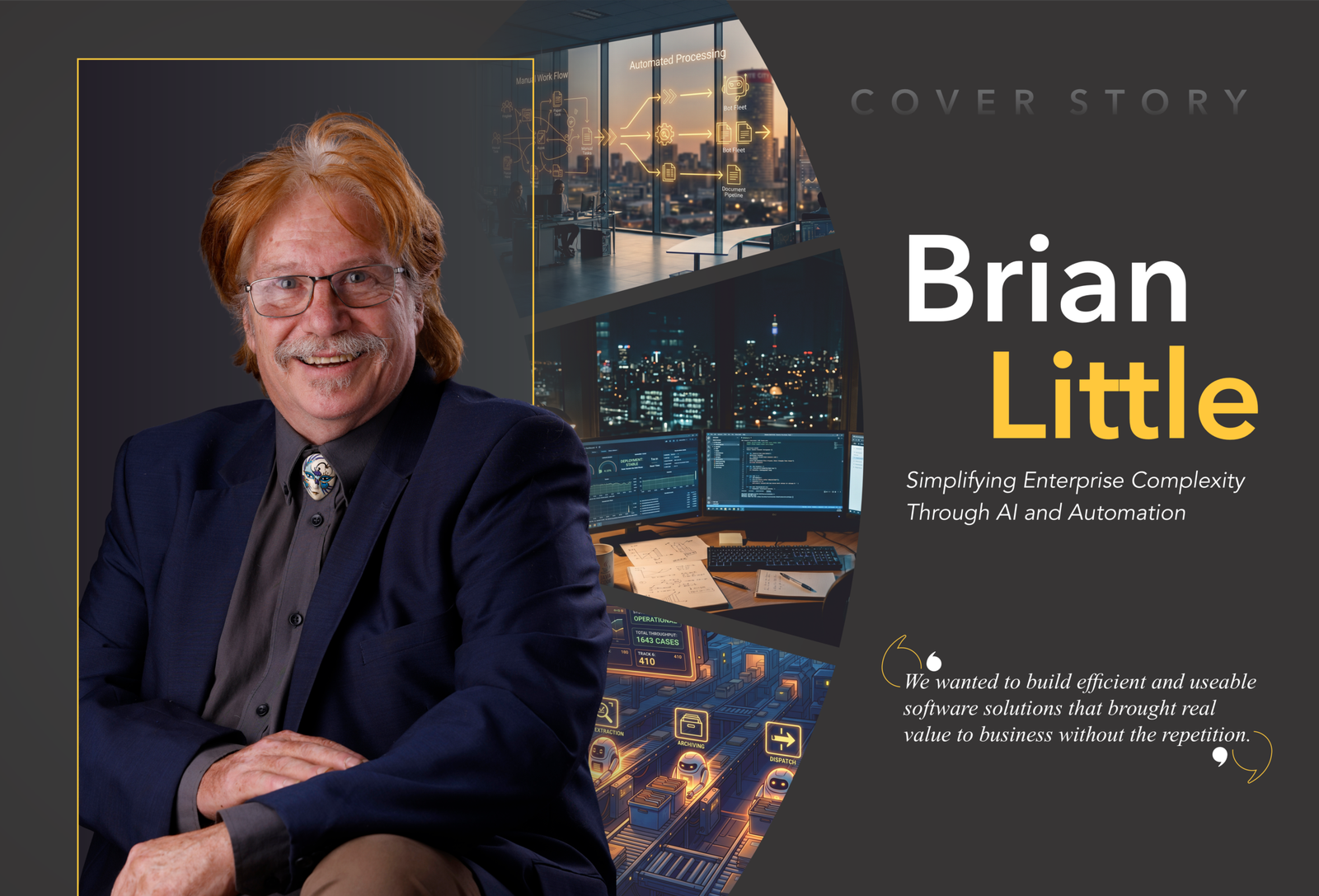
A great deal of software development is spent solving problems that have already been solved before. The login page gets built again, information travels through another chain of manual steps, and teams spend hours connecting systems that were never designed to speak to one another. The real cost is not always the complexity of the work, but the amount of effort repeatedly spent getting the same things done. What if technology could remember what had already been built, recognise what could be reused, and leave people free to concentrate on what actually needs a new solution?
This question reflects the thinking that has shaped Brian Little’s career. With decades of experience spanning computing, enterprise software, and automation, he has focused on making technology more practical, efficient, and responsive to business needs. As Business and Operations Director at Saucecode, he helps advance this approach through ROBOTEUR and ROBOTEUR NEXT, platforms that combine reusable software components, automation, and AI to simplify development and improve business processes.
From the Soundboard to the Silicon Revolution
Brian’s journey into technology began far from the software development environments and intelligent automation platforms that would later define his professional career. In the late 1970s and early 1980s, he worked as a musician in South Africa and the United Kingdom while also pursuing sound engineering in television media. It was during a period away from that work, while studying electronics for a National Technical Diploma, that he encountered early programming languages and Boolean algebra. Something clicked. The logic of computing offered a new kind of creative possibility, one that would keep his curiosity alive for decades.
Brian entered the information technology industry at a time when personal computing was still finding its footing. Computers required hands-on assembly, memory chips had to be installed on motherboards, and a 10-megabyte hard drive represented the limits of what was possible. His encounter with Unix, a multi-user, multitasking operating system capable of operating within the limited hardware available at the time, introduced him to a field that was technically demanding and full of possibilities. He moved from Unix technical support into technical marketing and business unit management, building a career during a period when computing was changing almost by the week.
The transformation that followed was extraordinary. Standalone computers gave way to local area networks, shared servers, wider networks, and eventually an internet that connected people and businesses across geographical boundaries. Hardware grew more powerful, cloud computing emerged, and software became increasingly accessible. For Brian, the attraction was never simply about the machines themselves. It was about the constant reinvention of what technology could make possible.
After serving as Unix Division Manager at Siltek Distribution Dynamics in Johannesburg and managing the technical division at Pinpoint Technologies, Brian moved into consultancy and later into digital advertising, working with Aqua Online, Gloo, and Ogilvy. It was during this chapter that the core team behind Saucecode came together and began developing the ideas that would shape the business.
Artificial intelligence has since reignited the excitement he felt during the earliest years of personal computing. Brian sees the current wave of AI as moving at a pace that surpasses even the internet revolution, presenting opportunities that are still unfolding. He remains drawn to unfamiliar technologies, unconventional ideas, and possibilities that others may hesitate to explore. For someone who has spent decades watching technology redefine its own limits, the prospect of what comes next remains as compelling as the discoveries that first drew him in.
When Repetition Became the Problem Worth Solving
Saucecode’s beginnings grew out of a frustration familiar to many people working in digital development: projects were expected to move faster even when the time required to build them was continually being squeezed. In the digital advertising industry, development teams often received assets late in project schedules while customer delivery dates remained fixed or were brought forward. Adding more people to a project could only solve so much. Meanwhile, developers were repeatedly building similar components for different clients, from login pages and campaign websites to data collection systems and video players.
Brian and his fellow leaders, Graham Fry and Barry Buck, recognised that much of this work did not need to be recreated from scratch. Barry had been developing an idea for a technical framework called Z1, designed to separate reusable software components from the constant changes in underlying technology. By modularising common elements and making them interchangeable through open APIs, the framework could allow developers to reuse established components while concentrating their efforts on the parts of a project that were genuinely unique.
The idea challenged an established approach in which development work was often sold primarily as time and materials. Rather than accepting repetition as an unavoidable cost of software development, the team wanted to make reuse, efficiency, and dependable delivery the foundation of its work.
When Saucecode was established in 2016, this thinking became central to its identity. The founders wanted to build software solutions that delivered practical business value while creating a company they themselves would have wanted to work for. They rejected exaggerated promises, incomplete deliveries, and the pressure to release products before they were ready. They also wanted to grow without unnecessary debt or outside interference dictating the direction of the business.
Their original principle, “We do what we say and we say what we do,” captured that determination. For Brian and his colleagues, credibility was inseparable from execution. The ambition was not merely to develop software, but to create a business whose products and professional standards could stand the test of time.
The Milestones That Changed the Company’s Direction
Saucecode’s development was not an uninterrupted climb. Its early years involved a combination of bespoke development, work for advertising agencies, and outsourced development resources for a major South African banking institution. These engagements provided revenue, but they also offered valuable exposure to the disciplines, security expectations, and operational requirements of large enterprise environments.
Reaching break-even and then becoming self-sustaining marked an important turning point. It gave the company greater freedom to phase out work that did not contribute to its long-term ambitions and direct more resources towards its own products, modular development framework, and enterprise solutions. Its banking work also provided exposure to early robotic systems and software automation, reinforcing the potential of modular development in a field where processes were increasingly suited to automation.
One of Saucecode’s early product milestones was TISTRO, a remote-worker productivity monitoring tool released shortly before South Africa’s COVID-19 lockdown. The timing presented a difficult challenge, restricting the company’s ability to take the product to market. The experience reinforced a hard lesson: technical innovation alone does not guarantee commercial success. Even a strong product can lose ground if it lacks the investment and reach needed to establish itself in the market.
The development of ROBOTEUR proved more consequential. Saucecode began building the platform around the principle that modular components could make software automation faster, more consistent, and accessible to developers with different levels of experience. By providing tested and reusable modules, the platform was designed to accelerate development while preserving quality and robustness.
Its adoption within a major banking environment became a defining milestone. ROBOTEUR reached 20 digital workers, or bots, supporting 15 production processes across five business units, including consumer lending, card disputes, business banking, recoveries, and deceased estates. According to the bank’s own business case, the automation generated annual savings exceeding R80 million in one domain alone.
For Brian, this represented more than a successful deployment. It demonstrated how years of work on modularity, process efficiency, and automation could translate into measurable business outcomes. ROBOTEUR enabled Saucecode to discontinue other income streams that no longer aligned with its objectives and concentrate more fully on its automation business.
The next chapter is ROBOTEUR NEXT, an AI-first reconstruction of the platform that brings intelligent automation and software integration together. It represents the company’s attempt to move beyond automating individual tasks towards delivering complete business solutions with greater speed and less development overhead.
The Common Logic Beneath Different Businesses
A bank, a manufacturer, a mining company, and a distribution business may appear to have very different operational needs. Their products, customers, regulations, and commercial objectives can vary enormously. Yet Brian believes that beneath these differences lie recurring patterns involving data, process flows, and decision-making.
Businesses collect information, verify documents, move data between systems, apply rules, make decisions, and produce outcomes. These activities appear in loan applications, purchase orders, contracts, invoices, payments, reconciliations, and countless other processes. The information changes, as do the rules and the systems involved, but the underlying movement from input to decision to output often follows recognisable patterns.
This observation shapes Saucecode’s approach to bespoke software. Brian believes that business requirements are unique in important ways, but that the work required to fulfil them contains more commonality than may initially be apparent. Repeatedly building the same underlying functions wastes time and introduces opportunities for error. Reusing established components allows development teams to focus on the elements that genuinely distinguish one organisation from another.
Automation becomes particularly valuable where employees must manually extract information from documents, verify details, transfer data between applications, and apply defined decision criteria. These tasks can consume substantial time while creating bottlenecks and increasing the risk of inaccuracies.
Artificial intelligence adds another capability by helping systems interpret information and support decision-making within workflows. Routine decisions can be handled through defined rules and automated processes, while exceptions that require judgement can be flagged for human consideration. This allows businesses to combine automated execution with human oversight where it matters.
Saucecode’s approach is built around identifying what can be standardised without ignoring what makes each client different. The objective is not to force every business into an identical system, but to use reusable technology to deliver solutions that reflect each organisation’s specific processes, decision criteria, and desired outcomes.
From Weeks of Development to a Working Blueprint
Traditional software development can take months of documentation, design, coding, and testing before clients see a working concept. Brian believes AI can accelerate this process through ROBOTEUR NEXT, which transforms recorded walkthroughs of existing business processes into documentation, solution designs, and visual mock-ups.
Within 24 to 48 hours, clients can review the proposed workflows, request changes, and refine the design before development begins. This allows them to identify gaps early and gain a clearer understanding of the intended solution.
Rather than forcing businesses to change their established processes, ROBOTEUR NEXT adapts to their existing workflows unless changes are requested. Brian’s ambition is to help clients visualise the outcome before committing to full development, reducing uncertainty and making software implementation more efficient.
Building Automation Around the Business, Not the Other Way Around
The development of ROBOTEUR NEXT brings together the lessons Brian and his team have accumulated across software development, enterprise systems, and automation. Its approach combines reusable modules with AI-assisted document intelligence and process design, allowing the platform to address both the common elements of business operations and the details that make each implementation specific.
Document intelligence is a key part of this model. Business processes frequently depend on information contained in PDFs, scanned documents, emails, spreadsheets, payslips, identity documents, and other records. Identifying the document, extracting the relevant fields, organising the information into a consistent structure, and directing it to the appropriate system can be labour-intensive when performed manually. AI-assisted processing aims to make these steps faster and more consistent, while verification and exception handling remain important parts of the workflow.
The other essential element is the end-to-end process itself. Automating a single task may provide limited value if employees must still manually move information between systems or manage the remaining stages of the workflow. Saucecode’s approach seeks to connect those stages into a coherent process, from the initial submission of information through validation and decision-making to the final outcome.
The combination of these capabilities reflects a broader change in how the company approaches software delivery. Rather than treating every project as a fresh exercise in coding, Saucecode aims to build on established components, understand the client’s workflow, and use AI to accelerate the journey from requirements to implementation.
For Brian, the value lies in making complex work more manageable without losing sight of the business need. Technology should reduce unnecessary effort, improve the handling of information, and give organisations a more dependable way to execute their operations.
A Future Still Full of Possibilities
After decades in technology, Brian remains energised by the same force that first drew him away from sound engineering and into computing: the possibility that an unfamiliar idea can change what people are able to accomplish. He has witnessed personal computing evolve from limited machines assembled by hand into connected systems, cloud platforms, and powerful software accessible across industries. He has also seen technologies rise, mature, and disappear as new approaches emerge.
Artificial intelligence has opened another chapter, one that Brian believes will create abundant opportunities for businesses willing to explore its practical value. Through Saucecode and ROBOTEUR NEXT, he is focused on translating that potential into working systems that address real operational needs.
His journey reflects a consistent conviction: innovation is most valuable when it moves beyond novelty and makes a measurable difference. For Saucecode, that means building technology that reduces repetition, accelerates delivery, and adapts to the way businesses actually work. For Brian, it also means remaining curious enough to investigate the unfamiliar, challenge established assumptions, and keep asking what could be done better.
The technologies will continue to change. The enduring challenge is to turn their possibilities into solutions that matter.
When Artificial Intelligence Moves From Possibility to Practice
Having witnessed decades of technological change, Brian believes AI is introducing an unprecedented level of uncertainty, with innovations emerging far faster than in previous technological revolutions. At Saucecode, the focus is on turning this rapid progress into practical business value rather than pursuing technology for its own sake.
Brian sees AI and automation as complementary capabilities. While automation handles repetitive tasks and data movement, AI can interpret documents, support decisions, and respond to complex situations. Together, they can streamline back-office operations, reduce errors, and accelerate business processes.
However, he emphasises that technological capability alone does not guarantee success. Poorly designed chatbots, for instance, can frustrate customers when human assistance is needed. AI systems must therefore be built around real user needs, with clear boundaries for human intervention.
At Saucecode, AI is being integrated into automation with features such as action recording, version control, timestamps, and defined decision limits. These safeguards help maintain accountability and ensure that situations requiring human judgement are referred to an operator rather than handled without appropriate oversight.
Preventing the Project That Works on Paper From Failing in Practice
Software projects can falter despite ambitious plans, with delays, rising costs, operational disruption, and inadequate requirements undermining their success. Brian has seen these challenges in both off-the-shelf and custom-built systems. While ready-made software may appear simpler, integrating it into established workflows can prove complex. Custom solutions offer greater flexibility but require technical expertise, security, long-term support, and careful planning.
Brian believes successful implementation begins with understanding business needs, existing systems, and critical workflows. This is particularly important as AI advances rapidly and lengthy projects risk delivering outdated solutions.
At Saucecode, these challenges are addressed through modular development and incremental delivery. Projects are divided into manageable stages, often using two-week sprints, allowing customers to realise value early while identifying integration issues before they escalate. Employees participate in testing, ensuring workflows and dashboards meet practical needs.
ROBOTEUR NEXT extends this approach by using AI to support business analysis, solution design, documentation, and development. It helps address a common weakness in custom software projects: beginning development with incomplete requirements and discovering too late that the final product fails to meet expectations.
A Small Team With the Capacity to Think Big
Saucecode has developed around a working model that differs from that of many traditional software companies. Since 2018, the company has operated remotely, having initially adopted the arrangement to test its own TISTRO software for monitoring remote workers. The experiment reportedly produced an immediate 30 per cent increase in productivity, encouraging the team to continue working online rather than return to a conventional office environment.
Over time, the remote arrangement became a defining feature of the business. Saucecode built its operations around online communication and collaborative software, allowing a closely connected team to work together without a central office. The company outsources functions such as accounting, maintains a small sales and marketing operation, and concentrates much of its internal capability on software development.
Brian believes the effectiveness of this model depends heavily on selecting the right people. In the company’s early expansion, conventional recruitment through employment agencies did not produce the lasting results the founders wanted. The team subsequently placed greater emphasis on personally identifying individuals with the technical ability, curiosity, and self-motivation required to thrive in its working environment.
For Brian, innovation is not something that can simply be demanded through targets or produced by adding more employees. It emerges when capable people are given meaningful problems, room to experiment, and the freedom to develop their skills. He places particular value on recognising talent early, understanding individual strengths, and creating conditions in which people can perform without unnecessary supervision.
The team is deliberately composed of people who enjoy exploring unfamiliar technologies and building new solutions. Brian, Graham Fry, and Barry Buck share an entrepreneurial outlook and a strong dislike of duplicated effort. That common instinct helped shape Saucecode’s modular development philosophy and continues to influence the architecture of ROBOTEUR NEXT.
Rather than scaling the business by continually expanding its headcount, Saucecode has invested in a platform designed to multiply the capability of each developer. ROBOTEUR NEXT combines reusable components, AI agents, visual development tools, and structured documentation to help individuals undertake work that would traditionally require a larger team.
Its strapline, “The Hero Factory,” reflects this ambition. The platform is designed to support a developer through multiple stages of a project, from understanding the client’s requirements and creating a solution blueprint to developing and implementing the final system. AI agents can assist with different aspects of the work, while reusable modules and established development practices help maintain consistency.
Documentation is another important part of this approach. System designs, user manuals, visual workflows, and clearly commented code help preserve knowledge and make it easier for new team members to understand an existing project. This reduces dependence on individual memory and supports smoother handovers when responsibilities change.
The company’s experience also shaped its approach to scalability. ROBOTEUR was initially developed and tested within demanding banking environments, where enterprise-level requirements informed its architecture from the beginning. Rather than needing to be rebuilt to meet the needs of smaller organisations, the platform could be adapted downwards to serve small and medium-sized enterprises, although reaching those markets commercially presents its own challenges.
Saucecode has also invested in identifying promising developers while they are still completing their university or college studies. Brian sees an opportunity to bring talented individuals into an environment where they can explore new technologies and develop their abilities before becoming constrained by the routines of a traditional corporate career.
The Intelligence Behind Better Banking
Brian has observed three major shifts in financial technology: the growing role of document intelligence, the need to balance AI capabilities with predictable automation costs, and the importance of data sovereignty. At Saucecode, these trends inform the development of ROBOTEUR NEXT, a platform designed to combine AI-driven interpretation with auditable business rules. He believes the future of enterprise software lies in applying AI where it adds genuine value while keeping business processes secure, efficient, and accountable.
Innovation Must Be Lived, Not Announced
For Brian, innovation cannot be created through slogans or corporate messaging. It grows from leadership that leads by example, recognises individual contributions, and gives talented people room to experiment. At Saucecode, careful recruitment, autonomy, and a culture of honesty help sustain this environment. He particularly values independent thinkers who challenge conventional approaches and enjoy solving difficult technical problems.
A Team Built on Talent and Trust
Brian believes high-performing teams begin with the right combination of talent, ability, and drive. Saucecode operates as a geographically distributed team, using digital collaboration and ROBOTEUR NEXT to coordinate development, document progress, and support decision-making. Its flat structure encourages people to ask for help, share knowledge, and focus on technical solutions rather than internal competition. Modular architecture also allows the company to adapt to changing technologies without repeatedly rebuilding its core systems.
Digital Transformation Begins With the Right Method
One of the biggest mistakes businesses make, according to Brian, is purchasing technology without defining how it should solve a problem. AI tools and software platforms cannot deliver meaningful transformation without clear objectives, appropriate governance, and an understanding of existing workflows. He advocates identifying operational bottlenecks, applying AI to complex or unstructured information, and using deterministic automation for established business rules. Results must be measured honestly, with unproven implementations kept separate from verified outcomes.
Finding Value Where Work Gets Stuck
Brian encourages businesses to examine the people who spend their days transferring information between systems, chasing exceptions, and assembling reports manually. These repetitive tasks often reveal the strongest opportunities for intelligent automation. AI can process documents and identify relevant information, while automation handles predictable workflows and directs unusual cases to human decision-makers. Saucecode’s banking automation has reportedly delivered more than R80 million in measured annual value in one domain, demonstrating the potential of a carefully targeted approach.
Leadership Through Freedom and Accountability
Brian’s leadership philosophy was shaped by mentors who trusted him with responsibility rather than prescribing every decision. From them, he learned to select the right people, give them room to make decisions, and accept that mistakes are part of professional growth. He also places great importance on direct communication, calculated risk-taking, and acting decisively. These principles remain part of Saucecode’s culture, where honesty with clients and colleagues is considered essential to lasting relationships.
From a Decade of Building to a Global Ambition
After a decade of self-funded development, Saucecode is preparing to take ROBOTEUR NEXT beyond its established South African market. The platform combines enterprise automation, AI integration, and a discovery-to-delivery development process intended to simplify complex business operations. The company plans to pursue investment to support its international ambitions, beginning with a prospective investor presentation in Dubai in December 2026. For Brian, the ultimate objective is to create technology that handles the heavy lifting, delivers measurable business value, and leaves customers and the team stronger for having worked together.
“We wanted to build efficient and useable software solutions that brought real value to business without the repetition.”
“The goal was an accelerated development platform that delivered quality and robust results.”
“A client walks us through one real process once, on a recorded call, and what comes back is the whole delivery.”