
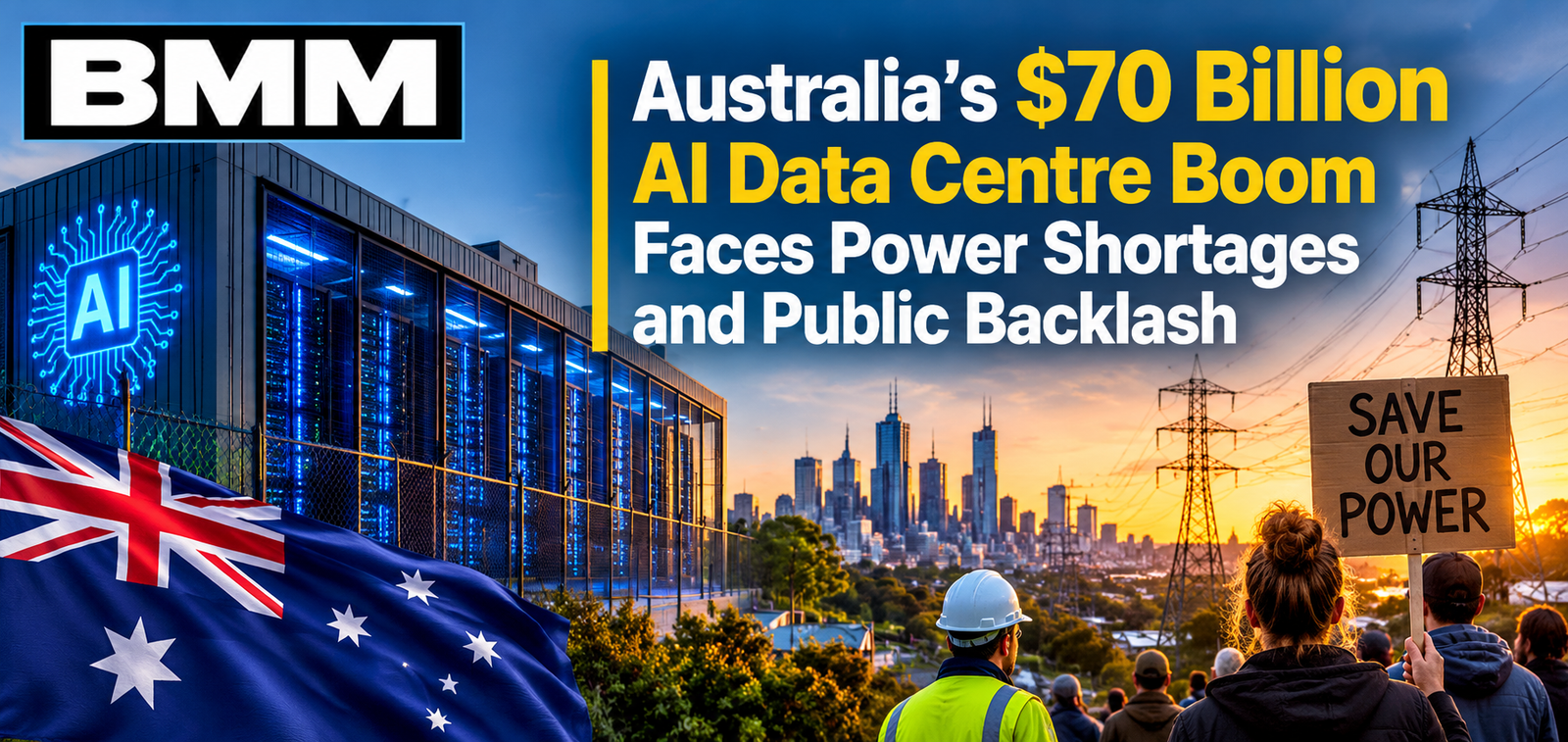
Australia’s ambition to become a major artificial intelligence hub for the Asia-Pacific region is encountering significant obstacles. Australia’s AI data centre boom, backed by billions of dollars in proposed investment, is facing growing resistance from local communities and constraints on electricity infrastructure, raising questions about how many announced projects will ultimately be completed.
According to a Bloomberg analysis reported by Business Standard on October 23, more than 40 large data centres planned or under construction across Sydney and Melbourne represent over A$100 billion (approximately US$70 billion) in projected investment. However, only 23% have publicly confirmed securing electricity supply or grid connections, suggesting that delays could affect a substantial portion of the pipeline.
The uncertainty presents a challenge for Australia, which hopes to capitalise on growing global demand for computing infrastructure required to develop and operate AI systems.
Electricity Supply Emerges as a Major Bottleneck
Power availability is becoming one of the biggest constraints on Australia’s AI data centre boom. Sydney and Melbourne attract developers because of their established telecommunications networks, business communities and existing infrastructure. However, concentrating large facilities in these cities is placing additional pressure on electricity networks.
Among the projects studied in the report, seven out of 28 projects being constructed in Sydney and three out of 15 in Melbourne had already been given the green light on their power agreements.
Transgrid, the organization that controls the electricity transmission network of New South Wales, stated that there was not enough transmission capacity to handle the 20 gigawatts worth of connection requests from large-scale power consumers in Sydney. Developing new infrastructure would assist in addressing the issue, but this entails significant amounts of money and time.
The difference between the planned computing capacity and electricity generation is an issue in concern.
Community Opposition Threatens Project Timelines
Apart from electricity shortages, the reluctance of locals is posing another problem to Australia’s AI data centre boom. Communities that live near the proposed or already built facilities have voiced their complaints regarding the noise, pollution, possibility of fires, consumption of water and the effect of the construction work on the residential areas.
Goodman Group’s withdrawal from building Project Mars, worth A$1.2 billion last month, is an example of such a problem. Hundreds of complaints were received in regard to the construction of the facility due to its closeness to residential buildings and a public school.
Data centre operator NEXTDC lowered its earnings forecast after local residents prevented the construction of necessary transmission infrastructure for the expansion of a facility in Melbourne. The case is evidence of how the opposition of the local population can turn into a commercial one.
Investors start taking into account the ability of developers to get enough social support, which is called a “social licence to operate.”
Water Consumption Adds to Environmental Concerns
Water is another resource under scrutiny. Water is required by data centres for cooling, and the environmental impacts associated with data centre operations in a given area could become more pronounced if there are several such data centres in the area.
According to an industry-funded study referenced in the report, data centres in Australia use 5.5 billion litres of water every year. This may be a small portion of national water usage, but water-scarce regions will have added pressure from data centres.
These concerns are adding to public debate over whether the economic benefits of Australia’s AI data centre boom justify the demands placed on local infrastructure and natural resources.
Can Australia Preserve Its AI Investment Ambitions?
With the advantages that currently exist in Australia, which include the availability of land, renewable energy, and existing digital infrastructure, the nation continues to be an attractive place for investments. Nevertheless, it is necessary to consider the practical constraints that may hinder the implementation of announced projects into functional facilities.
This is because it is not enough to attract investments; rather, it is also important for the electricity grid, water supply, planning, and communities in the vicinity to accommodate the new facilities.
In order for Australia’s AI data centre boom to meet the economic promise of this development, it is necessary for the developers and policymakers to ensure the expansion of infrastructure with responsible use of resources and engagement of communities.