
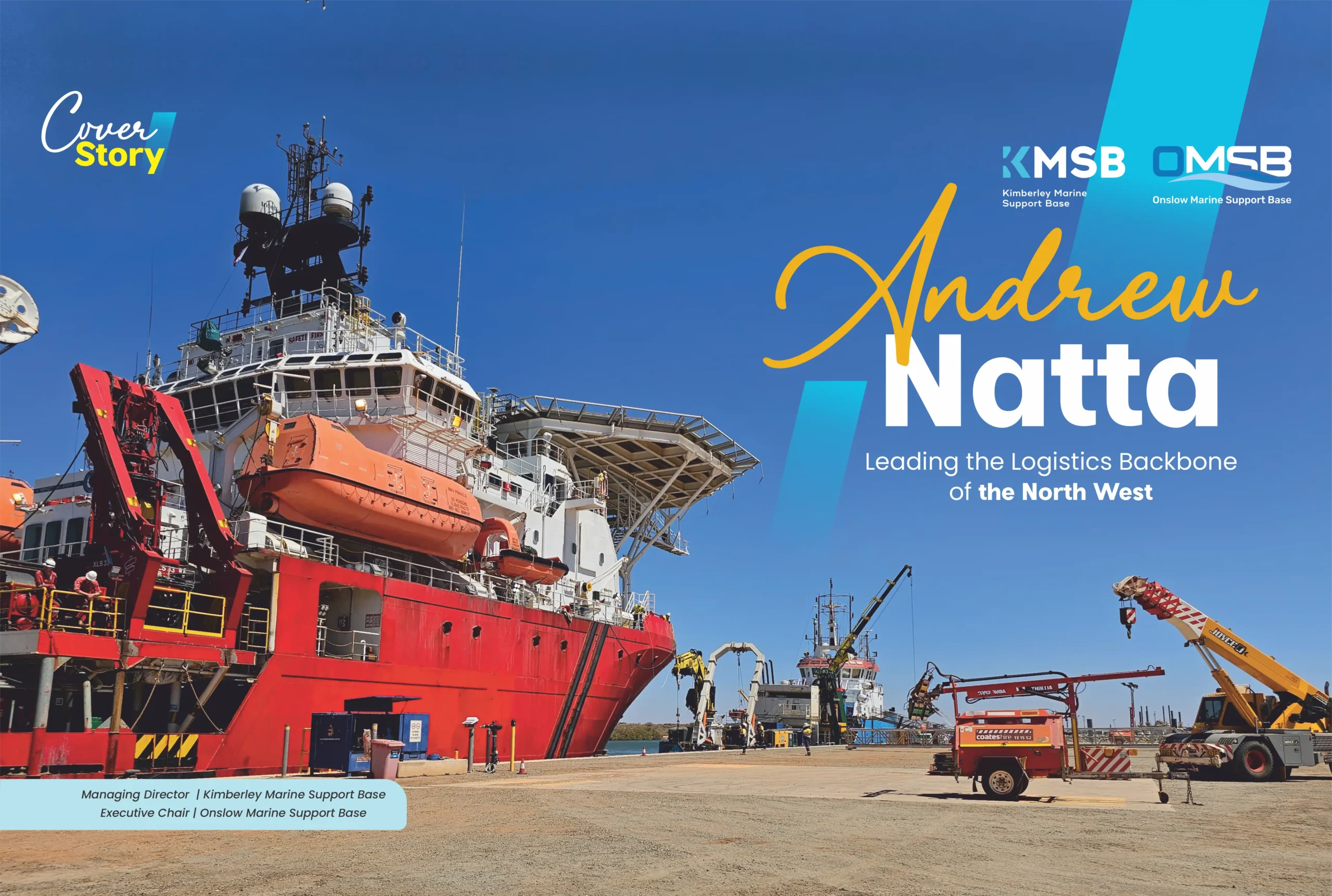
Before a ship ever reaches a berth, decisions have already been made by tide, distance, weather, and time. In Northern Australia, logistics is not a back-office function but a negotiation with nature itself. Here, minutes matter, metres of tide reshape schedules, and a single bottleneck can ripple across entire supply chains. Ports are not just places where vessels arrive and depart. They are the quiet arbiters of whether industries advance, stall, or move elsewhere entirely.
Andrew Natta has built his work around mastering that reality. As Managing Director of Kimberley Marine Support Base and Executive Chair of Onslow Marine Support Base, he leads two ports designed for environments where compromise is costly.
Leading Two Ports with One Clear Purpose
Andrew Natta approaches his dual leadership role with a strong emphasis on clarity, governance, and regional relevance. As Managing Director of Kimberley Marine Support Base and Executive Chair of Onslow Marine Support Base, he balances oversight by focusing on alignment rather than uniformity. While the Kimberley and Pilbara regions serve distinct markets, both port assets are guided by a shared objective of removing structural barriers that limit regional trade and supply chain efficiency.
At a strategic level, Andrew ensures consistency across safety standards, compliance, ESG commitments, capital discipline, and long-term regional value creation. At the same time, he recognises that Broome and Onslow operate under very different conditions. Decision-making is therefore decentralised, with strong local leadership teams empowered to manage daily operations and respond to their specific customer and environmental contexts.
His role centres on maintaining cohesion across both assets while respecting regional differences. Regular engagement with executive teams, customers, regulators, and Traditional Owners ensures that each port remains responsive to local needs while contributing to a coordinated northern logistics network that supports Western Australia’s broader economic ambitions.
Redefining Broome’s Port Capabilities
Andrew Natta describes the establishment of Kimberley Marine Support Base as a direct response to long-standing operational constraints at the Port of Broome. One of the earliest and most significant challenges identified was the region’s extreme tidal range, which can reach up to ten metres and historically restricted vessel movements, increasing delays, costs, and operational complexity for port users.
KMSB was purpose-designed to complement the existing KPA wharf by removing these tidal limitations. At the centre of the development is a state-of-the-art floating wharf engineered to enable true round-the-clock, non-tide-dependent operations. By maintaining a consistent working height relative to vessels, the floating deck allows safer access, faster turnarounds, and reliable cargo handling regardless of tidal conditions.
These improvements are further enhanced by the Port of Broome’s channel optimisation project, which removed a major navigational constraint and now allows deep draft vessels to berth at any time of the year. Together, these developments have transformed Broome into a port where operators across cargo, offshore, agriculture, and cruise sectors can plan with confidence rather than around tidal windows.
Andrew Natta also highlights KMSB’s designation as a Biosecurity Entry Point, enabling certain international vessels and select cargoes to arrive directly into Australia via Broome. This capability represents a major advancement for the region, with scope for further expansion in the future. Supported by more than twenty hectares of laydown and mobilisation space and a fully localised workforce delivering integrated services, KMSB has emerged as a future-ready logistics hub for Northern Australia.
Building Adaptability for a Multi-Industry Port Environment
Adaptability, Andrew explains, sits at the heart of KMSB’s operating philosophy. The Port of Broome serves a uniquely diverse mix of industries, including mining, energy, agriculture, cruise, defence, green energy, and major project logistics. Each sector brings different cargo profiles, timelines, and regulatory requirements, making a uniform operating model impractical.
The tide-independent floating wharf plays a critical role in enabling this flexibility by providing continuous access and eliminating congestion caused by tidal restrictions. Its generous width, operational footprint, and bi-directional causeway allow efficient vessel movements across a wide range of classes. This has delivered tangible benefits, particularly for live export operations, where cattle vessels can now berth, load, and depart on demand. The result has been reduced time at anchor, more predictable sailing schedules, improved animal welfare outcomes, and lower charter costs for exporters.
Beyond the wharf, KMSB’s infrastructure supports heavy lift cargo, roll-on roll-off operations, subsea equipment, bulk and break-bulk cargo, large project modules, and cruise vessel requirements within a single integrated precinct. This versatility allows the facility to transition seamlessly between different operational profiles without compromising safety or efficiency
By combining flexible commercial frameworks with agile operational planning and multi-use infrastructure, Andrew has positioned KMSB as a resilient and responsive logistics gateway. This adaptability not only meets current industry demand but also prepares the region to capture emerging opportunities in future-focused sectors.
Creating a Port of Choice in the Pilbara
Andrew Natta explains that Onslow Marine Support Base has earned its position as a preferred port in the Pilbara by offering a level of flexibility and integration that is difficult to replicate elsewhere in the region. Unlike traditional port models, OMSB operates as a fully coordinated logistics ecosystem across two strategically positioned marine assets, Beadon Creek and the Port of Ashburton, located just seventeen kilometres apart.
This dual-port configuration provides priority berthing, deep water capability, and more than six hundred metres of combined berth line, enabling congestion-free and scalable operations. These features are critical for industries that underpin the region’s economy, including oil and gas, mining, cargo movements, and offshore decommissioning campaigns.
Andrew highlights OMSB’s ability to deliver genuine end-to-end project support as a key differentiator. In addition to core marine services, OMSB integrates marine agency support, SPS, UWILD, and OOS vessel maintenance, heavy lift capability, LCT ramps, warehousing, fabrication, supply chain management, equipment hire, and comprehensive waste solutions. All services are supported by twenty-four-seven residential stevedores, providing clients with a single, reliable point of coordination.
He also points to OMSB’s strong credentials as a decommissioning hub. The facility operates as a Prescribed Premises licensed site and holds ISO 9001, 14001, 45001, and HACCP certifications, along with DG and NORM licences. This positions OMSB as a leader in safe, compliant decommissioning services, a capability of growing importance as offshore assets across the Pilbara reach maturity. By combining dual port flexibility, integrated services, and proven compliance expertise, OMSB delivers operational performance that reduces cost, improves safety, and keeps critical supply chains moving.
Translating Location and Access into Measurable Client Value
According to Andrew Natta , OMSB’s strategic location in Onslow, close to the Northern Carnarvon Basin, delivers immediate and measurable benefits for clients. Reduced steaming distances lead to lower fuel consumption, shorter transit times, and fewer vessel hire hours, all of which are major cost drivers in offshore operations. These efficiencies also enable more frequent vessel rotations, faster resupply cycles, and improved project productivity.
The congestion-free nature of OMSB’s dual-port precinct further strengthens these advantages. With more than six hundred metres of combined berth line and round-the-clock residential stevedores, clients experience minimal queuing, fewer berth conflicts, and predictable vessel turnarounds. This reliability lowers the risk of demurrage and helps offshore campaigns stay aligned with tight operational schedules.
Andrew notes that these efficiencies also translate into reduced operational risk. Faster mobilisation supports timely responses to weather changes or equipment issues, while reduced time at sea lowers fatigue-related risks and incident exposure. In decommissioning projects, where compliance and timing pressures are particularly high, OMSB’s integrated and streamlined operating model significantly reduces the likelihood of delays or regulatory setbacks. Together, these factors deliver clear cost savings and greater certainty for clients.
Leading Infrastructure Development in Remote Regions
Reflecting on operations across both the Kimberley and Pilbara, Andrew emphasises that developing infrastructure in remote and logistically complex regions requires practical, grounded leadership. He believes the process must begin with listening to Traditional Owners, local businesses, industry partners, and frontline teams who understand the realities of working in these environments.
Reliability is a central principle guiding development. With conditions shaped by tides, weather, and long supply chains, Andrew says infrastructure must be designed to remove uncertainty. This includes delivering tide-independent access, scalable laydown areas, and heavy lift capability that allow operators to plan with confidence.
Adaptability is equally important. Serving a wide range of industries demands flexible, solutions-focused teams that can respond quickly when conditions or client requirements change. Andrew also stresses the importance of building local capability. By employing and supporting local people and investing in long-term skills development, both KMSB and OMSB strengthen regional resilience and ensure that economic benefits remain within the community.
Together, these leadership and operational principles underpin infrastructure that is built to endure, adapt, and support regional growth well into the future.
Strengthening Supply Chain Resilience Through Regional Ports
Andrew Natta believes the role of regional ports in Northern Australia is becoming increasingly critical as global supply chains grow more fragmented and risk-sensitive. With a strong focus on the Pilbara, he points to the scale of change expected over the next twenty-five years, particularly in offshore decommissioning. Australia is set to undertake one of the largest decommissioning programs in its industrial history, with the majority of this activity concentrated in the North Carnarvon Basin, directly offshore from Onslow.
In Andrew’s view, this presents both an opportunity and a risk for Western Australia. Without sufficient regional port capacity, billions of dollars in decommissioning work could continue to be sent offshore. Regional ports such as OMSB are therefore no longer optional assets but central to safeguarding national capability and retaining economic value within the state.
He explains that OMSB’s strategic location and dual port model provide the redundancy, scalability, and congestion-free operations needed to complement other heavily utilised Pilbara ports. By expanding total port capacity in the region, OMSB supports a distributed and integrated northern ports network capable of absorbing the upcoming decommissioning wave without bottlenecks, scheduling blowouts, or project delays.
By developing a dedicated decommissioning capability in Onslow, OMSB ensures that a multi-decade pipeline representing nearly half of Australia’s offshore liability can be managed locally. This approach keeps jobs, skills, supply chain activity, and billions of dollars in economic value in Western Australia, strengthening the Pilbara economy, supporting diversification within the Shire of Ashburton, and anchoring a new long-term industrial sector in the region.
Andrew also notes that as global supply chains become more risk-averse, compliance, safety, environmental performance, and traceability are taking on greater importance. OMSB’s licensing framework, including Dangerous Goods, NORM, and Prescribed Premises licences, combined with Climate Active certification and ISO certified systems, positions regional ports as specialist logistics hubs capable of managing complex and highly regulated operations. In an environment of tightening regulatory and environmental expectations, this level of control is increasingly essential.
Building Ports That Give Back to the Regions
Andrew emphasises that for both Kimberley Marine Support Base and Onslow Marine Support Base, commercial success is meaningful only when it delivers long-term, sustainable outcomes for the communities they serve. He says this alignment begins with genuine partnerships, built through close collaboration with Traditional Owners, local businesses, and regional stakeholders to ensure infrastructure is developed with the community rather than around it.
Environmental responsibility is embedded through a clear ESG strategy that sets targets for carbon reduction, circular economy practices, waste minimisation, and renewable energy integration. Andrew highlights the use of ISO certified systems, waste reduction initiatives, and practical reuse and recycling approaches within OMSB’s decommissioning hub as examples of how environmental sustainability is integrated into daily operations without compromising efficiency.
He also points to the adoption of a non-biased, common user model across both ports, which ensures equitable access and enables local businesses to participate in opportunities created by major infrastructure. This approach broadens economic benefit, strengthens regional capability, and supports long-term prosperity across the Kimberley and Pilbara.
Building Trust Through Consistent Stakeholder Engagement
According to Andrew Natta , strong stakeholder relationships are built on transparency, consistency, and follow-through. From the earliest stages of both KMSB and OMSB, there has been a focus on early and open engagement with government agencies, regulators, industry users, and Traditional Owners to ensure alignment with regional priorities and regulatory requirements.
Rather than limiting engagement to formal approval milestones, Andrew explains that dialogue is maintained throughout planning, construction, and ongoing operations. This continuous engagement allows issues to be addressed early, reduces uncertainty, and builds confidence that commitments will be honoured. Local, accessible teams play a key role, with authority to resolve matters efficiently on the ground.
With industry partners, engagement is deliberately practical and operational. By working closely with customers to understand their project drivers, constraints, and risk profiles, Andrew ensures that infrastructure design and operating models are shaped to genuinely support client needs. This collaborative approach has been central to building long-term partnerships and delivering port solutions that work in real-world conditions.
Infrastructure Built for Enduring Returns
From an investor’s perspective, Andrew explains that assets such as Kimberley Marine Support Base and Onslow Marine Support Base offer long-dated relevance driven by structural demand rather than short-term market cycles. Both facilities address fundamental infrastructure gaps in regions that support industries of national importance, providing essential services that remain in demand regardless of broader economic fluctuations.
He notes that the common user model applied across both assets plays a critical role in their attractiveness. By diversifying revenue across multiple sectors, the ports reduce reliance on any single commodity or customer. Long asset lives, high barriers to entry, and strategic proximity to offshore activity further strengthen their defensible market positions.
Andrew also highlights that both KMSB and OMSB are purpose-built to remove inefficiencies, congestion, and logistical uncertainty. By delivering clear operational value to customers, the assets support stable utilisation and repeat demand. While remote operating environments present challenges, they also limit competitive duplication. When combined with disciplined capital deployment, strong governance, and regulatory certainty, these factors position KMSB and OMSB as resilient, long-term infrastructure investments aligned with northern Australia’s development trajectory.
Operational Wisdom in Action
Andrew Natta reflects that one of the most important lessons from establishing and operating Onslow Marine Support Base was the need to eliminate operational constraints at their source rather than managing around them. At Onslow, the focus on congestion avoidance, flexible berthing, and integrated services proved far more effective than incremental or reactive upgrades.
This experience directly informed the design and execution of Kimberley Marine Support Base. The emphasis on tide-independent access, scalable laydown areas, and multi-use infrastructure at Broome reflects these insights. KMSB’s floating wharf, generous landside footprint, and common user model were all shaped by the operational learnings gained at OMSB.
Another key lesson was the value of service integration. Andrew explains that OMSB demonstrated how coordinating marine, landside, and logistics services reduces interface risk and improves overall efficiency. This approach has been embedded into KMSB’s operating model, with a strong focus on seamless quayside and landside support delivered by a local, integrated team.
He also points to the importance of early and sustained stakeholder engagement in regional environments. The approach refined at OMSB was applied from the outset at KMSB, contributing to smoother project delivery and strong local support.
Shaping the Future of Marine Logistics in Northern Australia
Looking ahead, Andrew envisions Kimberley Marine Support Base and Onslow Marine Support Base playing a central role in shaping a more resilient, connected, and regionally based marine logistics network across Australia’s north west. Over the next decade, activity across offshore decommissioning, renewable energy, agriculture, and regional trade is expected to accelerate, increasing the need for ports that are flexible, scalable, and able to operate as part of a coordinated system rather than in isolation.
Andrew sees the two ports functioning as complementary hubs. Onslow provides congestion-free, dual-port capacity at the core of the Carnarvon Basin, while Broome delivers round-the-clock, tide-independent access supporting energy, agriculture, defence, tourism, and northern supply lines. Together, they broaden Western Australia’s operational footprint and reduce reliance on any single port or region.
He also identifies potential opportunities to participate in the future of Darwin Port, reflecting a belief that Australian-owned northern ports must work collaboratively to strengthen national supply chain resilience.
By investing private capital, partnering with Traditional Owners, embedding ESG outcomes, and delivering common user infrastructure, Andrew believes KMSB and OMSB will help ensure that the economic value of emerging industries remains in Western Australia and Australia more broadly. In doing so, the two assets are positioned to define the next generation of marine logistics in the Pilbara and Kimberley while supporting long-term regional prosperity.
Also Read :- Business Minds Media for more information
“If we don’t build the right port capacity locally, the work will go elsewhere. Our focus is on keeping jobs, skills, and economic value in Western Australia for the long term.”
“Trust is built by showing up early, staying engaged, and doing what you say you’ll do. In regional environments, relationships matter just as much as infrastructure.”
“What differentiates Onslow is integration. Clients don’t want fragmented services or multiple interfaces. They want certainty, coordination, and a port that works at the pace of their projects.”