
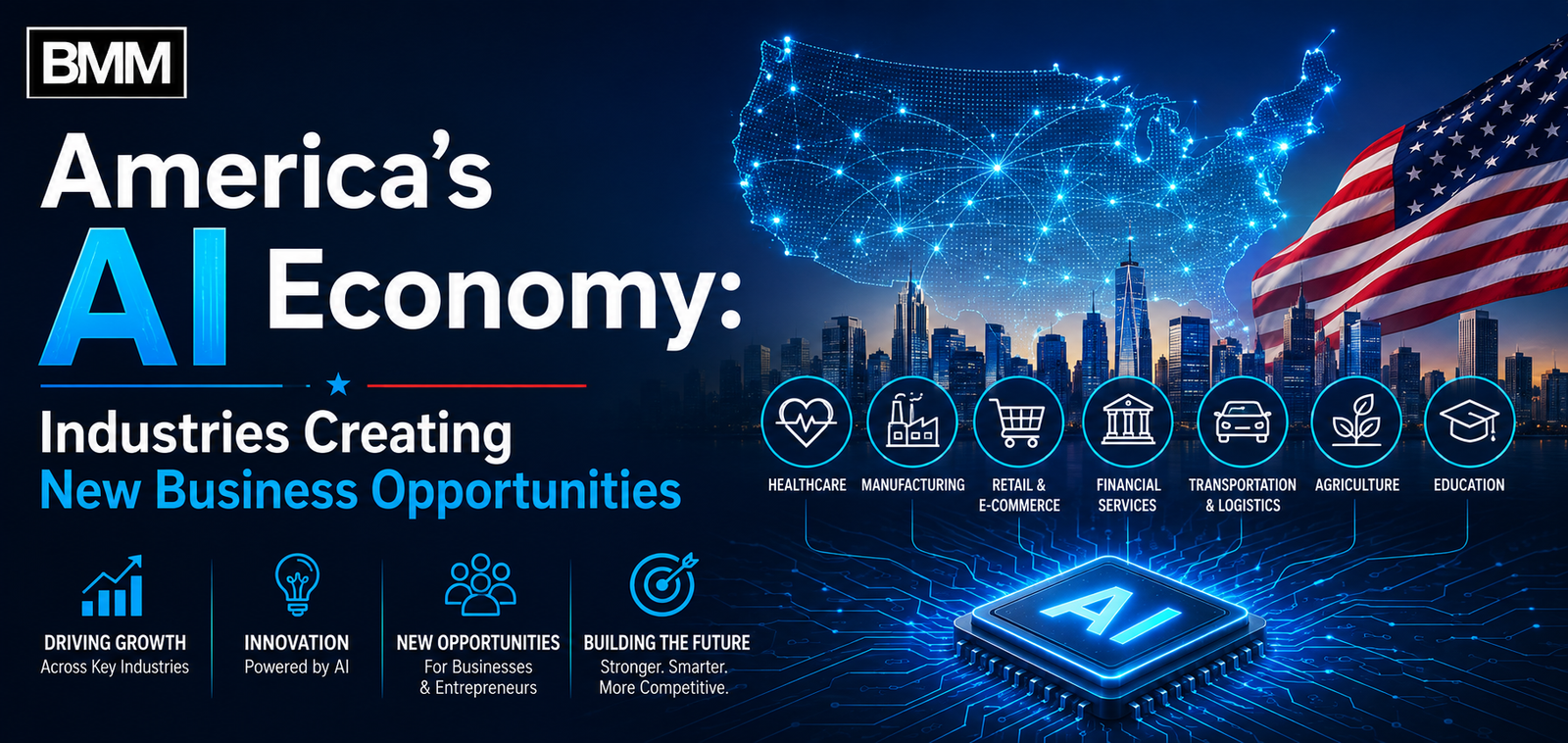
Artificial intelligence is no longer confined to research labs or Silicon Valley startups. It has become a driving force behind economic transformation across the United States, reshaping industries, creating new revenue streams, and enabling businesses to operate with greater efficiency and intelligence. As organizations move beyond experimentation and into large-scale implementation, AI Business Opportunities USA are expanding across sectors ranging from healthcare and finance to manufacturing and retail.
The rapid growth of AI is creating a new economic landscape where innovation, productivity, and data-driven decision-making are becoming essential competitive advantages. Businesses that successfully integrate AI into their operations are discovering new ways to serve customers, optimize resources, and unlock previously untapped markets.
The Rise of America’s AI Economy
The US still holds its place among the top centers for AI development, thanks to venture funding, infrastructure, institutions, and an entrepreneurial environment. According to recent reports by the Federal Reserve and Census Bureau, the number of American companies that use AI technologies keeps increasing year after year, especially in industries such as financial, professional, healthcare, manufacturing, and IT businesses. The trend reveals large enterprises as the primary adopters of AI; however, AI technologies now penetrate businesses of all kinds.
The importance of this change lies in the fact that AI has become not only a technology but also a business approach. Companies apply AI technologies to enhance customer experience, optimize processes, speed up the process of creating products, and find completely new opportunities on the market.
Healthcare: Transforming Patient Care and Operations
The area of healthcare has been recognized as one that has huge potential for AI developments. Hospitals, clinics, insurers, and companies engaged in health care technologies use AI to improve the results of their operations and minimize costs.
AI-based diagnostic software is used to analyze medical images, detect diseases early, and help doctors make better decisions. Predictive analytics allows healthcare companies to find vulnerable patients and create treatment plans for them. Automated administrative procedures include scheduling, processing of claims, and documentation.
These advancements are generating significant AI-driven business growth as healthcare organizations invest in solutions that improve efficiency and patient satisfaction. Start-ups specializing in AI in medicine, digital health, and predictive analytics of health care have been attracting great investments recently.
In addition, healthcare is one of those areas that show considerable growth of AI usage.
Financial Services: Redefining Risk and Customer Experience
The financial industry has been one of the first to adopt AI technologies actively. The use of AI by banks, insurers, investment funds, and fintech companies is aimed at improving decision-making, enhancing security, and providing personalized services.
The applications of AI include the detection of fraudulent activities in real-time, credit risk assessment, and the provision of customer service via virtual assistants. Investment funds use machine learning algorithms for assessing market trends and optimizing portfolio management.
According to the Federal Reserve and Census data, finance and insurance are one of the most AI-adopting industries in the United States.
This widespread adoption is creating substantial AI market opportunities for software providers, cybersecurity firms, data analytics companies, and financial technology startups. Organizations that develop specialized AI solutions for compliance, fraud prevention, and financial forecasting are experiencing strong demand across the industry.
Manufacturing: Building Smarter Factories
The field of manufacturing is currently experiencing great change with respect to its integration with AI.
Intelligent factories employ the use of AI-based sensors and predictive maintenance technologies to assess the performance of machinery to avoid downtime. Machine learning techniques can help schedule production and manage inventory as well as determine any problems in the quality of products before distribution.
According to recent reports in the industry, data centers for AI have created opportunities in the supply chains of manufacturing as well. The need for generators, cooling units, and electrical machinery has grown due to the construction of data centers for AI.
This trend highlights how AI adoption in US industries extends far beyond software companies. Traditional manufacturers are finding new revenue opportunities by supplying the physical infrastructure needed to support AI growth.
Retail and E-Commerce: Personalization at Scale
Businesses today are adopting AI technology in order to engage their customers and become more efficient operationally. Be it in terms of providing customers with personalized products or automating the process of managing inventories, AI helps businesses provide better experiences at reduced cost.
AI enables e-commerce sites to understand customer behavior in order to make product recommendations, predict demand, and formulate pricing strategies. Chatbots are used to assist customers instantly, while logistics systems use AI to predict delivery processes.
Those retailers who adopt AI efficiently will get insights on what kind of products their customers prefer, which in turn will help them deliver a highly personalized shopping experience to their customers.
Professional Services: The Next Frontier
Consulting, legal services, accounting, and business advising firms, among others, are being recognized as major gainers from AI innovation.
Studies have shown that professional services can be considered to be one of the leading industries for AI implementation and AI-related labor demands. AI is being used by professionals to perform document analysis, research, report writing, and even automate some of the repetitive administrative functions.
Consulting firms are utilizing AI to improve data analytics and strategy-making. Legal firms are employing AI to examine contracts and detect any risk areas with regard to compliance.
These developments are creating significant AI-driven business growth opportunities for technology vendors that develop industry-specific solutions. At the same time, professional service providers are discovering new ways to increase productivity and deliver greater value to clients.
Generative AI Opens New Markets
Perhaps the most exciting development within the AI economy is the rise of generative AI. Unlike traditional AI systems that focus primarily on analysis and prediction, generative AI can create content, designs, software code, marketing materials, and multimedia assets.
The emergence of generative AI business opportunities is reshaping industries such as media, marketing, entertainment, education, and software development.
Some of the applications of generative AI technology include generating personalized marketing campaigns, creating content on a large scale, developing software programs quickly, and improving customer engagement. AI-generated video creation tools are helping businesses to create high-quality marketing material easily and economically.
For entrepreneurs and startup companies, generative AI opens up an excellent chance to develop new products and services that can be highly useful for the market. With the improvement in the capability of AI technology, new business models are likely to evolve.
As companies continue to experiment with advanced content creation, automation, and software development tools, generative AI business opportunities are expected to become one of the fastest-growing segments of the broader AI economy.
Infrastructure and Data Centers: The Foundation of Growth
The underlying structure of each AI implementation is made up of an intricate infrastructure ecosystem. Companies like data centers, cloud computing systems, semiconductor makers, energy producers, and networking vendors are all cashing in on the swift growth in AI.
As demand grows for AI computing capability, there is considerable investment in data centers and infrastructure in the US. Banks and individual investors are pouring millions into AI projects, opening up more AI market opportunities.
Such infrastructure development is generating demand not only for technology companies but for construction companies, equipment makers, utilities, and engineering firms too.
The Road Ahead
It is safe to say that the AI-driven economy in America is still at the very beginning. Despite the fact that the adoption rate of AI keeps increasing, most of the companies still try to grasp what benefits can be offered by it. Research shows that AI is widely used in particular areas such as marketing, business development, IT, and document processing. The potential for further growth is considerable.
The possibilities of utilizing artificial intelligence will become accessible to businesses from nearly all industries as AI becomes increasingly available and affordable. Companies that will experiment and be willing to implement AI technologies in order to innovate, increase efficiency and generate new value will find themselves well-placed for further growth.
The future of the American economy will not just be determined by artificial intelligence itself. It will be defined by companies, entrepreneurs, and industries that will learn to use it to their benefit.
The continued expansion of AI adoption in US industries will likely accelerate innovation, strengthen competitiveness, and create entirely new categories of products and services over the coming decade.
FAQ
Anthropic AI job-loss forecast
Anthropic CEO Dario Amodei has made one of the strongest warnings about AI-related job losses. In May 2025, he said AI could eliminate around 50% of entry-level white-collar jobs within the next 1–5 years and potentially push unemployment to 10–20%. He specifically mentioned areas such as technology, finance, law and consulting.
Important: This is Amodei’s forecast, not Anthropic’s official prediction of exactly how many jobs will disappear. More recent Anthropic research has found no systematic rise in unemployment among highly AI-exposed workers since late 2022, although there are signs that hiring of younger workers has slowed in exposed occupations.
What does the Anthropic CEO say about jobs?
Amodei believes AI could cause significant disruption to white-collar employment and says governments and companies need to prepare workers for the transition.
He has argued that retraining alone will not solve the problem and that governments may eventually need to become directly involved in helping workers transition to new jobs.
AI → productivity increases → some jobs disappear → especially entry-level knowledge work → society needs retraining and other policies.
How is the AI boom transforming the American economy?
The AI boom is doing much more than changing software jobs.
It is driving huge investment in:
Data centers
GPUs and other chips
Electricity generation and transmission
Construction
Cloud computing
AI software
Cybersecurity
Engineering
Real estate around data centers
Recent analysis suggests AI-related investment is already making a significant contribution to U.S. economic growth. At the same time, it is creating an unusual situation where productivity and corporate investment can rise while employment growth remains relatively weak, particularly for young workers entering white-collar professions.
4. Is an AI recession possible?
Yes, but it is not inevitable.
There are actually two different risks:
AI-driven economic boom:
AI increases productivity, investment and profits → economic growth accelerates.
AI investment bust:
Companies spend enormous amounts on AI infrastructure → expected revenues fail to appear → investment falls → technology stocks decline → construction/data-center/chip spending falls → broader economic slowdown.
There are already concerns that Big Tech’s AI investment could exceed the growth in its free cash flow. Reuters estimates that the five major hyperscalers could face significant cash-flow pressure as AI capital expenditure continues increasing.
5. Could AI be “going bust”?
AI itself is unlikely to disappear or become worthless.
The more realistic possibility is an AI investment bust.
That would mean:
AI technology remains useful, but investors have paid too much for companies and infrastructure relative to the profits eventually generated.
This happened with the dot-com bubble: the internet was real and transformative, but many internet companies were dramatically overvalued.
The same distinction is important with AI:
AI technology ≠ AI stocks ≠ AI infrastructure investment.
The technology can succeed even if some AI companies, projects or investments fail.
6. Could the AI bubble burst?
Yes. I would consider a correction/bubble burst a meaningful risk, but not something that can be predicted with confidence.
There are warning signs:
Extremely high technology valuations
Huge AI infrastructure spending
Heavy dependence on continued AI demand
Increasing debt financing
Massive data-center construction
Expectations of very rapid future AI revenue growth
The Guardian has reported that investors and market analysts are increasingly concerned about an AI bubble, although it also notes that the boom could continue for some time before a correction.
At the same time, this isn’t simply another speculative bubble with no underlying demand. Data-center vacancy is extremely low and demand for computing capacity remains strong.
My assessment: a correction is plausible; a complete collapse of AI is much less plausible.
What is The Guardian saying about the AI bubble?
The Guardian’s recent coverage essentially presents a “boom now, risk later” argument.
The key concern is that AI companies are attracting enormous amounts of capital because investors believe future AI profits will be huge. If those profits don’t materialize quickly enough, valuations could fall sharply.
But the Guardian also points out that AI infrastructure has a real economic purpose and isn’t purely speculative.
What are the chances of an AI bubble?
There is no scientifically reliable percentage for the probability of an AI bubble.
I would separate the risks like this:
Scenario
My assessment
AI continues expanding
High
AI investment slows substantially
Moderate–high
AI stocks experience a major correction
Moderate–high
Some AI companies fail
High
Complete collapse of AI technology
Very low
AI causes a broad recession by itself
Possible, but uncertain
The important point is that an AI bubble can burst without AI itself failing.
How much has Meta invested in AI?
Meta is spending an extraordinary amount on AI infrastructure.
As of July 2026, Meta’s expected 2026 capital expenditure is $130–145 billion. Much of this spending is directed toward AI infrastructure, including data centers and computing capacity.
That does not mean all $130–145 billion is purely “AI investment.” Capex also covers other infrastructure and equipment.
Microsoft’s AI investment in 2026
Microsoft expects to invest approximately $190 billion in capital expenditure during calendar 2026. Microsoft says the spending includes significant investment in data centers, GPUs/CPUs, storage and other infrastructure needed to support AI and cloud demand.
Microsoft’s FY2026 filing also says its AI and cloud strategy requires substantial and increasing capital expenditures, with investments being made ahead of fully developed revenue streams.
So:
Microsoft 2026 capex ≈ $190 billion
but again, $190 billion is total capex, not $190 billion exclusively on AI.
What jobs will AI replace by 2030?
There is no credible list saying “these exact jobs will disappear by 2030.”
Instead, AI is more likely to automate tasks within jobs.
The most exposed areas include:
Data entry
Basic customer support
Routine administrative work
Basic accounting/bookkeeping
Some legal research
Basic financial analysis
Routine coding
Translation
Content production
Simple graphic/design work
Certain research/analysis tasks
Some back-office operations
Jobs involving physical work, human relationships, complex judgment or unpredictable environments are generally harder to automate completely.