
The construction industry has always stood at the intersection of creativity and precision. From ancient monuments to modern skyscrapers, every structure begins with a vision that must be translated into reality through careful planning and collaboration. Augmented Reality in Construction Yet, despite technological progress, the sector continues to struggle with inefficiencies, miscommunication, and delays. Augmented Reality, or AR, is changing that narrative by merging the digital and physical worlds in powerful new ways.
Augmented Reality in Construction allows engineers, architects, and builders to visualize and interact with virtual models layered over real environments. It transforms the planning process from static drawings into immersive, interactive experiences. Instead of waiting for a structure to take shape, professionals can now explore it before it exists. This leap from concept to reality makes design more intuitive, collaboration more effective, and outcomes more predictable.
Seeing Before Building
At its core, Augmented Reality in Construction enriches what we see by overlaying digital elements such as 3D blueprints, data points, and virtual components onto the physical world. Using devices like tablets, smart glasses, or headsets, construction professionals can stand on an undeveloped site and view the entire structure at full scale. They can analyze spatial dimensions, check alignment, and make instant corrections before construction begins.
This ability to “see before building” bridges one of the most persistent gaps in the industry—the divide between design offices and construction sites. With AR, everyone from architects to project managers can visualize how plans translate into physical form. Potential errors, design conflicts, or structural inconsistencies are identified early, reducing costly rework and delays later in the project.
Turning Vision Into Shared Reality
One of the greatest strengths of Augmented Reality in Construction lies in its power to align perspectives. Traditional blueprints and 2D drawings, while essential, often leave room for misinterpretation among non-technical stakeholders. AR eliminates that uncertainty. Clients, engineers, and construction teams can all see the same model, at the same scale, in the same context.
A client can walk through a virtual version of their future building, inspect rooms, and request changes on the spot. Engineers can overlay plans on existing structures to test feasibility. Contractors can preview complex installations before they begin. This shared visual understanding fosters clearer communication, reduces misunderstandings, and accelerates decision-making. What once took weeks of revisions can now happen in real time with a few gestures or commands.
Smarter Sites and Safer Workflows
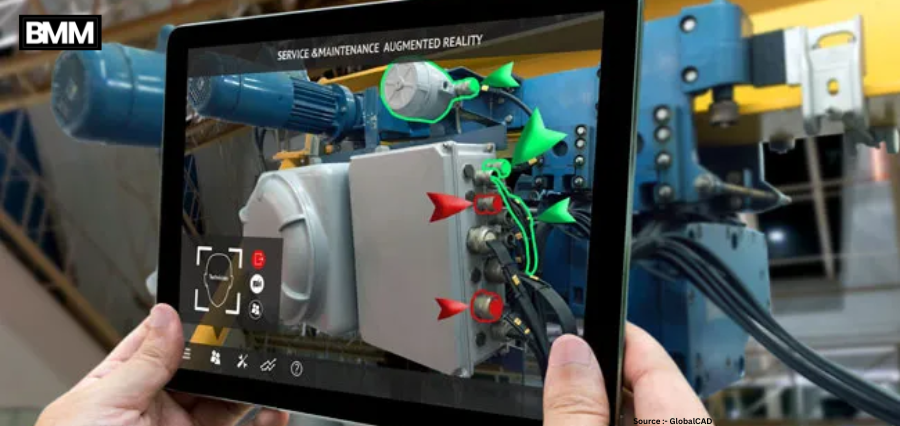
Augmented Reality in Construction is not limited to visualization; it is an active on-site assistant. Workers equipped with AR devices can access live installation guides, safety instructions, and project data without leaving their work areas. For example, when placing pipes or electrical wiring, workers can see exactly where components should go through AR overlays, reducing errors and material waste.
When integrated with Building Information Modeling (BIM), AR provides a live comparison between planned and actual progress. Supervisors can detect deviations instantly and adjust workflows accordingly. The result is a construction site that functions with real-time intelligence. This not only enhances efficiency but also promotes safety. Workers can be alerted to potential hazards, restricted zones, or underground utilities before they pose risks.
From Blueprint to Lifetime Management
Augmented Reality in Construction continues to add value long after construction is complete. Facility managers and maintenance teams can use AR overlays to locate hidden systems such as wiring, plumbing, and HVAC ducts behind walls. By scanning the environment, they can access maintenance records, performance data, and repair histories directly in their field of view.
This capability turns building management into a proactive process rather than a reactive one. Instead of relying on outdated paper plans or guesswork, technicians have precise, real-time information. Over the life of a building, this digital transparency reduces maintenance costs, minimizes downtime, and extends asset longevity.
Learning Through Immersion
Training and education within the construction industry are also being redefined by AR. New workers can experience complex tasks virtually before performing them on site. Through simulation-based learning, they can practice operating heavy machinery, assembling components, or managing emergencies without any real-world risk.
This approach enhances skill development, boosts confidence, and creates safer workplaces. For companies facing labor shortages or high turnover, AR-based training ensures that knowledge transfer remains consistent. It also allows workers to keep up with emerging technologies and techniques, building a more skilled and adaptable workforce.
The Future Is Already Under Construction
Around the world, AR is reshaping how cities and infrastructure are built. Governments and private developers are using AR to simulate large-scale urban projects, test designs against real environments, and ensure sustainability before committing resources. As AR converges with Artificial Intelligence and the Internet of Things, its potential grows exponentially.
Imagine a future where every site worker receives real-time feedback from sensors, where design updates appear instantly on AR devices, and where safety risks are flagged automatically. This is not science fiction; it is the next phase of digital transformation in construction.
Also Read :- Business Minds Media for more information