
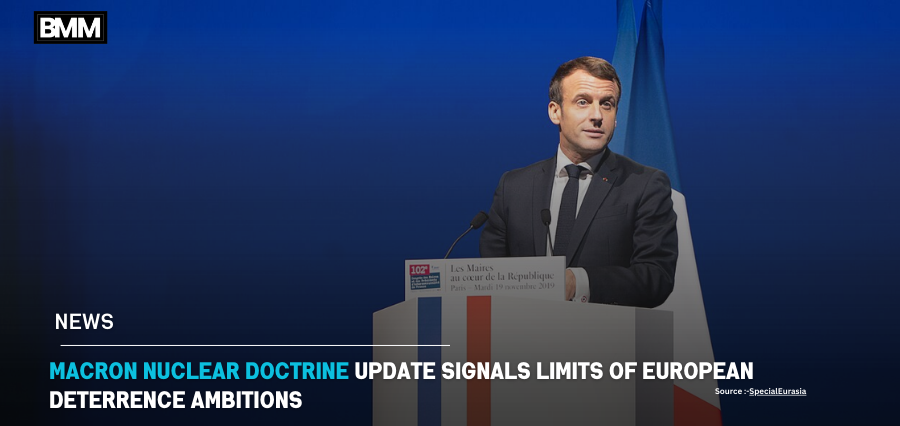
President Emmanuel Macron is set to update France’s nuclear strategy on Monday, offering clarity on what Paris can provide to European allies while firmly ruling out shared European control of its arsenal. The Macron nuclear doctrine update comes at a time of growing anxiety across Europe about the long-term reliability of the United States nuclear umbrella under President Donald Trump.
For a long time, American nuclear deterrence has been a key part of European security and the transatlantic alliance. France and Britain have their own nuclear weapons, but most European countries depend on Washington’s promises to keep potential enemies at bay. Recent changes in world politics have led to more discussion about whether Europe should strengthen its own system of deterrence.
Strategic Uncertainty Under the U.S. Umbrella
People were even more worried when Trump said he would be more lenient with Russia about the war in Ukraine but stricter with traditional allies. His comments about possibly taking over Greenland, a self-governing part of NATO ally Denmark, made governments that were already worried about changing American priorities even more worried.
Against this backdrop, the Macron nuclear doctrine revision seeks to define France’s position within Europe’s evolving security landscape. Earlier this month at the Munich Security Conference, German Chancellor Friedrich Merz revealed that Berlin had opened discussions with Paris about the possibility of a broader European nuclear deterrent. Macron responded by emphasizing that any conversation must take a holistic approach to defence and security rather than focusing narrowly on atomic weapons.
Nordic countries that have historically been close to Washington have also cautiously shown interest in looking into other security arrangements. This shows that there is a lot of uncertainty about what the U.S. will do in the future.
Questions Over French Capabilities
Despite renewed interest in European nuclear autonomy, serious questions remain about whether France’s arsenal could realistically extend protection across the continent. The Macron nuclear doctrine update is expected to address these concerns while reinforcing that launch authority will remain exclusively under French control.
France is the fourth-largest nuclear power in the world, with about 290 nuclear warheads that can be launched from submarines and planes. Paris spends about 5.6 billion euros a year to keep its deterrent up to date and in good shape. European leaders are not sure if this force structure is strong enough to stop threats against more than one allied state at the same time.
Sharing costs is another problem. To make deterrence commitments bigger, partner countries would have to give a lot of money. It would also bring up politically sensitive questions about who really has the power to launch during a crisis. Macron has said many times that France will not give up its right to control its nuclear weapons.
NATO’s Position and U.S. Nuclear Sharing
Mark Rutte, the Secretary General of NATO, recently warned against thinking that Europe could easily copy the size of American deterrence. In January, he spoke to the European Parliament and said that building an independent nuclear capability would cost billions of euros and could weaken the U.S. nuclear umbrella, which is the ultimate protector of European freedom.
The US has about 100 nuclear bombs in Belgium, Germany, Italy, the Netherlands, and Turkey as part of NATO’s current nuclear sharing plan. In the event of war, the U.S. would oversee the delivery of the weapons by the air forces of these non-nuclear states. This plan gives different countries the job of deterring while keeping American control.
The Macron nuclear doctrine debate, therefore, intersects with broader questions about NATO cohesion and future alliance structures. While France may expand consultations and strategic dialogue with European partners, it is unlikely to replace the scale or infrastructure of U.S. nuclear deployments in the near term.
A Balancing Act for Europe’s Future
The upcoming Macron nuclear doctrine announcement reflects a delicate balancing act. Paris aims to reassure allies that it remains committed to European security while preserving national sovereignty over its ultimate deterrent. The move signals that France is prepared to play a stronger leadership role, yet not at the expense of its independent decision-making authority.
As tensions between countries stay high and doubts about America’s reliability keep coming up, the update to Macron’s nuclear doctrine could be a big step forward in Europe’s search for more strategic independence. The future of European defense policy will depend on whether it becomes a deeper continental deterrence framework or stays a reaffirmation of French sovereignty.
Also Read :- Business Minds Media For more information