
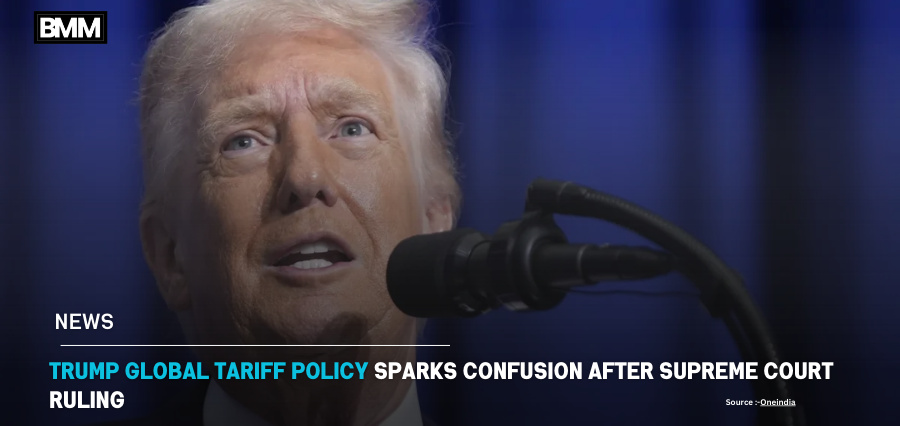
The latest twist in Trump global tariff policy has introduced fresh uncertainty into international trade markets. The United States began collecting a temporary 10% global import tariff at midnight on Tuesday, even as the administration signaled its intention to raise the rate to 15%.
On Friday, President Donald Trump signed an executive order that put a 10% tariff in place for 150 days under Section 122 of the Trade Act of 1974. The measure was meant to take the place of broader duties that the Supreme Court of the United States had thrown out. But just one day later, Trump said in public that the tariff would go up to 15%, which caused confusion among importers and global markets right away.
Even though they said that, U.S. Customs and Border Protection (CBP) officially told shippers that the rate would stay at 10%, citing only the signed executive order.
Legal Backdrop and Refund Disputes
The confusion surrounding Trump global tariff policy stems largely from last week’s Supreme Court decision invalidating tariffs imposed under the 1977 International Emergency Economic Powers Act. Those earlier duties had ranged from 10% to as high as 50%.
After the decision, the Supreme Court sent the case back to lower courts to figure out how to give the money back. The Liberty Justice Center, which represents small businesses that fought the tariffs, asked the U.S. Court of International Trade and the U.S. Court of Appeals for the Federal Circuit to immediately enforce the ruling and give back the money with interest.
The Penn-Wharton Budget Model’s earlier estimates said that the now-defunct tariffs brought in more than $175 billion in federal revenue. Lawyers for businesses say that they should get their money back quickly, and they warn that long delays would undermine the promises made by the courts.
The legal wrangling adds another layer of uncertainty to Trump global tariff policy, as courts determine both compliance and compensation mechanisms.
Market Reaction and Economic Implications
Markets were cautious, even though the 10% tariff was less severe than the expected 15%. On Tuesday, global stocks opened lower because of uncertainty about trade. But by the end of the day, U.S. markets had bounced back. The Nasdaq rose 1.05%, the Dow Jones Industrial Average rose 0.76%, and the S&P 500 rose 0.77%, mostly because of technology stocks.
Economists still don’t agree. Some Deutsche Bank analysts said that the overall effective tariff rate could go down this year compared to what it was before the Supreme Court. Some people say that unpredictable policies could make businesses less likely to invest and break supply chains.
Trump global tariff policy is now closely tied to broader debates about trade deficits and economic security. The administration has justified the temporary measure by citing a $1.2 trillion annual U.S. goods trade deficit and a current account deficit of 4% of GDP. Critics, however, argue that the United States is not facing a balance-of-payments crisis severe enough to warrant such emergency measures.
International Fallout and EU Concerns
The European Union is in a very uncertain situation. The group recently agreed to a trade deal that set a base tariff rate of 15%. EU officials call the current situation a “transitional period” because the U.S. is only charging 10%. They want to make sure that Washington will keep its other promises.
At the same time, China told the US to drop what it called “unilateral tariffs” and said it was open to more trade talks. Beijing’s statement shows that people around the world are more worried about the direction of Trump’s global tariff policy and how it might affect trade between countries.
What Happens Next?
A White House official said that President Trump still wants a 15% tariff, but there hasn’t been an official executive order yet to make it happen. CBP can only enforce the 10% rate that is currently in effect until such documents are released.
The coming days may bring clarification, particularly as the administration outlines its broader economic agenda. However, with legal challenges ongoing and international partners watching closely, Trump global tariff policy remains in a state of flux.
For businesses, investors, and global trading partners, the immediate challenge is navigating uncertainty. Whether the tariff ultimately settles at 10% or rises to 15%, the broader implications for trade stability and legal precedent will shape economic policy discussions for months to come.
Also Read :- Business Minds Media For more information