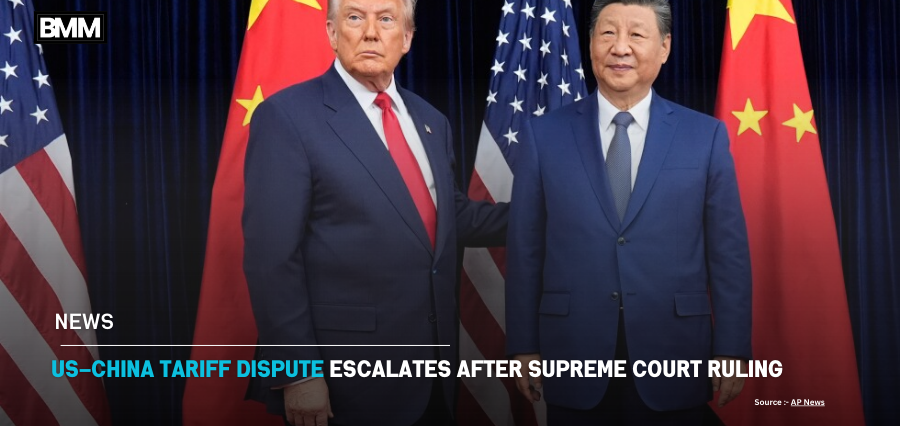
The ongoing US–China tariff dispute has entered a new and uncertain phase after the U.S. Supreme Court struck down several tariffs imposed during President Donald Trump’s global trade campaign. In response, China has announced it is conducting a “full assessment” of the ruling while urging Washington to lift what it described as “unilateral tariff measures.”
The development has added fresh volatility to global markets and trade diplomacy, especially as both countries prepare for a high-profile meeting between President Trump and Chinese President Xi Jinping in the coming weeks.
Supreme Court Ruling Shakes U.S. Trade Policy
The U.S. Supreme Court dealt a big blow to the Trump administration by throwing out several tariffs that had been put on Asian export economies, such as China, South Korea, Japan, and Taiwan. The decision raised questions about the legality of some trade measures used during the global tariff push.
Within hours of the decision, President Trump announced a new 10% duty on imports from all countries, later raising it to 15%. The move appeared to surprise even some U.S. officials and has further complicated the US–China tariff dispute.
Section 122 of U.S. trade law is said to be the basis for the new tariffs. This section lets tariffs go up to 15%, but Congress must approve extensions beyond 150 days. It’s important to note that no president has ever used this section before, which could lead to legal challenges.
China Calls for End to “Unilateral” Measures
China’s Commerce Ministry firmly stated that U.S. tariffs that are only applied to one country break both international trade rules and U.S. law. It stressed that working together is good for the two biggest economies, while fighting is bad.
“Cooperation between China and the United States is beneficial to both sides, but fighting is harmful,” the ministry said, signaling Beijing’s concern over escalating tensions in the US–China tariff dispute.
Chinese officials said they would keep a close eye on things and do what they needed to do to protect the country’s interests. Gao Lingyun, a research fellow at the Chinese Academy of Social Sciences, said that the U.S. tariff decisions were “highly arbitrary” and that they were used as a political tool instead of being based on careful economic analysis.
Global Ripple Effects
The lack of clarity about U.S. tariffs in the legal and political spheres has had effects around the world. The court’s decision made tariffs on important Asian economies that are important to global supply chains, especially in the production of technology and semiconductors, illegal.
South Korea said it would keep talking to Washington to keep everyone’s interests in mind. Industry Minister Kim Jung-kwan said that industries like cars, batteries, and semiconductors are already facing a lot of competition around the world.
Meanwhile, India delayed plans to send a trade delegation to Washington to finalize an interim trade deal. The postponement was largely attributed to fresh tariff uncertainty stemming from the evolving US–China tariff dispute.
Before the talks, it was thought that U.S. tariffs on Indian goods would go down to 18%, and India promised to buy $500 billion worth of U.S. goods over the course of five years. These included things like energy supplies, airplanes, precious metals, and tech products. But the changing trade situation in the U.S. has raised new questions about how long these agreements will last and when they will happen.
High-Stakes Diplomatic Talks Ahead
When President Trump goes to China in late March and early April, trade and tariffs are likely to be the main topics of conversation. Global investors and policymakers are keeping a close eye on the meeting with President Xi Jinping.
The US–China tariff dispute remains central to broader geopolitical and economic dynamics between the two nations. While both sides acknowledge the benefits of cooperation, recent actions suggest strategic positioning ahead of negotiations.
Analysts say that using Section 122 could make legal matters in the US more complicated and make diplomatic talks more difficult abroad. If the new tariffs are in place for more than the first 150 days without congressional approval, they could face legal challenges like those that the Supreme Court threw out.
Uncertainty Dominates Global Trade Outlook
The global business environment is once again uncertain because major economies are changing the way they trade. Countries in Asia that depend on exports are looking again at their supply chains, plans for diversifying their markets, and plans for long-term investments.
The US–China tariff dispute underscores the fragile balance between economic interdependence and political rivalry. As legal battles unfold and diplomatic talks approach, businesses worldwide are bracing for potential shifts in tariffs, trade rules, and market access.
For now, the markets are being careful and waiting for Washington and Beijing to make things clear. One of the most important questions in global trade right now is whether the upcoming talks will ease tensions or make the standoff worse.
Also Read :- Nvidia OpenAI Investment Nears $30 Billion Deal in Landmark AI Funding Round