
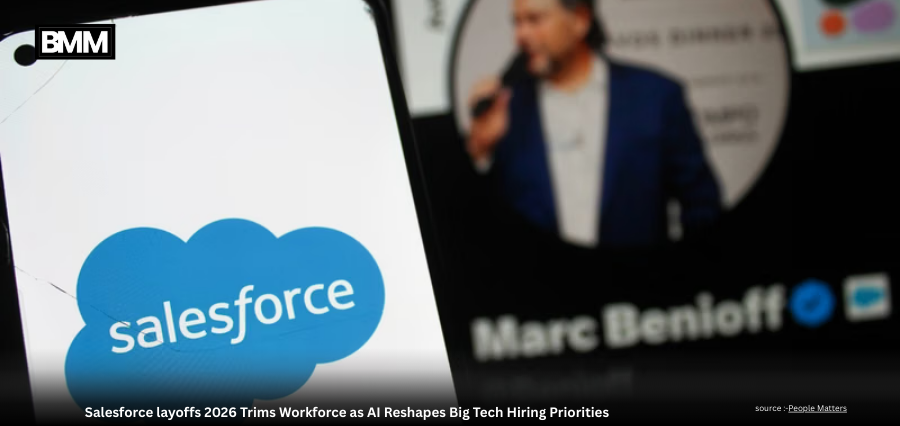
Cloud software major Salesforce has reportedly cut fewer than 1,000 roles at the beginning of this month, marking another step in how large technology firms are reshaping their workforce in response to rapid advances in artificial intelligence. According to Business Insider, the reductions affected teams across marketing, product management, data analytics, and the company’s Agentforce AI product unit. While Salesforce has not made a public announcement detailing the cuts, the move places Salesforce layoffs 2026 firmly within a broader trend of cost optimisation and AI-led restructuring sweeping the U.S. tech sector.
Roles Impacted Across Key Functions
The latest Salesforce layoffs 2026 were identified through LinkedIn updates and discussions with employees, suggesting that the cuts were spread across multiple departments rather than concentrated in a single vertical. Notably, teams linked to Agentforce, Salesforce’s flagship AI agent platform, were also impacted, highlighting that even growth-focused AI initiatives are not immune to internal realignments. Industry analysts see this as a signal that companies are becoming more selective about roles, prioritising efficiency and automation over headcount expansion.
AI Adoption Accelerates Workforce Changes
The beginning of the year has seen widespread layoffs across U.S. corporations as artificial intelligence tools increasingly replace or streamline traditional job functions. The Salesforce layoffs 2026 fit into this wider narrative, where companies are reassessing which roles remain essential in an AI-first operating model. Tasks once handled by large teams in customer support, analytics, and operations are now being partially automated, enabling firms to scale output with fewer employees.
Big Tech Follows a Similar Path
Salesforce is not the only one. In January, Amazon, a huge tech company, said it would cut 16,000 jobs around the world. This was the company’s second major round of layoffs in just three months. These cuts are part of a bigger shift in Big Tech, where companies are trying to find a balance between short-term pressure to improve margins and long-term investments in AI infrastructure. People who watch the business world say that Salesforce layoffs 2026 and similar actions by other companies show how deeply AI is changing not only product development but also business strategy.
Leadership Signals on ‘Less Heads’
Marc Benioff, the CEO of Salesforce, has been open about how AI will affect jobs in the past. Benioff said in an August 2018 podcast that Salesforce had already cut about 4,000 customer support jobs. He said that the company needed “fewer heads” because AI tools were taking over routine tasks. Those comments now seem to have been right on the money, as the most recent Salesforce layoffs 2026 support the idea that automation is permanently changing the company’s workforce needs.
Strong Financial Outlook Amid Cuts
Salesforce’s financial outlook is still good, even though it is cutting jobs. In December, the company raised its revenue and profit forecasts for fiscal 2026 because businesses were very interested in its AI-driven agent platform. Management thinks that more and more big companies will start using AI, which will make Salesforce a big winner in the next wave of business automation. Salesforce layoffs 2026 are marked by this contrast between positive financial guidance and ongoing layoffs. This shows that the company is focused on making money and growing its business rather than hiring more people.
A Defining Moment for the Tech Workforce
The most recent round of job cuts at it shows a bigger change happening in the tech industry. Companies are changing their ideas about talent, productivity, and scale as artificial intelligence moves from testing to core infrastructure. Salesforce layoffs 2026 are a reminder to employees that even the biggest companies are quickly changing their roles. For the industry, they are another step toward leaner, AI-powered companies, where growth is driven more by code than by people.
Also Read :- Seahawks Claim Super Bowl LX Glory with Dominant Defensive Performance Against Patriots