
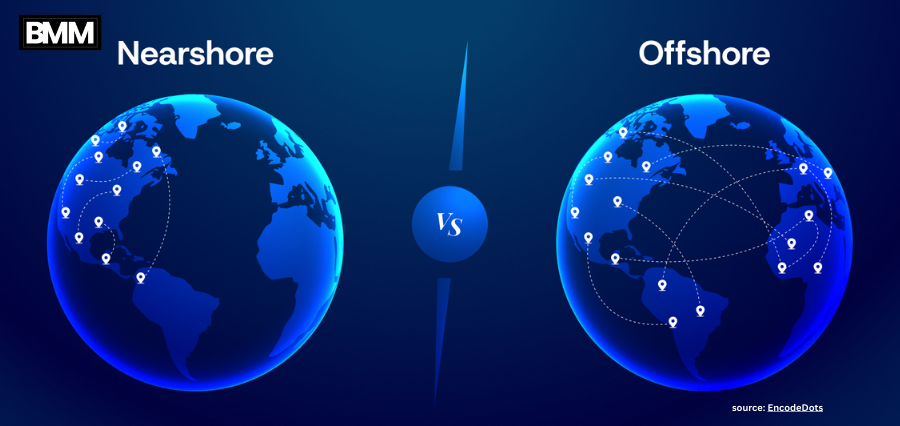
The global supply chain has always been shaped by the need to balance cost, speed, and resilience. For decades, offshoring was the dominant strategy.Nearshoring here operations are moved closer to the end market. By 2030, the competition between these two models will reach a turning point, and the outcome will reshape global trade.
The Traditional Case for Offshoring
It emerged as a cost-saving solution in the late twentieth century. Companies shifted manufacturing to countries with significantly lower labor costs, often in Asia, to improve profit margins. The strategy also provided access to specialized skills and large-scale manufacturing capabilities that were not available in domestic markets.
For many industries, It meant tapping into an established global ecosystem. Electronics manufacturers relied on the advanced infrastructure of East Asia. Textile companies benefited from high capacity factories in South Asia. Service sectors, such as customer support and IT, gained from skilled labor in regions like the Philippines and India.
The advantages were clear. Lower costs allowed for competitive pricing. Large and experienced workforces provided scalability. Over time, supply chains became tightly integrated into offshore locations, making them difficult to replace.
The Rise of Nearshoring
It , by contrast, focuses on bringing production and services closer to the target market. For a company based in the United States, this might mean moving operations to Mexico or Central America. For European businesses, it could involve shifting production to Eastern Europe or North Africa.
The appeal of nearshoring has grown in the past decade. Global disruptions, from the COVID-19 pandemic to geopolitical tensions, have exposed the vulnerabilities of long supply chains. Shipping delays, port congestion, and sudden trade restrictions have made proximity a powerful advantage. Nearshoring can reduce transit times, simplify logistics, and make supply chains more agile.
Proximity also allows for better oversight and quality control. Managers can visit facilities more frequently, address issues faster, and build stronger relationships with suppliers. In sectors where customization and rapid delivery are key, nearshoring offers a competitive edge that far outweighs potential cost savings from distant It .
Cost vs. Resilience
The debate between nearshoring and offshoring often comes down to a choice between cost and resilience. It generally offers lower unit production costs because of cheaper labor and large-scale facilities. However, these savings can be offset by high transportation costs, import duties, and the risk of disruptions.
Nearshoring usually comes with higher labor costs but can reduce inventory levels and lead times. This agility can be especially valuable in industries with fast-changing consumer preferences, such as fashion or electronics. By producing closer to the market, businesses can respond to demand shifts within weeks instead of months.
Technological Impact
Advances in automation, robotics, and artificial intelligence are changing the cost equation. As production becomes more automated, the labor cost advantage of Its weakens. This makes nearshoring more financially viable, especially for high value or customized products.
Technology also enhances supply chain visibility. Real-time tracking and predictive analytics make it easier to manage production across long distances, reducing some of the risks associated with offshoring. At the same time, digital tools enable faster collaboration with nearby suppliers, strengthening the nearshoring model.
Environmental Considerations
Sustainability is another factor influencing the shift. Long-distance shipping contributes significantly to carbon emissions. It reduces transportation distances, helping companies meet environmental, social, and governance (ESG) goals. With regulators and consumers placing greater emphasis on sustainable practices, this advantage could tip the balance in favor of nearshoring by 2030.
However, offshore facilities in some regions are also investing heavily in green energy and efficient manufacturing. If these efforts succeed, It could retain its appeal while addressing environmental concerns.
Geopolitical and Economic Influences
Political stability, trade agreements, and economic policy will play a decisive role in shaping the future of both strategies. Its benefits when regional trade blocs reduce tariffs and streamline cross-border movement. For example, the United States-Mexico-Canada Agreement has made North America a more integrated production zone.
It thrives when global trade remains open and predictable. However, rising protectionism and geopolitical tensions in some regions could make long supply chains riskier. By 2030, the strategic choice may depend less on cost and more on the ability to secure reliable access to markets and resources.
Which Strategy Will Dominate in 2030?
It is unlikely that either nearshoring or offshoring will completely replace the other. Instead, the future may see a hybrid approach in which companies maintain offshore operations for cost sensitive products while shifting certain production closer to the end market for speed and flexibility.
Industries that prioritize cost efficiency and can tolerate longer lead times, such as basic textiles or commodity electronics, may continue to rely on It . Sectors that need rapid adaptation, high customization, or greater oversight, such as automotive components or specialty consumer goods, may lean toward nearshoring.
The decision will also be influenced by the continued evolution of technology, environmental regulations, and global trade policies. By 2030, businesses will likely select a mix of both models, optimized through advanced analytics to balance cost, speed, and risk.
Conclusion
The competition between nearshoring and offshoring is not a simple contest with one clear winner. Both strategies have strengths that make them suitable for different industries and circumstances. What is changing is the balance of power between them. Rising geopolitical uncertainty, environmental priorities, and technological advances are giving nearshoring a stronger position than it has had in decades.
Also Read :- Business Minds Media For more information