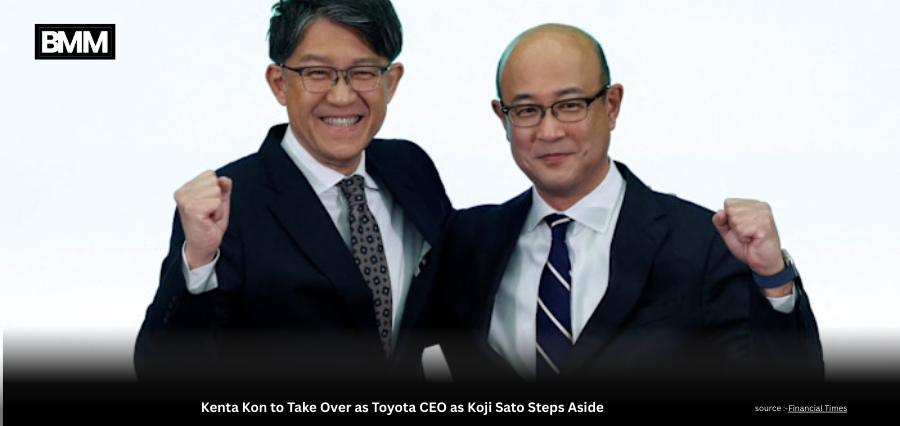
Toyota Motor Corporation on Friday announced a significant leadership change, with Chief Executive Koji Sato stepping down after just three years at the helm and handing over the top role to Chief Financial Officer Kenta Kon. The move marks a pivotal Toyota CEO transition for the world’s largest automaker, coming amid heightened investor scrutiny, governance concerns, and intensifying global competition.
From Product Leadership to Boardroom Reshuffle
Koji Sato took charge in April 2023, succeeding Akio Toyoda, the grandson of the company’s founder. His appointment came at a sensitive moment for Toyota, which was facing mounting criticism for its slower embrace of battery electric vehicles compared with global peers. While Sato’s tenure was relatively short, the Toyota CEO transition has been framed as a strategic reshuffle rather than an abrupt exit, with Sato set to become vice chairman and chief industry officer.
Investor Scrutiny and the Toyota Industries Buyout
The change in leadership comes at a time when there is a lot of controversy over Toyota’s plans to buy out its publicly traded subsidiary, Toyota Industries. Minority shareholders are worried that the deal isn’t clear and that it undervalues the subsidiary. Governance issues linked to the proposed acquisition have intensified pressure on Toyota’s board, making the Toyota CEO transition particularly significant for investor confidence.
Hybrids Prove a Winning Strategy
Even though people outside of the company criticized him, Sato’s time as leader was good for business. Toyota’s long-held belief in gasoline-electric hybrids, instead of going all-in on battery EVs, turned out to be correct. This strategy helped the car company set a new record for sales and stay the world’s top-selling carmaker last year. The success of hybrids has been a stabilizing factor during the Toyota CEO transition, demonstrating the resilience of Toyota’s diversified powertrain strategy.
Market Share Challenges in Asia
Toyota’s sales around the world stayed strong, but it lost ground in some important areas, especially Southeast Asia, where Chinese car companies have moved quickly. Companies like BYD have gained market share by making electric cars that are priced competitively and are quickly expanding their businesses.
These competitive pressures form part of the backdrop against which the Toyota CEO transition is unfolding, underscoring the challenges awaiting new leadership.
Kenta Kon’s Financial Expertise Takes Center Stage
People think that Kenta Kon, the new CEO, is a very experienced financial strategist who knows a lot about Toyota’s balance sheet and how to allocate capital. Analysts call him the “mastermind” behind the Toyota Industries buyout because he had a big say in some of the group’s most important financial choices. Compared with Sato, who rose through product development, Kon brings a finance-led perspective to the Toyota CEO transition, signaling a possible shift in priorities toward governance, transparency, and shareholder relations.
Redefined Roles at the Top
With the new leadership structure, Sato’s move to vice chairman and chief industry officer ensures that product planning and industry engagement continue, while Kon takes over as the top executive. This division of responsibilities suggests Toyota is seeking balance, pairing strategic and technological continuity with stronger financial oversight during the ToyotaCEO transition.
What the Change Signals for Toyota?
The change in leadership at Toyota is a sign of bigger problems in the global auto industry, such as electrification, competition, activist investors, and changes to governance. Toyota seems to be directly addressing these problems by making its chief financial officer the top person in charge. This also keeps institutional knowledge among its senior leaders.
Looking Ahead
As Kenta Kon takes over as CEO, people will be watching to see how he deals with shareholder concerns, carries out complicated group restructuring, and puts Toyota in a good position against fast-moving global competitors. The success of this Toyota CEO transition may prove crucial in shaping the automaker’s next phase as it seeks to defend its leadership in a rapidly evolving automotive landscape.
Also Read :- Oil Prices Drop 2% as US-Iran Talks in Oman Ease Fears of Middle East Supply Disruption